


Fretwork Music Canterbury
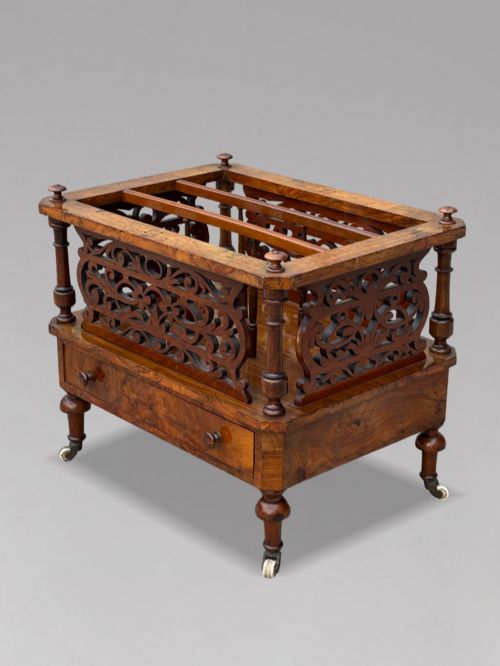
These fretwork music canterbury stands are Victorian multi-tiered storage pieces designed for scores and folios, bringing refined organisation to a music room.
Fretwork Music Canterbury
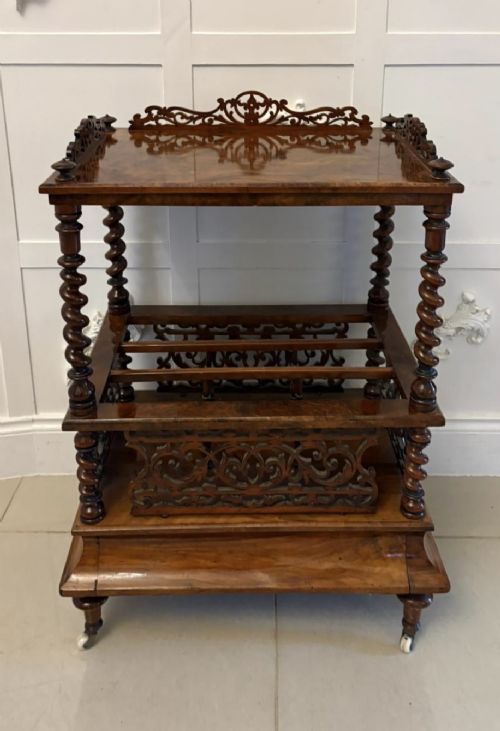
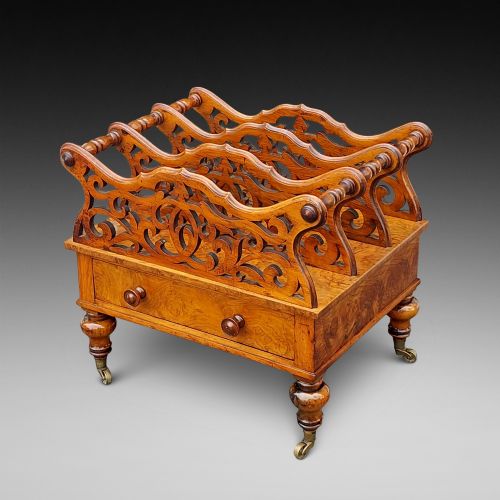
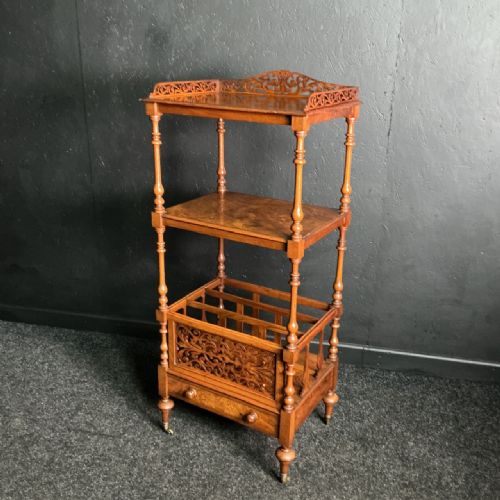
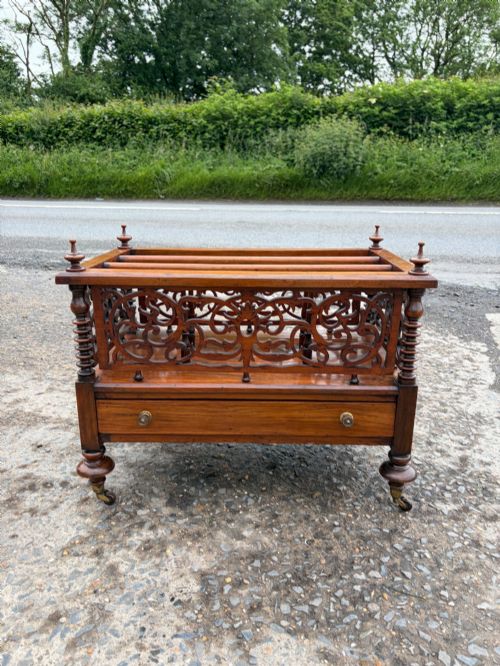
A fretwork music canterbury is a dedicated storage piece designed during the Victorian era to hold sheet music, folios, and books in upright divisions. Most examples encountered on this page date from the nineteenth century, specifically between eighteen fifty and eighteen eighty, spanning standard music canterburys, combined magazine racks, and multi-tiered whatnot tables.
These stands often incorporate lower drawers, castor feet, and pierced fretwork partitions that separate the upper compartments. Formats range from rectangular mahogany and walnut models to oval tables and specialised music stands intended to sit beside a piano or in a parlour.
Materials and construction
Makers utilised timber veneers such as burr walnut, rosewood, and mahogany over solid secondary woods, frequently applying intricate inlaid details and fine pierced fretwork to the partitions. Brass castors support many of these freestanding pieces, allowing them to be moved easily across carpets in nineteenth-century interiors.
The upright dividers are shaped with pierced scroll designs or geometric fretwork, demonstrating the cabinetmaker's skill in handling delicate fret-sawn panels. Ceramic or porcelain elements occasionally appear alongside brass fittings on specific models.
Materials recorded across the inventory include walnut, burr walnut, rosewood, mahogany, satinwood, brass, and ceramic components.
What separates the tiers of quality
The distinction between standard examples and superior pieces rests upon the choice of timber and the execution of the fretwork. Finely figured burr walnut veneers and crisp, hand-pierced scrolls indicate a higher grade of cabinetmaking than plain mahogany with simpler turned supports.
Integration of secondary functions, such as a fitted lower drawer or a combined whatnot top with turned columns, elevates the piece from a simple utilitarian rack to a more complex parlour furnishing.
The Fretwork Music Canterbury Glossary
- Canterbury
- A low stand with divisions for holding music sheets, magazines, or books, often mounted on castors. Originating in the late eighteenth century, the form gained widespread popularity throughout the Victorian period.
- Fretwork
- Ornamental work consisting of interlaced or pierced patterns carved or sawn into wood. This technique provides the distinctive openwork dividers characteristic of these musical stands.
- Burr Walnut
- A mottled wood veneer taken from the growth excrescence on a walnut tree. Cabinetmakers prized this material for its rich figuring on table tops and cabinet fronts.
- Whatnot
- An open set of freestanding shelves used for displaying ornaments or holding books and papers. Combinations of canterburys and whatnots integrate storage with display surfaces.
- Gothic Revival
- A nineteenth-century architectural and decorative style drawing inspiration from medieval forms. Pieces in this style often feature pointed arches, heavy tracery, and dark woods.
Fretwork Music Canterbury: Frequently Asked Questions
What is a fretwork music canterbury used for?
These pieces were originally designed to hold sheet music and musical scores upright in individual partitions near a piano or music stand.
Today, they function well in living spaces for organising magazines, journals, or vinyl records while serving as small side tables.
How do I date a Victorian canterbury?
Dating relies on observing the timber choice, decorative motifs, and construction methods characteristic of the nineteenth century.
Pieces from the eighteen fifties through the eighteen eighties often exhibit distinct combinations of burr walnut veneers, ceramic castors, and pierced fretwork.
Can I use a music canterbury as a side table?
Many surviving examples incorporate flat tops or oval surfaces that function effectively as lamp or occasional tables.
Their sturdy construction and convenient height make them suitable for placement beside a sofa or armchair.
What woods were used for these stands?
Cabinetmakers primarily constructed these pieces using walnut, burr walnut, rosewood, and mahogany.
Satinwood and various inlaid veneers also appear on select refined examples from the mid to late nineteenth century.