


French Village Landscape Art
French village landscape art captures rural life through oil on canvas and watercolour, offering a direct window into European country scenes.
French Village Landscape Art
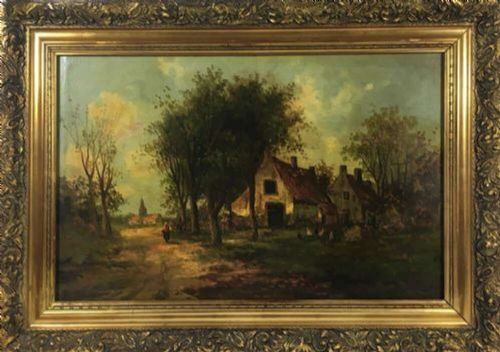
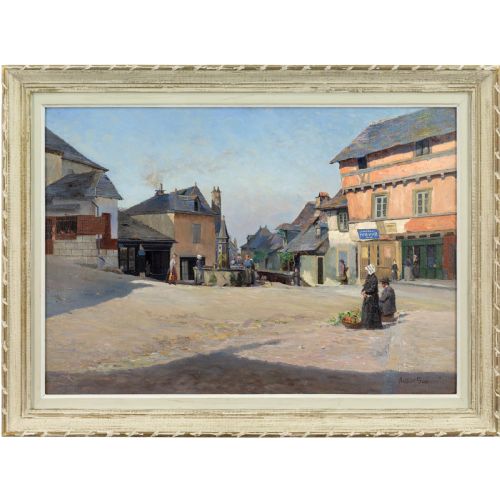
French village landscape art encompasses rural scenes, townscapes, and country views executed primarily in oil on canvas, oil on panel, and watercolour on paper. These works document agricultural settlements, village squares, and quiet lanes across various periods from the nineteenth century to the mid-twentieth century.
The versions most commonly met on this page span the Barbizon School, Post-Impressionism, and mid-century modernist movements. Painters record regional specifics such as Normandy spring scenes, Corrèze squares, and Provençal summer light through distinct painterly traditions.
Makers represented range from nineteenth-century figures like EUGENE BATTAILLE to twentieth-century painters including Paul-Élie Gernez, Maurice Asselin, and Mario Pinetti. Works often arrive framed in wood and giltwood, preserving their period presentation.
Materials and Techniques
Artists apply oil paint to canvas or wood panels, building texture and depth through layered brushwork. Watercolour and gouache on paper appear frequently for lighter, more immediate topographical recordings of village markets and streets.
Frames utilise wood and giltwood construction to house and protect the painted surface. Support materials range from stretched canvas to rigid panel boards, reflecting the practical choices available to painters in different decades.
Horses, carts, and winter fuel gathering make unexpected cameo appearances in quiet country lanes.
Quality Variations
The strength of composition and brushwork distinguishes individual works, where confident handling of light and architectural form elevates a rural scene. Works by documented painters or those associated with specific artistic groups carry greater contextual weight.
The preservation of the original paint layer and associated framing contributes significantly to the integrity of the piece. Barbizon and post-impressionist examples demonstrate distinct technical execution that separates standard topographical records from significant artistic expressions.
Arthur Gué·Paul-Élie Gernez·Gaston Cornil·Mario Pinetti·Mercedes Legrand·Joseph W. Milliken·Maurice Asselin·Jeffrey Pratt·EUGENE BATTAILLE·HENRI THERME·Martin Lamotte·Victor Valery·Olga Ceretti Borsini
The French Village Landscape Art Glossary
- Barbizon School
- A nineteenth-century French art movement dedicated to naturalistic landscape painting. Artists associated with this group worked directly from nature, focusing on rural and forest environments.
- Post-Impressionism
- An art movement developing from the late nineteenth century that extended impressionist ideals while rejecting its limitations. Painters focused on symbolic content and structural brushwork.
- Gouache
- An opaque water-based paint medium consisting of pigment, water, and a binding agent. It provides solid blocks of colour in works on paper.
- Giltwood
- Wood that has been treated with gold leaf or a metallic gilding process. It is standard for traditional picture frames.
French Village Landscape Art: Frequently Asked Questions
What periods do these paintings cover?
The available selection spans from the nineteenth century through the 1950s, capturing stylistic shifts from Barbizon realism to mid-century modernism.
Works from the 1900s to the 1940s form a substantial portion of the rural scenes represented.
Are these works painted on canvas?
Artists utilised multiple supports, including oil on canvas, oil on panel, and watercolour on paper.
Each medium dictates the visual texture and framing requirements of the individual artwork.
How do I identify a village landscape style?
Styles range from nineteenth-century academic realism to post-impressionist brushwork and avant-garde interpretations.
Examining the handling of light, brushstroke density, and subject matter reveals the artistic movement.
How should I frame and display these?
Many pieces retain their original wood or giltwood frames, which complement the period of the painting.
Display away from direct sunlight to preserve the integrity of oil paints and watercolours on paper.