


French Table Garnitures
French table garnitures bring symmetry and presence to a room, pairing a central mantel clock with matching candelabra or vases.
French Table Garnitures
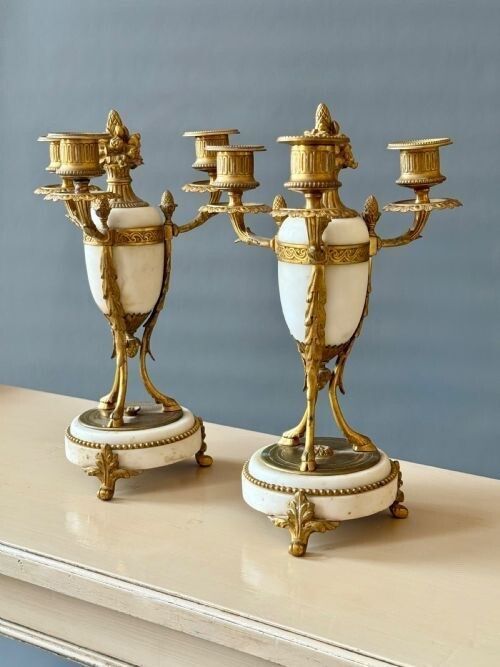
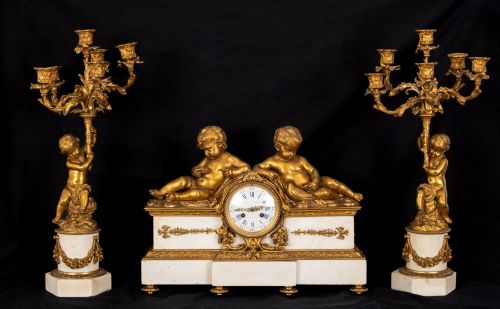
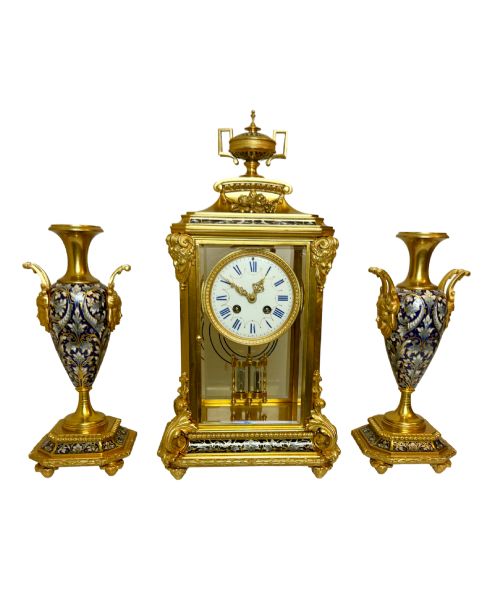
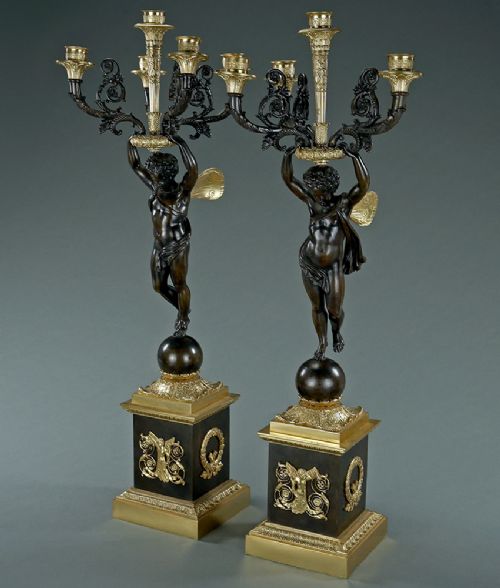
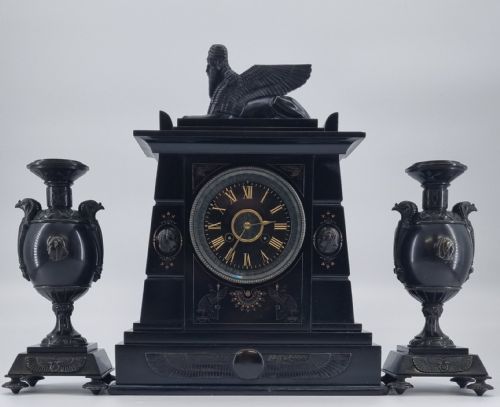
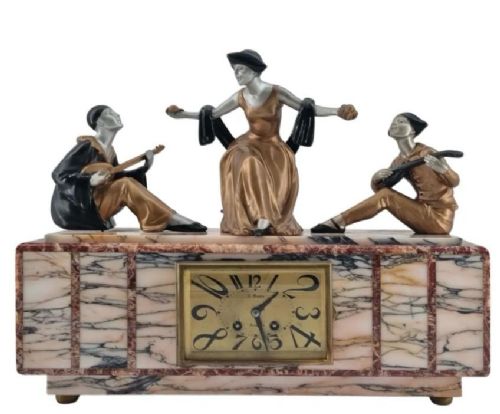
French table garnitures are matched decorative sets designed for domestic display, typically featuring a central clock flanked by two matching side pieces such as candelabra, urns, or vases. You will most frequently encounter sets comprising a mantel clock paired with a pair of candelabra or candleholders, originating from the nineteenth and early twentieth centuries.
The materials utilised in these sets define their visual weight and period character, ranging from gilt bronze and ormolu paired with white or black marble, to glass, enamel, and slate. Stylistic influences span Louis XVI Revival, Empire, Rococo, and Art Deco, reflecting the changing tastes of French and Victorian interiors.
Comprising three or more matching items, these garnitures served a primarily decorative purpose on mantelpieces, sideboards, and drawing-room tables. The coordinating design creates a balanced focal point within a formal interior scheme.
Materials and Construction
Foundries and workshops shaped these sets using cast metals such as bronze, brass, and ormolu, often combining them with natural supports like white marble, black slate, or green onyx. Ormolu involves applying finely ground gold to a bronze base through a mercury amalgamation process or electroplating, yielding a rich metallic lustre.
Surface ornamentation frequently incorporates champleve enamel, glass crystal drops, and hand-carved details, while movements rely on mechanical brass gear systems. The marriage of stonework and cast metal required precision fitting to ensure stability across the central clock and its matching side garnitures.
Assessing Quality and Execution
Quality rests in the crispness of the metal casting and the depth of the gilding or patination. Finer sets display sharply defined chased details on the bronze elements, whereas lesser examples show softened edges and superficial surface treatments.
The integration of materials also marks distinction, seen in the selection of unblemished marble bases and the precision of enamel dials. Superior sets maintain harmony between the clock movement and the matching side pieces, with uniform patination across the complete ensemble.
A.D Mougin·Sega·Deniere Paris·Ferdinand Barbedienne
The French Table Garnitures Glossary
- Garniture
- A set of matching decorative objects for display on a mantelpiece or table, usually consisting of a clock and two side pieces. The pieces share identical stylistic motifs and materials.
- Ormolu
- Gilded bronze produced by applying finely ground gold to a metal base. This technique creates a bright, durable golden finish characteristic of decorative metalwork.
- Champleve
- An enamelling technique where troughs or cells are hollowed out of a metal surface and filled with vitreous enamel before firing. It produces colourful decorative patterns on clock cases and dials.
- Candelabra
- Branched candlestick holders designed to hold multiple candles. In a garniture set, they match the ornamentation and height of the central clock.
- Mantel Clock
- A clock designed to sit on a fireplace mantel or shelf. These timepieces form the centrepiece of most decorative garniture sets.
French Table Garnitures: Frequently Asked Questions
What is a French table garniture?
A French table garniture is a matching set of decorative objects designed to be displayed together on a surface such as a mantelpiece. It typically consists of a central clock accompanied by two matching side pieces like candelabra or urns.
The concept relies on symmetry, providing a balanced decorative scheme that was popular in formal nineteenth and early twentieth century interiors.
How do you style a garniture set?
Garniture sets are traditionally arranged on a mantelpiece, sideboard, or large table, with the central clock positioned between the two matching side pieces. This creates a balanced, symmetrical display.
Ensure the surface is level and sturdy, as the combination of marble bases and cast metal makes these sets quite heavy.
What materials are used in these sets?
These sets combine cast metals such as bronze, brass, and ormolu with natural stones including white marble, black slate, and green onyx. Enamel work and glass crystal drops frequently appear as decorative accents.
The choice of materials often reflects the specific design period, from ornate Rococo gilt metal to clean-lined Art Deco marble.
How do I identify the period of a garniture?
Period identification relies on observing the stylistic cues, materials, and manufacturing techniques present in the clock and its matching pieces. Elements like Louis XVI Revival motifs, Art Deco geometric forms, or Victorian slate construction offer clear dating clues.
Maker signatures on the clock dial or movement mechanisms can also help pinpoint the origin and date of production.