


French Regulator Mantel Clock
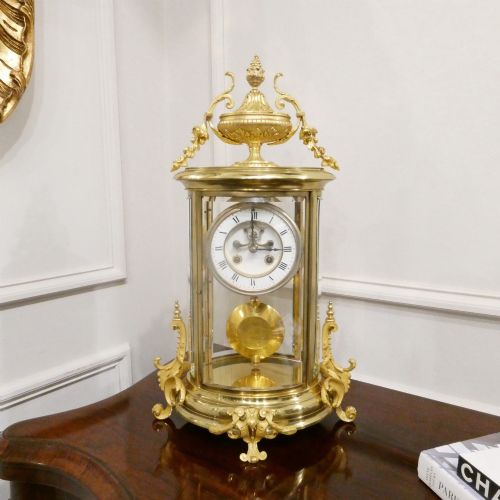
A french regulator mantel clock brings striking architectural presence to a room, housing precision movement inside crystal and polished metal.
French Regulator Mantel Clock
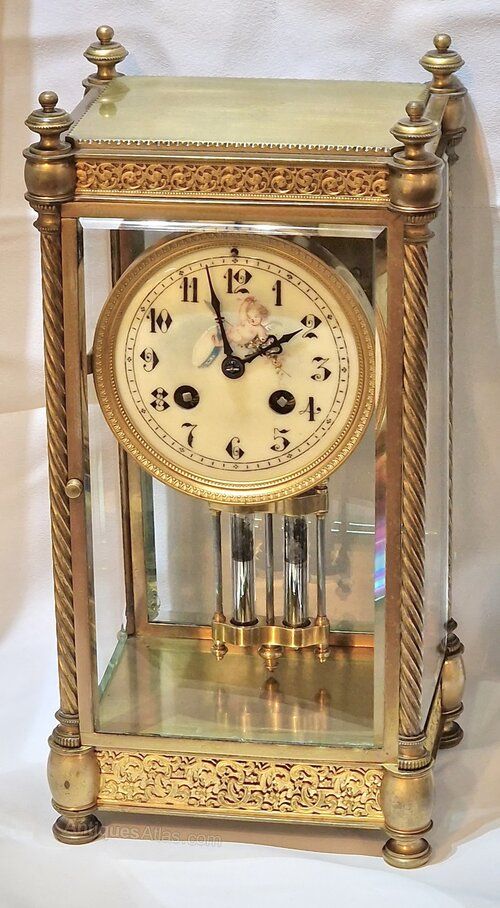
A french regulator mantel clock typically takes the form of a four glass display or a crystal regulator, showcasing the mechanical movement suspended within a glazed brass or gilt bronze case. The forms span the late nineteenth century into the twentieth century, reflecting the ornate tastes of the Belle Epoque and Second Empire periods.
Buyers encounter architectural upright cases, oval profiles, and portico table regulators alongside standard rectangular four glass configurations. Dial designs range from simple white enamel to decorative variations featuring painted floral motifs, cherubs, and visible moon-phase complications.
The aesthetic bridges domestic utility with mechanical exhibition, allowing the pendulum and gear train to remain fully visible from multiple angles. Most surviving examples date from the 1870s to the early 1900s, reflecting the peak period of French mantel clock production.
Materials and construction
Cases combine heavy cast brass, gilt bronze, or ormolu frames fitted with thick bevelled glass panels to enclose the movement securely. The metal components often receive a fire-gilt or polished finish that highlights the cast decorative details.
Interiors utilise brass clockwork mechanisms, frequently driven by pendulum suspensions such as knife-edge designs. Dials are constructed from curved enamel plates with painted Roman or Arabic numerals, sometimes accompanied by hand-painted ceramic panels in blue, green, or pink hues.
Some dials feature painted cherubs peering out from behind the numerals, watching the pendulum swing back and forth.
Judging quality and execution
The distinction between tiers of production lies in the weight of the cast ormolu and bronze, alongside the crispness of the chased ornamentation on the brass framework. Heavier, more substantial metal framing provides better structural stability for the extensive glass panels.
Movement finishing dictates the tier of the piece, with recognised makers supplying finely adjusted gear trains and jewelled escapements that ensure accurate timekeeping. The complexity of the dial work, including multi-coloured enamel panels and detailed moon-phase apertures, also elevates the status of an individual clock.
Samuel Marti·L Epee France
The French Regulator Mantel Clock Glossary
- Crystal regulator
- A mantel clock housed in a glass and brass or bronze case that allows the movement and pendulum to be viewed from all sides. These pieces often feature a mercury or deadbeat pendulum.
- Four glass clock
- A style of mantel clock enclosed by four bevelled glass panels, typically featuring an exposed escapement and a mercury-filled pendulum. They were extensively produced in France during the Victorian era.
- Ormolu
- Gilded bronze produced by applying a mercury and gold amalgam to a bronze object and heating it to drive off the mercury. This technique creates a rich, durable golden surface.
- Moon-phase dial
- A rotating dial mechanism that displays the lunar cycle alongside the standard time. It adds complexity and visual interest to the clock face.
- Knife-edge suspension
- A delicate clock suspension system using a knife edge resting on a flat surface to reduce friction in the pendulum swing. It is typically found in precision table regulators.
French Regulator Mantel Clock: Frequently Asked Questions
What is a French regulator clock?
A French regulator clock is a high-precision timepiece housed in a glazed brass, bronze, or crystal case designed for mantel or table placement.
These clocks emphasise mechanical visibility, using glass panels to display the swinging pendulum and intricate gear trains.
How do I wind the clock?
Winding requires a dedicated key inserted into the winding arbors on the enamel dial face to tension the internal springs.
Care must be taken not to over-wind the mechanism, ensuring the clock maintains its intended running duration.
Where should I place it?
These clocks suit stable surfaces like mantelpieces, sideboards, or dedicated tables where vibration is minimal.
Placing the clock on a level surface is essential for the pendulum to beat evenly and keep accurate time.
How do I identify the period?
Dating relies on stylistic clues such as the heavy cast bronze of Second Empire pieces or the refined brass framing of later Belle Epoque models.
Maker stamps on the movement backplate and dial signatures also provide clear chronological markers.