


Neoclassical Brass Clock
A neoclassical brass clock brings architectural dignity and precise brasswork to a mantelpiece, offering the enduring symmetry of classical antiquity.
Neoclassical Brass Clock
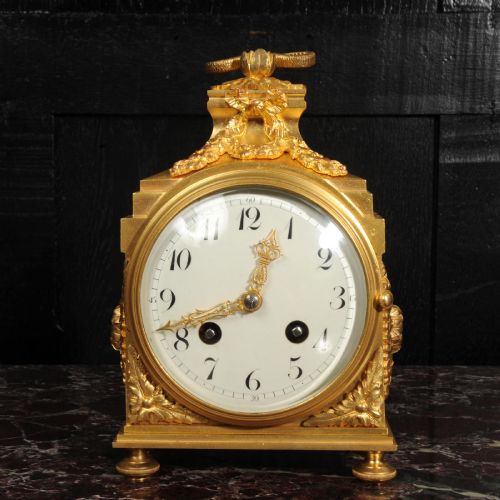
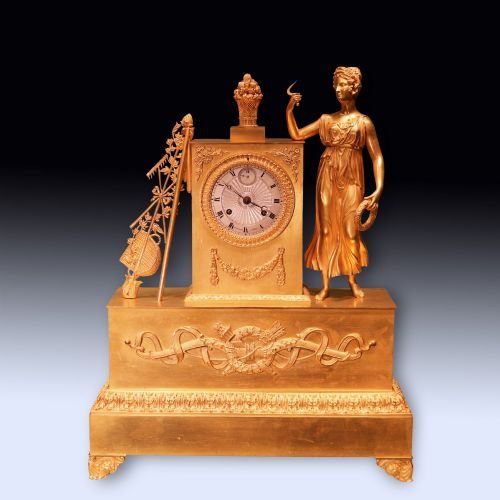
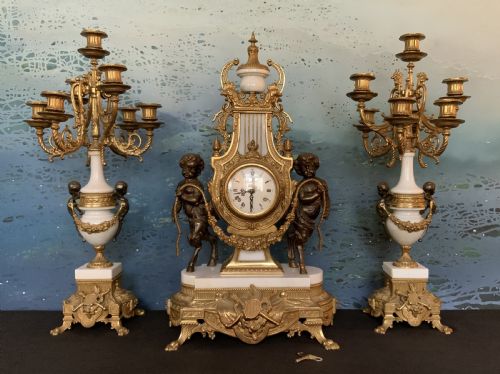
A neoclassical brass clock is an architectural timepiece shaped by classical design principles, drawing heavily on French Empire, Louis XVI, and nineteenth-century revival styles. These objects appear primarily as mantel clocks, wall clocks, and multi-piece garniture sets complete with candelabras.
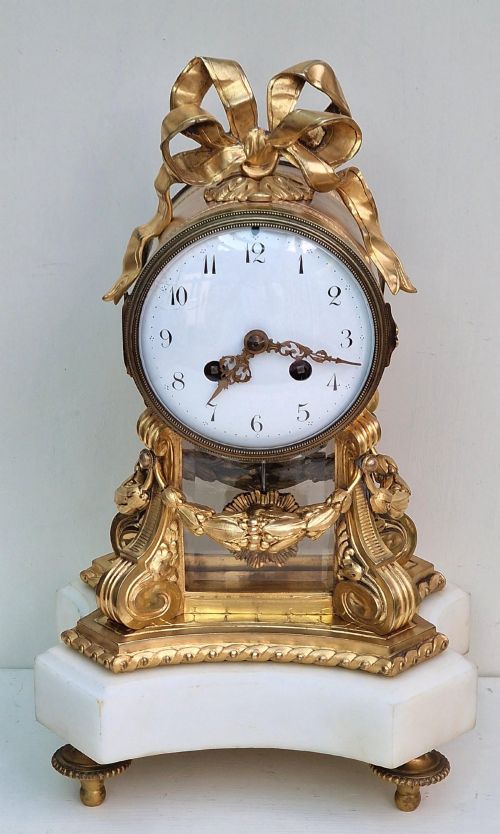
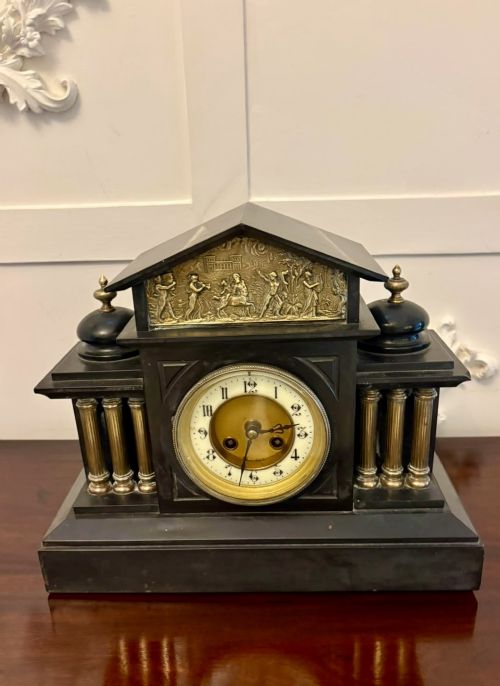
The versions most commonly met on this page combine cast brass, gilt bronze, or ormolu with contrasting materials such as white, black, and sienna marble or glass panels. Architectural forms range from four-glass regulators to classical urns, drum heads, and cartel wall clocks.
Originating largely from French workshops during the nineteenth century, these clocks reflect periods spanning the Victorian era back to the eighteenth century, alongside later mid-century interpretations. Collectors encounter both simple desk timepieces and large, substantial garniture sets designed for prominent interior placement.
Materials and construction
Makers constructed these clocks using heavy casts of brass, bronze, and ormolu, often mercury-gilded to achieve a durable golden lustre. These metallic elements were paired with polished white, black, or red rouge marble bases and architectural marble columns.
Movements relied on complex mechanical engineering, including eight-day and single chain fusee configurations housed behind enamel dials and protective glass plates. Four-glass mantel clocks utilised transparent glass panels to expose the intricate inner workings from every angle.
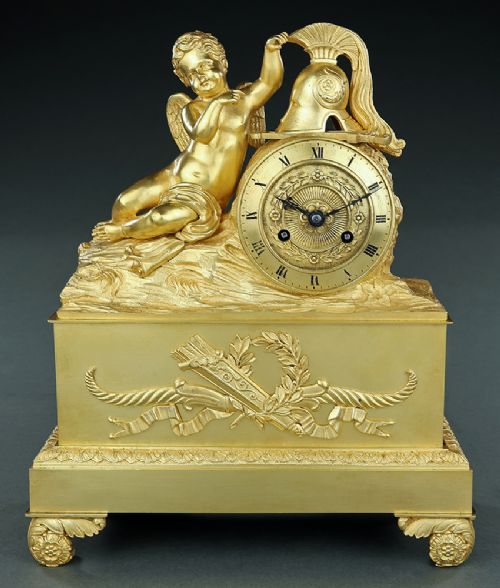
Some nineteenth-century French models celebrate romance quite literally, bearing inscriptions such as 'Love Conquers All' on their gilded bronze bases.
Distinctions in quality
The upper tier of these timepieces is distinguished by the crispness of the bronze casting and the depth of the fire-gilding, where intricate details like lion masks and floral swarf remain sharp and well-defined. Lesser examples exhibit softer, shallower chasing and inferior metal alloys.
Quality also rests in the integration of the movement with the case, where signed French makers and robust gear trains ensure dependable timekeeping alongside substantial marble or bronze housings.
Canaillor of Paris·Le Roy, Paris·Sacre·L Epee France·Asprey Of London
The Neoclassical Brass Clock Glossary
- Ormolu
- A gilded bronze technique utilising finely ground gold-mercury amalgam applied to a bronze base. This process creates a rich, enduring metallic finish characteristic of high-end French clocks.
- Garniture
- A set of matching decorative objects consisting of a central clock flanked by matching ornaments such as candelabras or urns. These sets were designed to create a balanced display on a mantelpiece.
- Cartel clock
- A wall-mounted clock housed within an ornate frame composed of metal, bronze, or wood. These pieces typically feature symmetrical scrollwork and classical motifs.
- Four-glass clock
- A mantel clock enclosed by glass panels on all four sides, allowing an unobstructed view of the mechanical movement. They often incorporate a mercury or compensating pendulum.
- Fusee
- A conical pulley used in clock movements to maintain even tension on the gear train as the mainspring unwinds. This mechanism improves the timekeeping accuracy of the clock.
Neoclassical Brass Clock: Frequently Asked Questions
How do I wind a mechanical mantel clock?
Winding requires inserting a dedicated key into the dial apertures and turning it gently until resistance is felt. Care must be taken not to overwind the mainspring.
Most nineteenth-century movements are eight-day mechanisms, meaning they require attention roughly once a week to maintain continuous operation.
Where should I place a heavy marble clock?
These substantial timepieces require a sturdy, level surface capable of supporting considerable weight from marble and bronze. A firm mantelpiece or dedicated console table prevents vibrations that might interfere with the pendulum.
Keeping the clock level is essential for ensuring the escapement ticks evenly and the movement runs reliably.
What is a clock garniture set?
A garniture set comprises a central clock accompanied by matching decorative side pieces, such as candelabras or ornamental urns. These matched groupings were created to be displayed together as a unified centrepiece.
They gained popularity during the nineteenth century for formal drawing rooms and grand mantelpieces.
How do I distinguish French Empire from Louis XVI style?
Louis XVI style draws inspiration from classical antiquity with straight lines, symmetrical proportions, architectural columns, and delicate floral mounts. French Empire pieces tend to be heavier and more martial, reflecting Napoleonic influence with bold patinated bronzes and military motifs.
Both styles frequently utilise gilt brass and marble, but the overall silhouette of an Empire clock is typically more robust.