
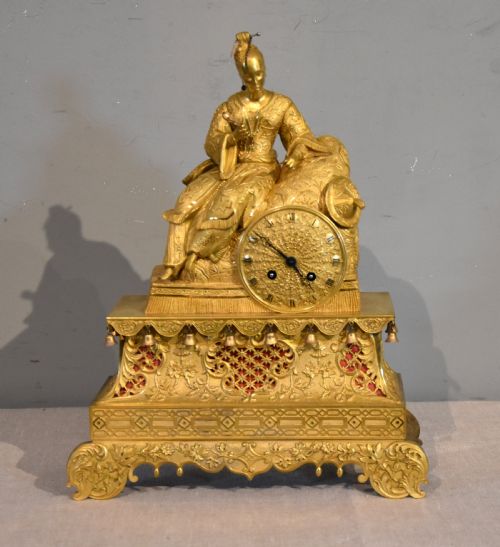


French Ornate Mantel Timepiece
A french ornate mantel timepiece brings nineteenth-century weight and gilt theatre to a room, driven by brass and porcelain.

French Ornate Mantel Timepiece
A french ornate mantel timepiece combines heavy cast metal cases with intricate surface decoration designed to sit prominently on a fireplace or sideboard. These items emerge chiefly from nineteenth-century workshops, spanning periods from the mid-Victorian era through to the turn of the twentieth century.
The objects take several distinct forms, ranging from substantial portico and rococo bracket clocks to smaller glass-cased carriage and crystal regulator clocks. Buyers meeting these pieces on this page will frequently encounter gilt bronze, ormolu, and marble constructions dating from the eighteen-eighties.
Stylistic influences draw heavily on earlier continental design, reproducing Louis XIV, Louis XVI, and Rococo revival aesthetics with ornate chasing and figural elements. The overarching purpose remains decorative as much as timekeeping, presenting a dense concentration of period craftsmanship.
Materials and construction methods
Constructing these objects involved casting brass, bronze, and ormolu into elaborate scrolls, foliage, and figural shapes, which were then gilded and hand-chased. Marble and porcelain plates, including Sevres style panels and champleve enamel work, were frequently integrated into the metal frames to add colour and texture.
Movements were housed within substantial stone or metal bodies, protected by bevelled glass panels in crystal regulators or enclosed within four-glass brass structures. Dials typically utilised white enamel with painted numerals, often paired with finely pierced hands and subsidiary mechanisms like grand sonnerie striking trains.
Listings feature brass, gilt bronze, marble, and porcelain across Victorian and nineteenth-century periods.
Judging quality and craftsmanship
Quality rests in the crispness of the bronze chasing and the depth of the gilding rather than the mere presence of shiny metal. Superior examples exhibit hand-finished details where every leaf and scroll is sharp and distinct, whereas lesser pieces display soft, blurred casting marks from worn moulds.
The weight and integration of materials also divide the range, with solid marble blocks and heavy ormolu mounts demonstrating superior construction compared to thin plated brass shells. Mechanical sophistication further separates standard timepieces from grander pieces housing signed movements by makers like Samuel Marti, Japy Freres, or Henri Jacot.
Samuel Marti·Japy Freres·Henri Jacot·Tiffany
The French Ornate Mantel Timepiece Glossary
- Ormolu
- Gilded bronze produced by applying a mercury and gold amalgam to a bronze base and firing it. This finish creates a deep, warm lustre characteristic of fine French decorative metalwork.
- Champleve
- An enamelling technique where troughs are dug into a metal surface and filled with vitreous colour before firing. It creates vibrant patterned details across brass and bronze clock cases.
- Crystal Regulator
- A clock housed in a brass frame with bevelled glass panels on all four sides. This design lets light pass through the movement and reveals the internal mechanics from multiple angles.
- Grand Sonnerie
- A complex striking train mechanism that sounds both the hours and the quarters automatically. It represents a higher tier of horological construction found in better carriage clocks.
- Portico
- An architectural clock case design featuring supporting columns beneath a pediment. This classical form frequently incorporates marble and gilt bronze ornamentation.
French Ornate Mantel Timepiece: Frequently Asked Questions
How do I wind a french ornate mantel timepiece?
Most of these movements require a key applied to the winding arbours on the dial face, turned gently until resistance is felt.
Care must be taken not to overwind the mainspring, as this can damage the internal mechanics of nineteenth-century movements.
What is a crystal regulator clock?
A crystal regulator is a tall, upright clock enclosed entirely by bevelled glass panels within a brass or gilt frame.
This design allows light to illuminate the swinging pendulum and gear train from every side.
How do I distinguish Rococo revival from Louis XVI style?
Rococo revival pieces feature asymmetrical scrolls, shell motifs, and curving organic shapes inspired by mid-eighteenth-century design.
Louis XVI style items rely on symmetry, straight architectural lines, urns, and neoclassical swags.
Where should I place a heavy marble clock?
Heavy marble and ormolu pieces require a sturdy, level surface capable of supporting considerable weight without sagging.
A solid sideboard or reinforced mantelpiece ensures the clock remains stable and keeps the pendulum swinging evenly.