


French Ornate Chenets
French ornate chenets anchor the hearth with sculptural brass and bronze, bringing Continental elegance and heavy metalwork directly to the fireplace.
French Ornate Chenets
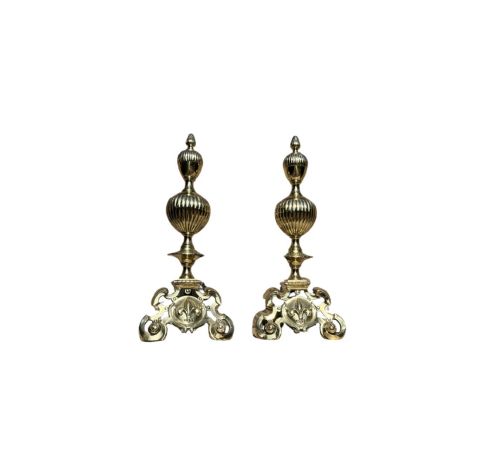
French ornate chenets, also known as fire dogs or andirons, support logs within the hearth while adding decorative presence to the room. The selection here spans the nineteenth century, capturing periods from eighteen fifty up to nineteen twenty.
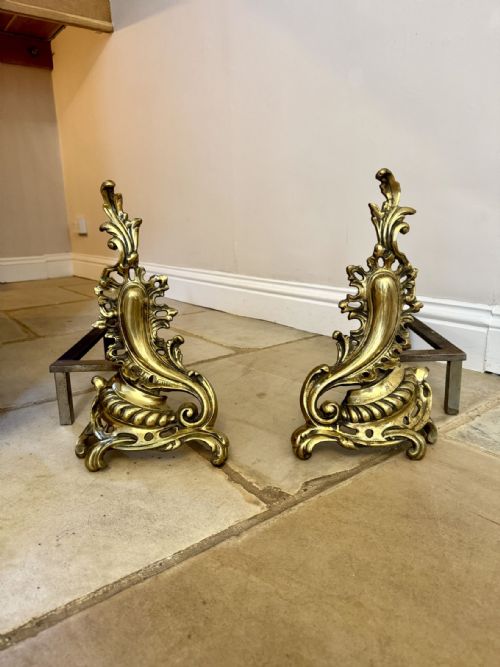
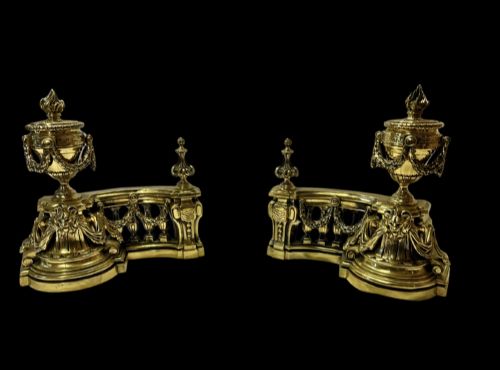
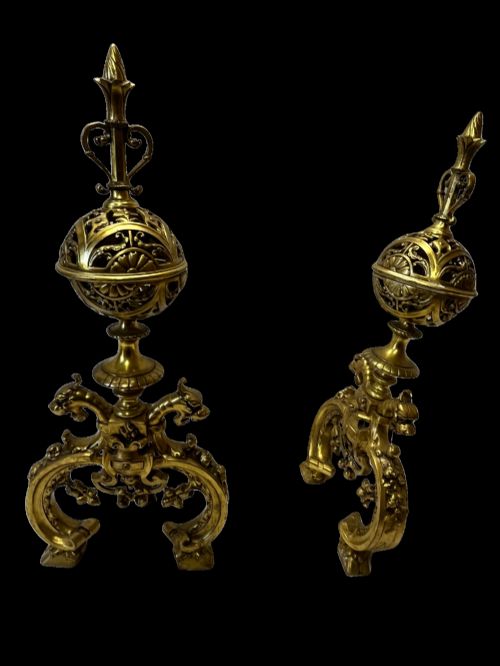
Most examples lean heavily into the French Rococo and Baroque styles, alongside Louis XVI and Victorian neo-classical revivals. These pieces function primarily as fireplace accessories and fire tool rests, often accompanied by matching fenders.
Buyers will encounter pairs executed in cast brass, gilt bronze, and ormolu, reflecting grand interior schemes. The form remains robust, designed to sit prominently at the front of the grate.
How they were made
The makers utilised casting techniques in iron, brass, and bronze to achieve intricate scrollwork and asymmetrical plant forms. Molten metal filled detailed moulds, capturing the depth required for Rococo and Baroque revival designs.
Gilt bronze and ormolu finishes involved applying gold or a gold-coloured alloy to the base metal surface. This process provided the bright, reflective sheen seen on the finer nineteenth-century examples.
Styles across the inventory concentrate on French Rococo, Baroque, and Louis XVI revivals.
What varies in quality
The crispness of the casting defines the upper tier of these metal pieces, where floral and scroll motifs retain sharp relief rather than soft edges. Finer pairs show careful chasing of the metal surface after casting to sharpen details.
Weight and material density separate solid bronze and heavy brass pairs from lighter alternatives. Superior mercury gilding or ormolu retains its lustre and depth across the curved surfaces over decades.
The French Ornate Chenets Glossary
- Chenet
- An alternative term for an andiron or fire dog, used to support firewood in an open hearth. These metal supports often feature decorative front faces.
- Ormolu
- Gilded bronze produced by applying a gold and mercury amalgam to a bronze object. The technique creates a rich, lasting metallic finish.
- Rococo
- An ornate design style marked by asymmetrical curves, scrolls, and plant motifs. It dominates nineteenth-century French decorative metalwork.
- Baroque
- A heavy, dramatic style preceding Rococo, featuring formal symmetry and grand proportions. Pieces in this manner display robust architectural framing.
- Andiron
- A horizontal metal bar raised on legs, paired to hold logs off the hearth floor. The front standard usually carries the decorative ornamentation.
French Ornate Chenets: Frequently Asked Questions
How do chenets work in a fireplace?
Chenets sit in pairs inside the hearth to hold logs above the floor, allowing air to circulate underneath for a better fire.
The decorated front standards remain visible outside the grate, while the rear bars support the burning wood.
What is the difference between chenets and fire dogs?
The terms are generally interchangeable for the same hearth furniture.
French makers historically favoured the word chenet, whereas English-speaking regions frequently used fire dogs or andirons.
How do I date nineteenth-century brass chenets?
Dating relies on stylistic markers such as Rococo revival curves or Louis XVI symmetry, combined with casting weight.
Earlier nineteenth-century pieces often show hand-chased surface details, whereas later twentieth-century copies display smoother, uniform machine casting.
Can these be used in a working fireplace?
Solid metal pairs made of iron, brass, or bronze handle the heat of a wood fire.
Gilt and ormolu surfaces require care to prevent smoke staining and heat damage over time.