



French Ormolu Clock Garniture
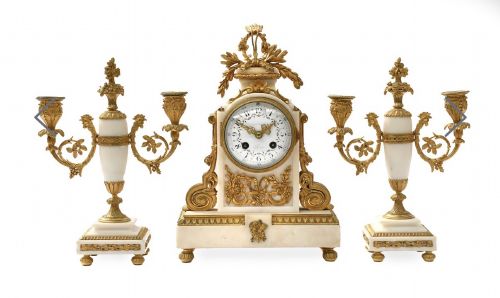
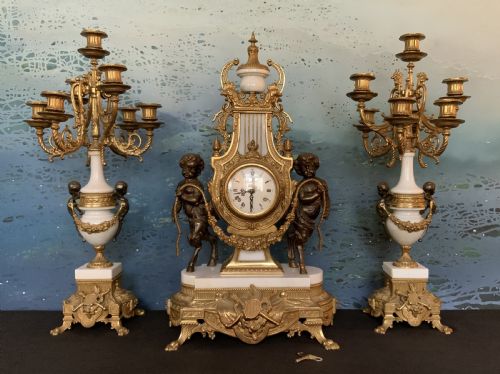
A french ormolu clock garniture brings monumental nineteenth-century presence to a mantelpiece through a matching centrepiece clock and side candelabras.

French Ormolu Clock Garniture
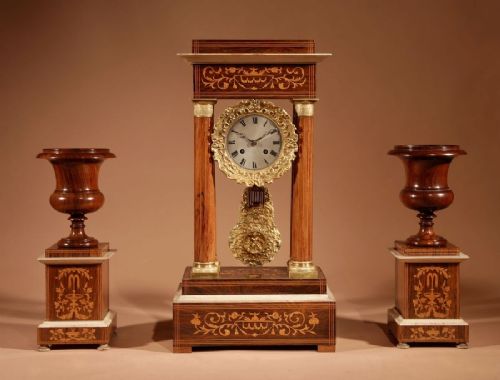
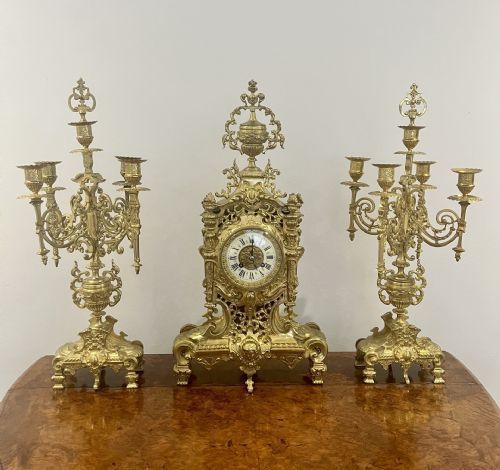
When searching for a french ormolu clock garniture, a buyer encounters matching three-piece or multi-piece mantel ensembles combining a central clock with flanking urns, candelabras, or vases. These sets date predominantly from the nineteenth century, spanning Victorian production periods and various revivals.
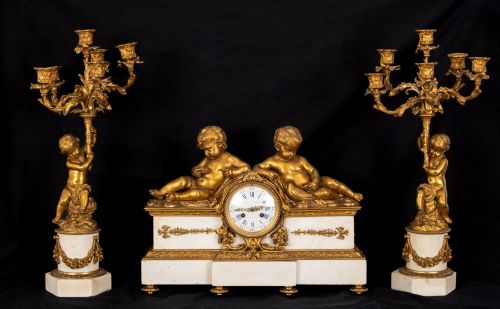
The most common versions met on this page include white or red marble bases mounted with gilt bronze ormolu, frequently styled in Louis XVI or Rococo revivals. Sets often incorporate figural elements such as cherubs or putti alongside enamel dials and eight-day movement mechanisms.
Originating largely from French workshops and Parisian makers, these assemblies served as opulent decorative focal points for period drawing rooms. Surviving examples frequently retain their matching side pieces, though complete sets under original glass domes also appear.
Materials and Construction
The creation of these objects relied upon fire-gilding or chemical gilding techniques applied to bronze or brass to produce ormolu, paired with turned and polished white, red, or black marble elements. Bronze casting captured intricate figural details, floral motifs, and scrollwork associated with Rococo and neoclassical styles.
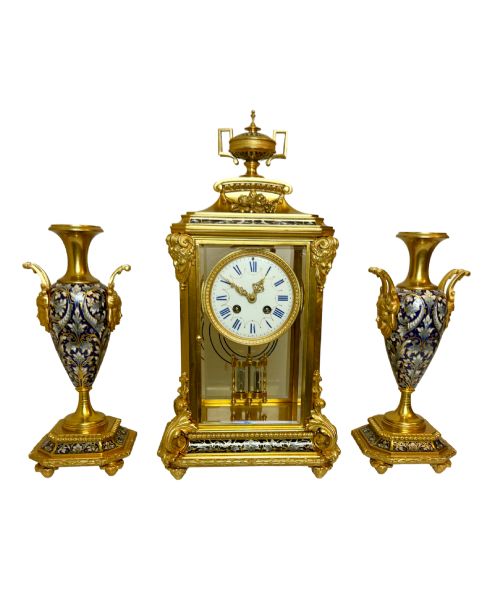
Dials were commonly constructed from white enamel with painted Arabic or Roman numerals, sometimes complemented by delicate Champleve or Cloisonne enamel panels. Porcelains from Sevres or similar traditions were frequently integrated into the clock bodies and matching garniture urns.
Cherubs appear frequently enough across these brass and marble assemblies to suggest nineteenth-century mantelpieces suffered from a minor celestial infestation.
Markers of Distinction
Movement quality separates ordinary items from exceptional pieces, with signed mechanical works by established makers offering superior reliability and precision. The integration of matching side pieces, harmonious porcelain plaques, and original components without replacement parts further defines the upper tier of the range.
Henry Dasson·A.D Mougin·H Luppens Paris·Vincenti of Paris·Japy Freres
The French Ormolu Clock Garniture Glossary
- Ormolu
- Gilt bronze produced by applying a mixture of finely powdered gold and mercury to a bronze base, then heating to drive off the mercury. This technique creates a durable, luminous golden finish characteristic of nineteenth-century French decorative arts.
- Garniture
- A set of matching ornamental objects designed to be displayed together on a mantelpiece or sideboard. Typically comprising a central clock flanked by two matching candelabras, urns, or vases.
- Champleve
- An enamelling technique where troughs or cells are hollowed out of the metal surface and filled with vitreous enamel paste before firing. The resulting design displays colourful glass-like patterns bordered by thin metal lines.
- Portico clock
- A mantel clock architectural in form, featuring a dial suspended between four or more vertical marble or wooden columns. This neoclassical layout gained popularity during the nineteenth century.
- Bleu de Roi
- A deep, rich cobalt blue ceramic glaze used extensively on decorative porcelain panels and urns. It frequently serves as a contrasting backdrop for gilt bronze mounts.
French Ormolu Clock Garniture: Frequently Asked Questions
How do you wind and maintain an eight-day movement?
An eight-day mechanical movement requires winding approximately once a week using a matching key inserted into the dial arbors. Care must be taken not to overwind the mainsprings, and the clock should rest on a completely level surface to keep the pendulum beating evenly.
Professional cleaning and oiling every few years ensure the brass gears and escapements continue to function reliably without excessive wear.
How can you tell Louis XVI style from Rococo?
Louis XVI style pieces display neoclassical symmetry, straight architectural lines, urns, ribbons, and restrained geometric ornaments. The bronze mounts follow orderly, balanced proportions derived from ancient classical architecture.
French Rococo revival pieces embrace asymmetry, swirling C-scrolls, naturalistic plant forms, and playful figural elements like cherubs, creating a more fluid and theatrical visual effect.
Why do some sets include glass domes?
Glass domes protected delicate ormolu surfaces, exposed clock movements, and hand-painted enamel dials from accumulating dust and airborne grime in nineteenth-century homes. They sat upon wooden or velvet-lined bases beneath the clock and garnitures.
Finding a set with its original blown glass dome is uncommon because fragile glass frequently broke over generations of domestic use.