


French Marquetry Library Table
A french marquetry library table brings sophisticated floral patterns and rich timber surfaces into a room, serving as both a grand desk and a striking centrepiece.
French Marquetry Library Table
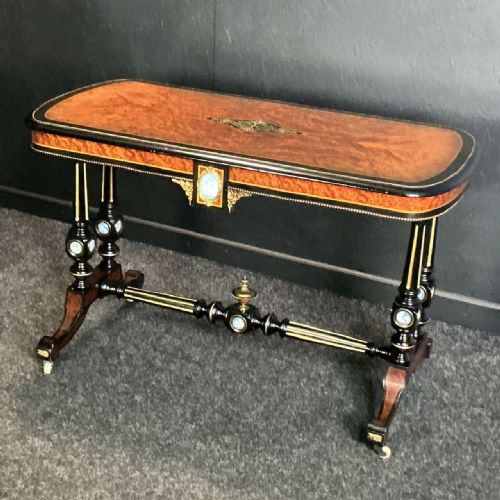
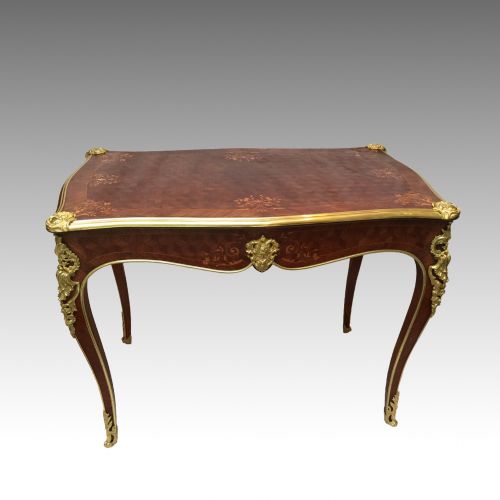
A french marquetry library table is a substantial writing or centre piece defined by intricate wood veneer inlay depicting floral or geometric patterns. These tables frequently emerge from the nineteenth century, drawing heavily on Louis XV and Louis XVI revival aesthetics.
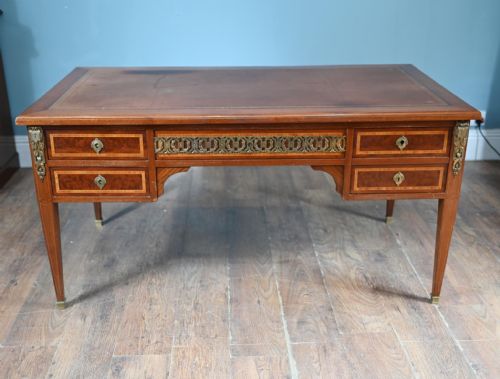
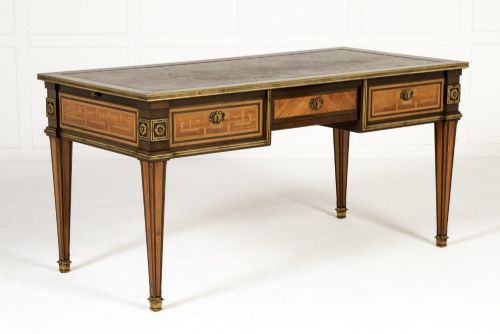
Makers shaped these forms in various silhouettes, ranging from kidney-shaped writing desks to expansive bureau plat designs. Walnut, kingwood, and rosewood form the foundational structures, often finished with detailed parquetry work.
Buyers will encounter numerous nineteenth-century examples on this page, particularly pieces bearing ormolu mounts and brass detailing. These tables function equally well as standalone centre tables or as functional writing desks.
Materials and Construction
Craftsmen built these tables using robust carcases of walnut, satinwood, or ebonised wood, upon which they applied delicate veneers of kingwood, rosewood, and amboyna. Artisans cut contrasting timbers by hand to form intricate marquetry and parquetry patterns across the top and sides.
Gilt bronze and ormolu mounts provide structural accent and protective edging around corners and drawers. Many surfaces also incorporate inset leather panels to create a durable writing surface framed by inlaid borders.
Materials recorded across the inventory include kingwood, walnut, burr walnut, rosewood, satinwood, coromandel, amboyna, ormolu, and leather.
Determining Quality and Execution
Quality rests in the precision of the veneer work and the depth of the floral marquetry. Superior examples display seamless integration of contrasting timbers without gaps, whereas lesser pieces show simple printed or poorly fitted veneers.
The cast quality of the ormolu mounts further distinguishes the work. Finely chased bronze mounts with sharp detail indicate higher craftsmanship compared to softer, unrefined metal fittings.
Maison Millet·Francoise Linke·Gillows
The French Marquetry Library Table Glossary
- Bureau plat
- A traditional French writing table featuring a rectangular top and one or more drawers in the frieze. These pieces typically stand on slender cabriole or tapered legs.
- Marquetry
- The art of applying pieces of veneer to a structure to form decorative patterns and pictorial designs. Artisans utilise various coloured woods to create depth and shading.
- Parquetry
- Geometric mosaic woodwork arranged in repeating patterns such as cubes or chequers. This technique frequently appears on table tops alongside floral marquetry.
- Ormolu
- Gilded bronze used for decorative furniture mounts and feet. The technique involves applying a mercury and gold amalgam to bronze.
- Boulle
- A style of marquetry using brass and tortoiseshell inlaid together, popularised in France. Pieces utilising this method show striking metallic contrast against dark grounds.
French Marquetry Library Table: Frequently Asked Questions
How do I use a bureau plat today?
A bureau plat functions exceptionally well as a standalone writing desk or a striking centre table in a study or drawing room. The finished back allows the piece to float in the middle of a space rather than sitting flush against a wall.
The integrated drawers provide practical storage for modern stationery or laptops while preserving the historical character of the interior.
What is the difference between a centre table and a library table?
Centre tables are designed to be viewed from all sides, often featuring symmetrical marquetry and finished backs suitable for placement in the middle of a room. Library tables generally serve a heavier working function, occasionally incorporating drawers or leather inserts for reading and writing.
In nineteenth-century French furniture design, these terms frequently overlap, as many decorative tables served both purposes.
How do I care for antique marquetry surfaces?
Protect the delicate wood veneers by keeping the table away from direct sunlight and sudden temperature changes, which can cause the timber to warp or split. Apply high-quality beeswax periodically to nourish the wood and maintain a soft lustre.
Avoid placing wet glasses or unpadded hot items directly onto the polished or leather-inset surface to prevent permanent ring marks and staining.
How do I identify Louis XV and Louis XVI styles?
Louis XV style furniture is characterised by flowing serpentine lines, asymmetric curves, and cabriole legs ending in sabots. The decoration leans heavily toward naturalistic floral marquetry and sweeping ormolu mounts.
Louis XVI style shifts toward classical restraint, featuring straight tapered fluted legs, rectangular silhouettes, and symmetrical geometric parquetry patterns inspired by antiquity.