
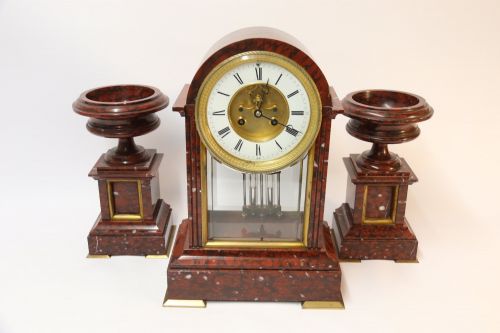


French Marble Pendulum Clock
A french marble pendulum clock brings weight and steady motion to a room, combining solid stone with disciplined brass and enamel.
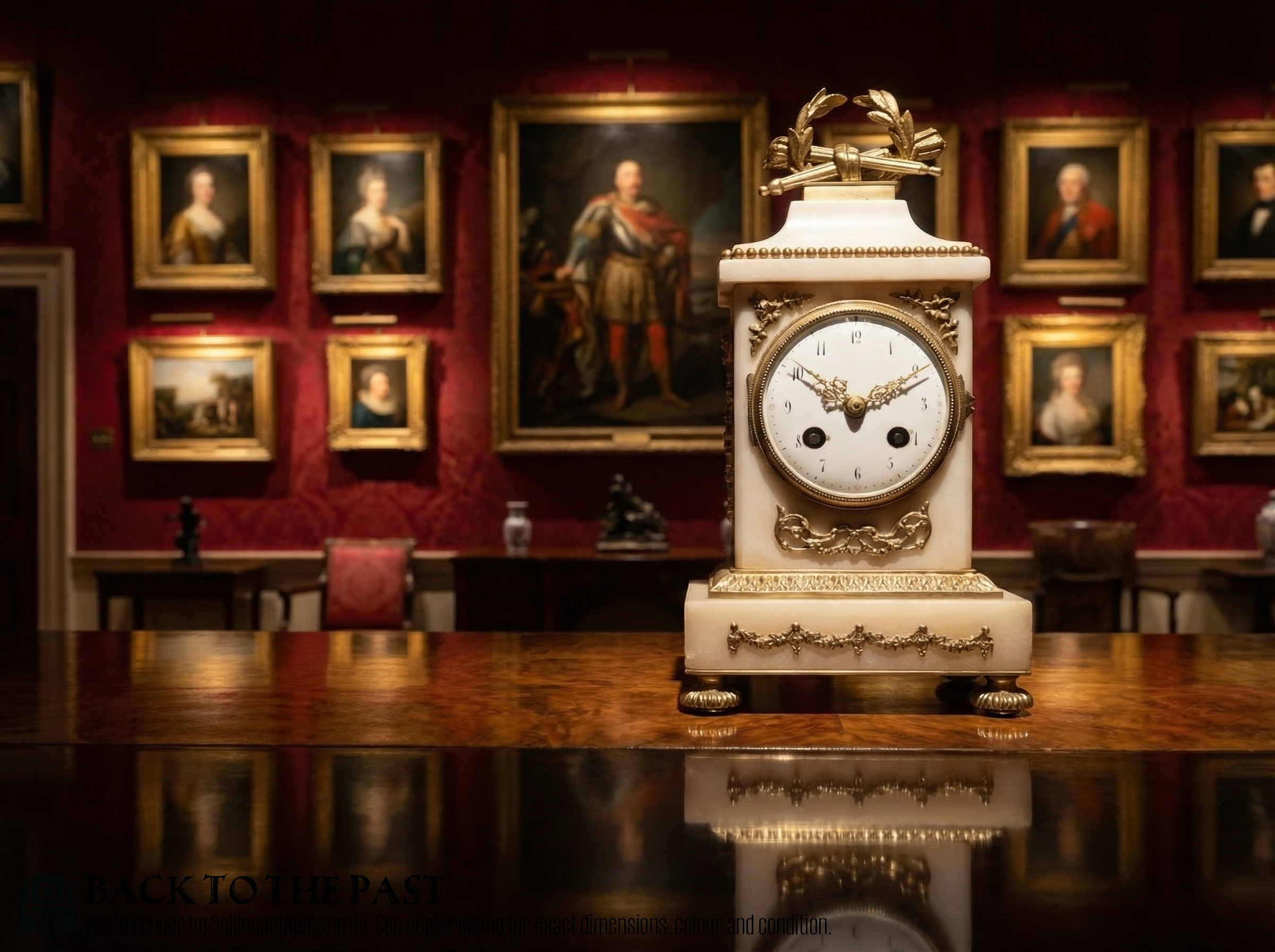
French Marble Pendulum Clock
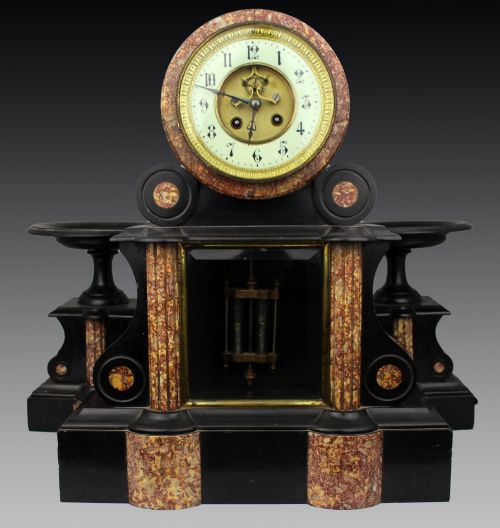
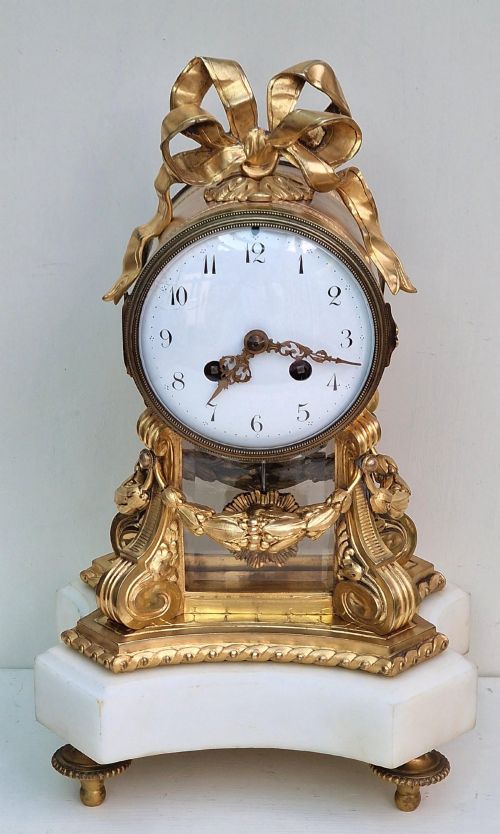
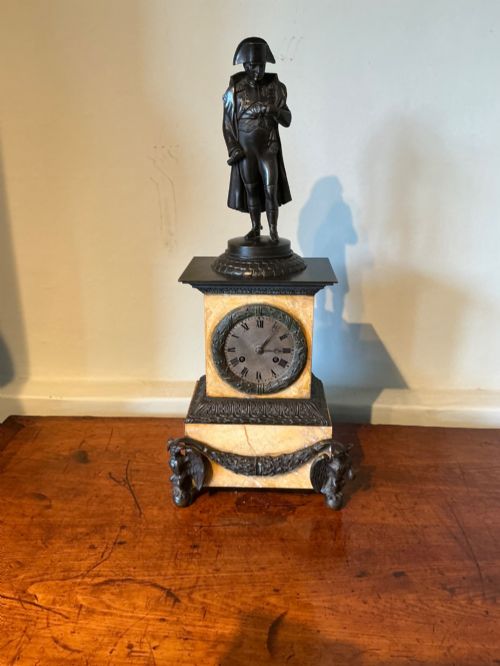
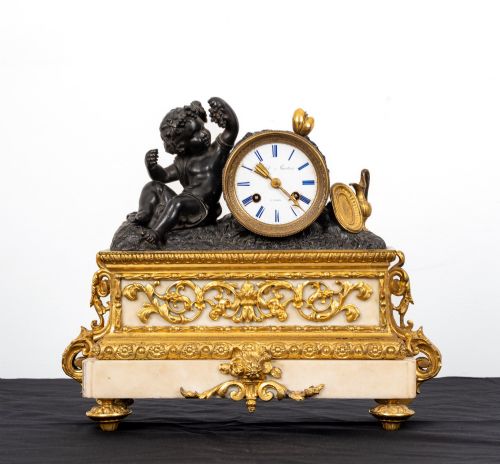
When you search for a french marble pendulum clock, you encounter heavy architectural cases built to house precise mechanical movements during the nineteenth century. These items appear as mantel clocks, portico clocks, and larger garniture sets flanked by matching ornaments.
The most frequent examples on this page date from the Victorian era and the broader nineteenth century, utilising dark black slate, white marble, red marble, or pink marble. They often incorporate cast ormolu mounts and gilt bronze figures depicting classical themes, cherubs, or historical subjects.
Makers and retailers such as Japy Frères, Samuel Marti, and Pinchon, Fils signed movements that regulated time through oscillating pendulums. Collectors seek these pieces for their combination of monumental stone architecture and intricate dial work.
Materials and Construction
Lapidaries cut and polished solid blocks of marble and black slate to form heavy architectural cases, occasionally inlaying contrasting stone specimens or incorporating glass panels for four-glass designs. Foundational structures relied on dense mineral blocks to support the heavy interior machinery.
Foundries cast bronze and ormolu mounts to adorn the stone cases, applying mercury gilding or modern electroplating to achieve bright metallic finishes. Enamel dials received delicate hand-painted numerals and minute tracks before being fitted behind protective glass bezels.
Materials recorded across the inventory include white marble, black slate, red marble, pink marble, Sienna marble, ormolu, brass, enamel, and glass.
Distinctions in Quality
Superior pieces display crisp, deeply chased bronze or ormolu mounts that fit seamlessly against the contours of the marble, whereas lower tiers show softer cast details and gaps where metal meets stone. The intricacy of the stone cutting, from simple block shapes to elaborate portico columns and inlaid polychrome panels, defines the maker's ambition.
The mechanical sophistication within the movement separates ordinary production from exceptional work. Dials featuring specialised complications, such as penny moon phases showing lunar cycles or sunburst pendulums, indicate higher tiers of nineteenth-century French clockmaking.
Japy Frères·Samuel Marti·Siffel and Cartier·Baby and Jannings·D Munsey of Cambridge·Deniere and Cailleaux·Pinchon Fils Paris·Ferdinand Berthoud
The French Marble Pendulum Clock Glossary
- Garniture
- A matched set consisting of a central clock flanked by side ornaments such as urns or vases. These suites create a balanced arrangement on a mantelpiece.
- Ormolu
- Finely chopped high-zinc brass applied to bronze objects via mercury gilding or electroplating. It provides a bright gold-coloured surface finish on decorative mounts.
- Portico Clock
- A clock case constructed with vertical columns supporting a horizontal entablature, creating an architectural temple form. They frequently house visible swinging pendulums.
- Enamel
- Fused glass powder applied to metal dial plates and fired at high temperatures. It produces a smooth, white glossy surface for painted numerals.
- Movement
- The internal mechanical assembly of gears, springs, and escapements that drives the hands and strikes the bell. Nineteenth-century versions typically employed eight-day spring or weight-driven systems.
French Marble Pendulum Clock: Frequently Asked Questions
What is a clock garniture?
A clock garniture is a matching set where the central timepiece is accompanied by two side pieces, such as vases, urns, or candelabra. These sets were designed to sit together on a mantelpiece to create a symmetrical display.
In nineteenth-century interiors, the side ornaments repeated the marble and ormolu motifs of the main clock case to unify the room's decor.
How do portico clocks work?
Portico clocks use an architectural frame with side pillars to suspend the pendulum in an open central space. The pendulum often swings visibly between the columns as the clock operates.
This open design allowed makers to showcase sunburst pendulums and delicate suspension springs while maintaining a classical temple silhouette.
What materials make up these clocks?
These clocks are built from heavy mineral cases such as black slate, white marble, red marble, pink marble, or Sienna marble. They are decorated with cast brass, bronze, and ormolu mounts.
Enamel dials and glass bezels protect the face, while internal brass gears and steel springs comprise the mechanical movement.
How do I identify the period?
Periods are identified by the architectural style, decorative motifs, and mechanical signatures stamped on the backplate. Pieces from the French Empire and Directoire eras feature strict classical geometry, while Victorian and late nineteenth-century examples often embrace ornate garnitures and Egyptian revival details.
Maker signatures and serial numbers stamped on the brass movements also help pinpoint the year of manufacture.