




French Mantel Clock Set
A french mantel clock set brings symmetry and historical weight to a room, pairing a central timepiece with matching side garnitures.

French Mantel Clock Set
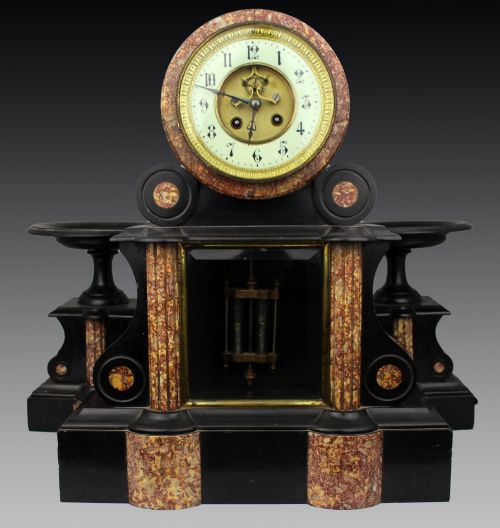
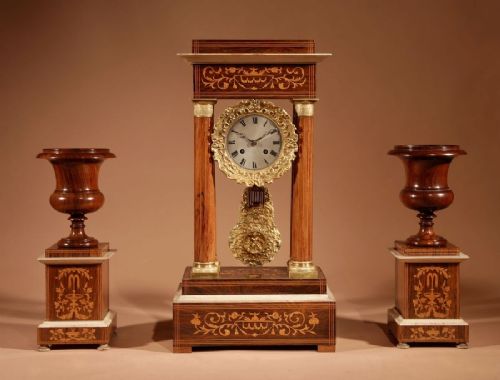
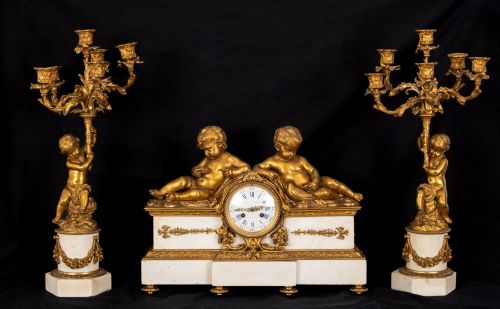
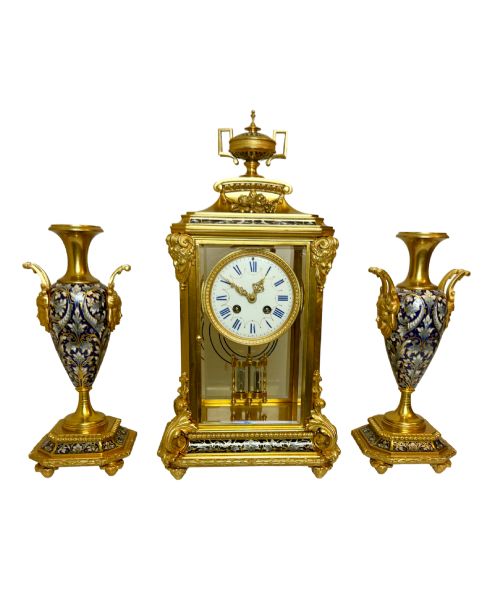
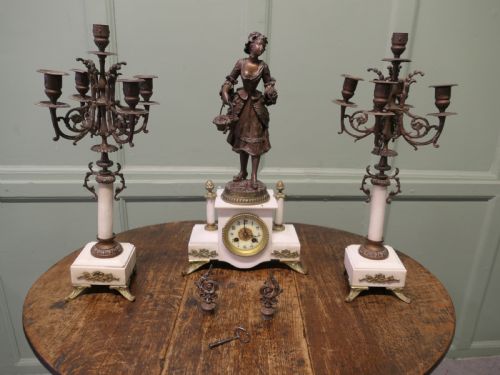
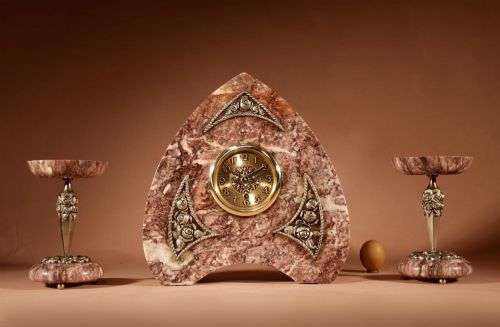
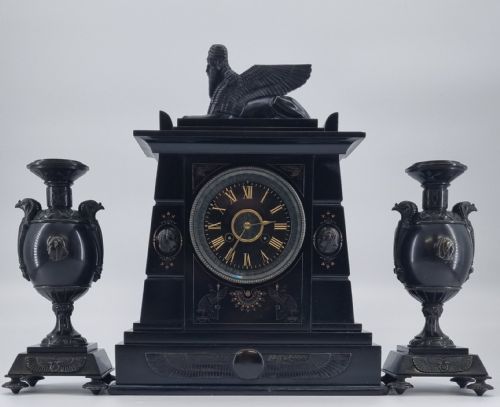
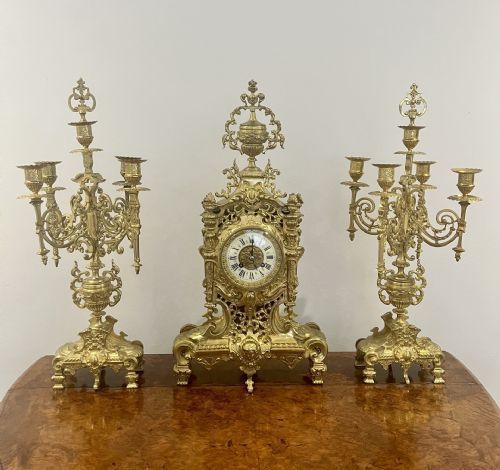
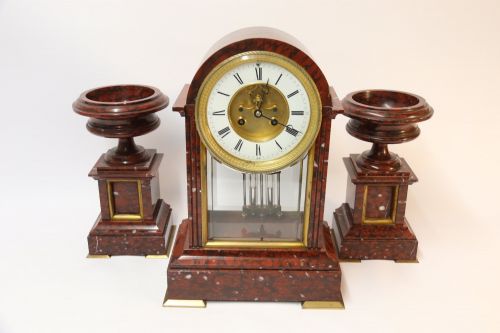
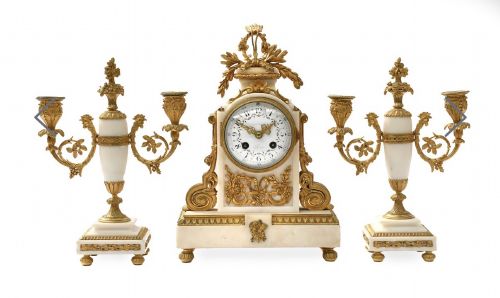
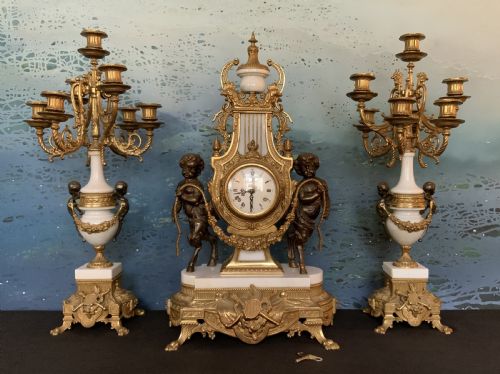
A french mantel clock set comprises a central timepiece flanked by matching side pieces such as candelabras, urns or vases, creating a balanced three-piece arrangement. When searching for a french mantel clock set, buyers encounter nineteenth-century examples most frequently, spanning styles from Victorian and Louis XVI Revival to Art Deco.
The materials utilised in these assemblies define their character, ranging from black or white marble and onyx to gilt bronze, ormolu, porcelain and enamel. Forms vary from portico and lyre shapes to architectural marble blocks and figural bronzes featuring cherubs or animals.

Materials and technique
Foundry work in bronze, gilt bronze and ormolu involved lost-wax casting or sand casting, followed by meticulous chasing and fire gilding to create rich surface textures. Stonework components such as marble and onyx were precision-cut, turned and polished to house the mechanical movements and support metal mounts.
Dial construction typically relied on white enamel with painted numerals, protected behind curved glass set into brass or bronze bezels. Decorative elements incorporated champleve enamel panels, hand-painted porcelain plaques, and applied brass or bronze cast ornaments.
French Mantel Clock Set Retail Price Guide 2026
Typical asking prices for french mantel clock set among the pieces listed under this phrase on Sellingantiques today, from the lower quarter to the upper quarter. They describe what is for sale here now, not the wider market.
Greyhounds occasionally stand guard on these mantelpieces, bringing a swift canine presence to otherwise solemn nineteenth-century marble and bronze assemblies.
Judging execution
Movement quality separates workshop output, where signed mechanisms by established makers and eight-day striking trains indicate superior reliability and precision engineering. The cohesion of the garniture pair with the central clock indicates whether the set was conceived together or assembled later.

Japy Freres·Samuel Marti·Henry Dasson
The French Mantel Clock Set Glossary
- Clock garniture
- A matching set of ornamental pieces designed to accompany a mantel clock, typically consisting of two matching urns, vases or candelabras displayed alongside the central timepiece. They provide visual symmetry on a mantelpiece or sideboard.
- Ormolu
- A technique of applying finely ground high-carat gold-mercury amalgam to a bronze object, creating a durable golden finish. The process was widely utilised on nineteenth-century decorative hardware and clock mounts.
- Portico clock
- A mantel clock featuring an architectural case supported by four or more columns, resembling a classical temple facade. This form frequently utilised marble and bronze materials in nineteenth-century French design.
- Champleve
- An enamelling technique where troughs or cells are hollowed out of a metal surface and filled with vitreous enamel paste before firing. The resulting panels add rich colour alongside polished bronze and marble.
French Mantel Clock Set: Frequently Asked Questions
What is included in a clock garniture?
A standard set includes a central timepiece accompanied by two matching side pieces, which may take the form of candelabras, urns, vases or figural ornaments. These companion pieces echo the materials and design motifs of the clock.
Together they create a balanced decorative arrangement designed for placement on a mantelpiece, credenza or architectural shelf.
How do I wind the clock?
Most nineteenth-century mechanical movements utilise a dedicated winding key inserted into small arbors on the enamel dial. Turning the key tensions the internal springs that power the timekeeping and striking trains.
Care must be taken not to over-wind the mechanism, as this can damage the internal springs and escapement components.
Where should I place the set?
These heavy sets require a stable, level surface capable of supporting considerable weight, particularly when constructed from solid marble, onyx and cast bronze. A mantelpiece, heavy sideboard or dedicated console table provides adequate structural support.
Keeping the arrangement away from direct sunlight and moisture protects the delicate enamel dials, gilding and polished stone surfaces over time.
How do I identify the period?
Stylistic indicators such as neoclassical columns, Louis XV scrollwork or streamlined geometric Art Deco lines point toward specific decades of manufacture. Material choices, dial construction and movement signatures further narrow down the era.
Comparing the casting methods and mounting techniques against documented nineteenth- and early twentieth-century examples helps confirm the date of production.