
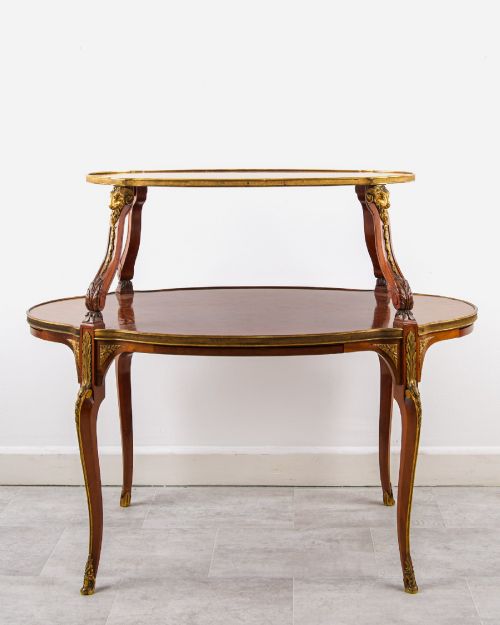

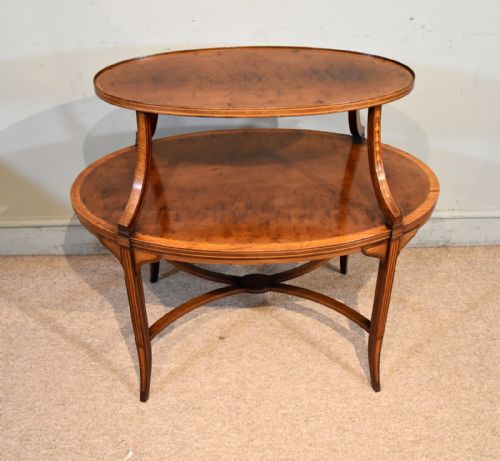


French Mahogany Etagere
A french mahogany etagere brings multi-tiered display space into a room, offering slender uprights and open shelves for books, plants or decorative objects.
French Mahogany Etagere
A french mahogany etagere is an open tiered stand designed for display, appearing most frequently in nineteenth-century and Edwardian forms. These pieces serve as side tables, occasional tables, or wall shelves, providing multiple levels supported by slender vertical columns or uprights.
The varieties on this page range from freestanding two-tier and three-tier tea and centre tables to hanging wall shelves and what-nots. Mahogany forms the primary structural timber across these examples, often combined with inlaid details and decorative mounts.
Evaluating quality in construction
Quality rests in the precision of the timber selection, such as plum pudding mahogany figures, and the crispness of the marquetry or satinwood inlay work. Finer pieces display integrated brass or ormolu mounts that fit flush against the mahogany structure rather than appearing as later additions.
The structural integrity of the tier joints and the weight of the brass or gilt bronze galleries differentiate standard pieces from those of finer manufacture. Well-executed tables maintain rigid upright alignment across multiple tiers without wobble.
Listings feature mahogany paired with ormolu, brass, marble, and marquetry inlay across nineteenth-century and Edwardian periods.
The French Mahogany Etagere Glossary
- Étagère
- An open piece of furniture with multiple tiers for displaying small objects or ornaments. It originated in France and appears as both freestanding tables and wall-mounted units.
- Ormolu
- Gilded bronze or brass mounts applied to furniture for decorative effect. It provides metallic contrast against the dark mahogany timber.
- Marquetry
- Decorative veneer work formed by fitting together small pieces of wood, shell, or ivory to create pictorial or geometric patterns on the surface. It is often executed in contrasting timbers like satinwood.
- Whatnot
- A nineteenth-century term for an open multi-shelved piece of furniture used for storing or displaying bric-a-brac. It shares a similar form to the etagere.
French Mahogany Etagere: Frequently Asked Questions
What is an etagere used for?
An etagere provides open shelving arranged in tiers to display decorative items, books, plants, or tea service elements. The multiple levels allow for vertical arrangement without cluttering the room.
Freestanding versions function as centre tables or side tables, while wall-mounted variants utilise vertical wall space for display purposes.
How do I clean mahogany furniture?
Dust mahogany surfaces regularly with a soft, dry cloth to prevent dirt accumulation on the polish and inlay. Avoid using silicone-based sprays or harsh chemical cleaners.
Apply a traditional beeswax polish occasionally to nourish the timber and maintain the natural lustre of the mahogany and its inlays.
Where should I place an etagere?
Position freestanding etagere tables where they can be viewed from multiple angles, such as beside seating or in the middle of a room as a centre table. Ensure they stay clear of direct sunlight to prevent the mahogany and inlay from fading.
Wall-mounted etageres require secure fixings into solid wall anchors to support the weight of the timber and any displayed objects safely.
How do I date a nineteenth-century etagere?
Examine the construction methods, timber choice, and decorative styles to determine the period. Nineteenth-century pieces often display hand-cut joints and distinct brass gallery work.
Compare the style markers, such as Napoleon III or Sheraton Revival influences, which point to specific decades within the Victorian era and the turn of the twentieth century.