



French Empire Side Stands
French empire side stands bring classical symmetry and gleaming bronze mounts into a room, offering compact surfaces with distinct architectural presence.
French Empire Side Stands
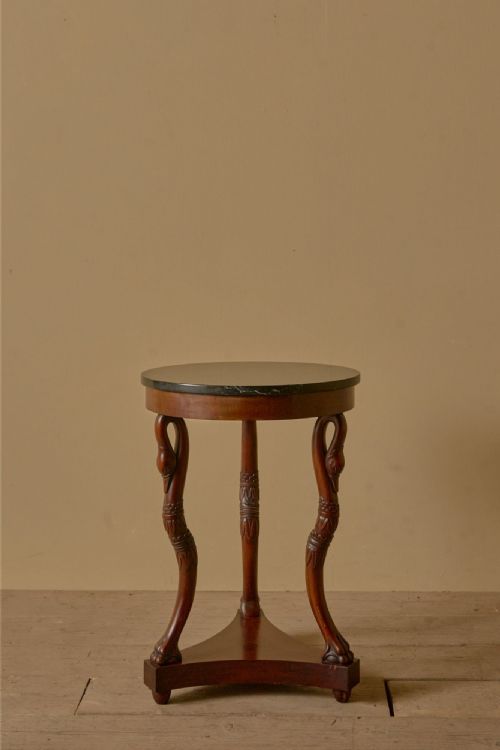
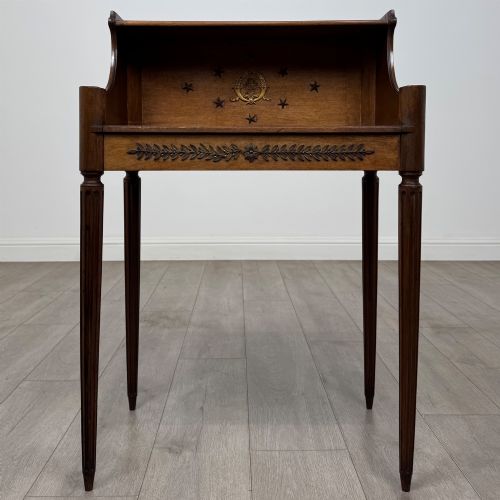
When you search for french empire side stands, you encounter a focused selection of small tables, cabinets, and pedestals rooted in nineteenth-century design. These pieces draw on classical motifs, providing useful surfaces for lamps, books, or decorative objects while occupying minimal floor space.
The versions most commonly met on this page span the nineteenth and early twentieth centuries, including Edwardian interpretations and pieces from the Regency era. They appear in forms ranging from octagonal occasional tables and two-tier gueridons to cylindrical bedside stands and console tables.
Origins cluster around French design traditions, frequently pairing rich hardwoods with contrasting metal mounts. Whether configured as bedside cabinets or centre stands, they function as versatile accents that anchor a room with formal restraint.
How they were made
Cabinetmakers built these stands using dense timbers such as mahogany, walnut, burr elm, and coromandel, often framing the grain to accentuate the natural figure of the wood. Surfaces were finished with polished treatments that highlighted the deep tones of the primary timber.
Decoration relied heavily on cast or chased ormolu and brass mounts applied to corners, friezes, and legs, introducing metallic contrast to the dark wood. Heavy inset marble tops, sometimes supported by parcel-gilt or giltwood frameworks, provided durable and cool surfaces.
French Empire Side Stands Retail Price Guide 2026
Typical asking prices for french empire side stands among the pieces listed under this phrase on Sellingantiques today, from the lower quarter to the upper quarter. They describe what is for sale here now, not the wider market.
Periods represented span the early nineteenth century through the Edwardian era, encompassing French Neoclassical and Regency styles.
What varies in quality
The standard of ormolu chasing and casting creates a primary division in quality, separating crisp, finely detailed bronze mounts from softer, simpler brass applications. Sharp definition in the acanthus leaves, classical figures, and geometric borders signals superior workshop production.
The selection of timber and the precision of the joinery further distinguish the pieces, particularly where complex curves, octagonal forms, or canework require meticulous hand assembly. Intact marble slabs with harmonious veining and secure seating within the wooden frame add to the structural integrity.
The French Empire Side Stands Glossary
- Ormolu
- Gilded bronze used for decorative mounts and accents on furniture. The technique involves applying a mercury-gilt finish to cast bronze.
- Gueridon
- A small circular or octagonal table, typically supported by a central column or three legs. This French form dates back to the seventeenth century.
- Coromandel
- A dense, dark cabinet wood imported from Asia, featuring contrasting streaks of black and brown. It takes a high polish and appears in select nineteenth-century tables.
- Parcel-gilt
- Partially gilded woodwork where gold leaf is applied only to specific carved details or highlights. This technique contrasts with the dark timber beneath.
- Canework
- Woven rattan or cane used for shelves or panels in tables and cabinets. It offers a lightweight textural element to the design.
French Empire Side Stands: Frequently Asked Questions
What is a french empire side stand?
A french empire side stand is a small nineteenth-century table or cabinet designed with classical architectural proportions. These pieces typically feature dark hardwoods paired with ormolu mounts and marble tops.
They serve as functional furniture for holding lamps or display items while adding formal character to a hallway, bedroom, or sitting room.
How were these stands used originally?
In period interiors, these stands functioned as bedside cabinets, occasional tables for tea or reading materials, or small pedestals for sculptures. Their compact footprints allowed them to fit easily into corners or beside seating.
Their sturdy marble tops also made them practical surfaces for holding water pitchers or resting hot items.
How do I care for marble top tables?
Marble tops require gentle cleaning with a damp cloth and mild, pH-neutral soap to preserve the polish and prevent staining. Avoid acidic liquids like citrus juice or vinegar, which can etch the stone surface.
Using felt pads under objects placed on the marble will help prevent scratches and maintain the finish over time.
How do I tell an original from a later style piece?
Examining the construction methods, wood ageing, and mount fixings helps distinguish nineteenth-century originals from Edwardian or later revivals. Hand-cut joinery and period-appropriate wear patterns point to earlier production.
Mounts should be secured with traditional screws or pins rather than modern adhesives, reflecting the hand-assembly methods of the period.