

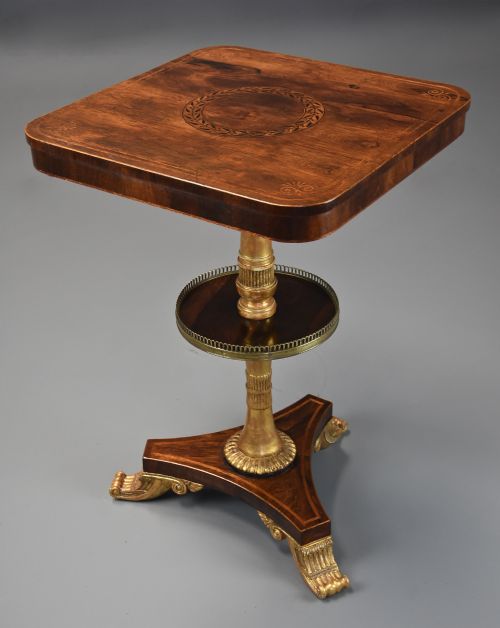
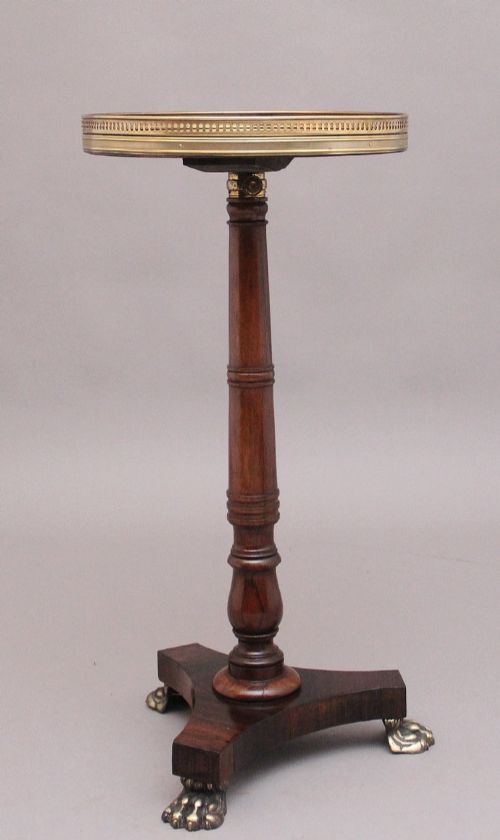


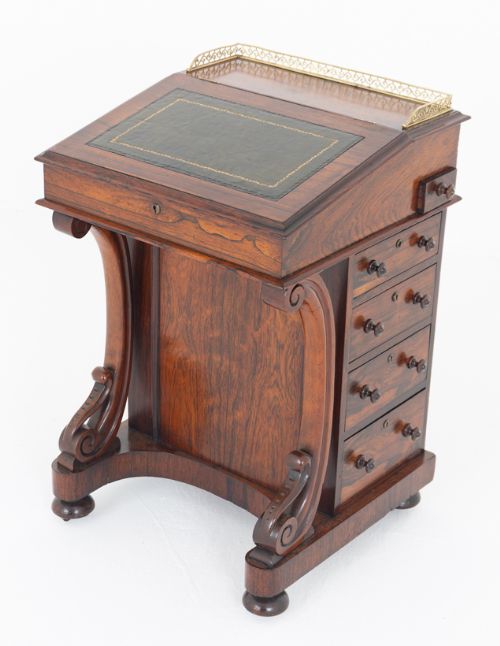


Brass Gallery Pedestals
Brass gallery pedestals provide a sturdy surface bounded by a fine metal rail, securing precious objects while adding a polished linear accent to a room.
Brass Gallery Pedestals
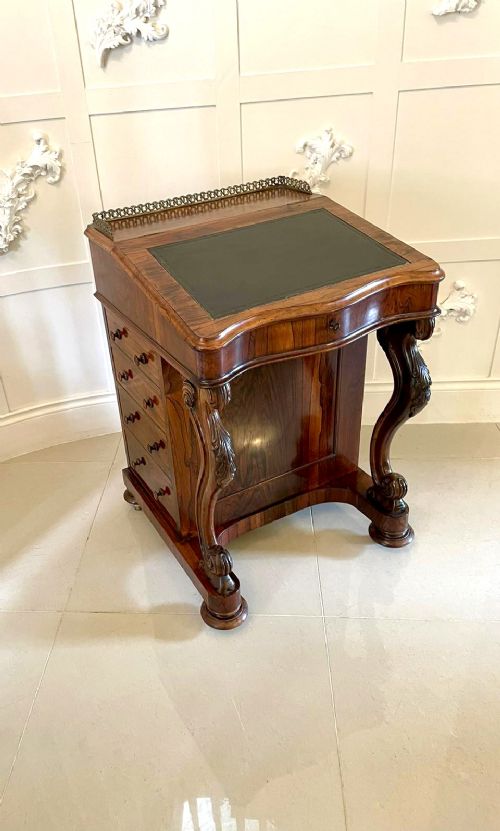
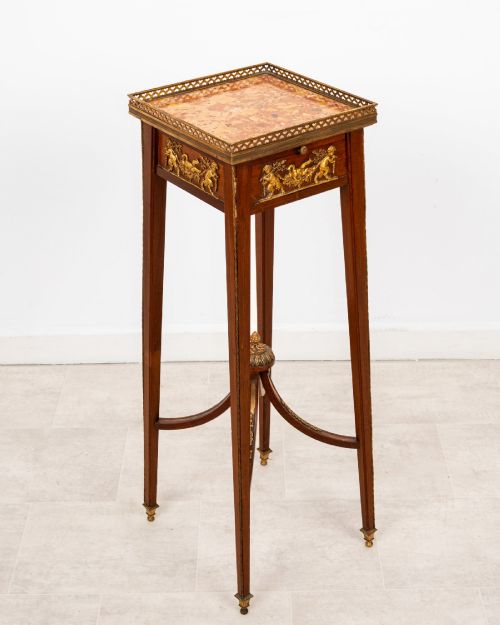
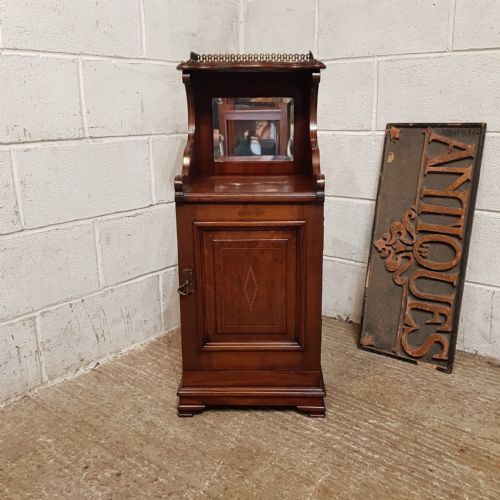
Brass gallery pedestals encompass occasional tables, stands and writing furniture fitted with raised metal borders designed to keep items secure. The listings show these pieces appearing across the nineteenth and early twentieth centuries, spanning periods from the Regency era through to Edwardian workshops.
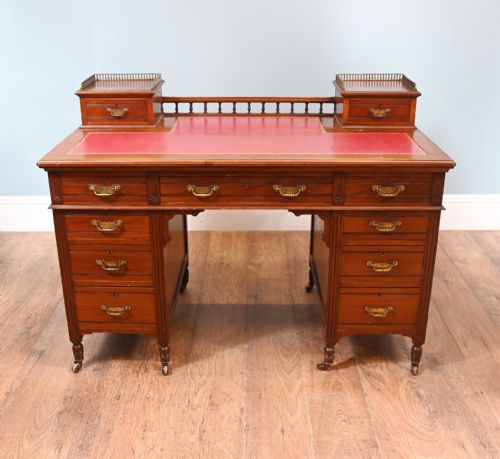
The most common forms on this page include mahogany and rosewood occasional tables, alongside writing desks like the Carlton House desk and Davenport. These pieces frequently incorporate supportive pedestals or tiered structures built for domestic display and daily study.
Originating largely from British and French makers, these items utilise cabinet woods such as satinwood, walnut and kingwood. The brass gallery itself acts as both a functional retainer and a defining decorative edge across various stylistic revivals.
What varies in quality
Quality reveals itself in the selection and matching of timber veneers, such as burr walnut or flame mahogany, where symmetrical grain patterns require high skill to lay. The crispness of marquetry inlay and the depth of crossbanding separate standard workshop output from finer cabinet work.
The weight, casting detail and finishing of the brass gallery indicate the level of craftsmanship invested in the piece. Well-made metal galleries fit snugly into the timber top with secure fixings rather than superficial surface pins.
Internal construction, including solid oak drawer linings and hand-cut dovetails, distinguishes superior desks and tables from simpler commercial productions. The integration of secondary materials like rouge marble or onyx also dictates the overall ambition of the piece.
The inventory records various writing desks and occasional tables incorporating marble, onyx and leather inserts alongside traditional timber surfaces.
François Linke·A Hugnet Paris·Edwards and Roberts·Gillows of Lancaster·George Bullock·George Hepplewhite
The Brass Gallery Pedestals Glossary
- Brass gallery
- A raised metal railing fitted around the edge of a table or desk top to prevent objects from sliding off. It is commonly pierced or cast in openwork patterns.
- Carlton House desk
- A distinctive writing desk featuring a permanent raised superstructure fitted with small drawers and compartments curving around the back and sides. This form frequently incorporates a leather-lined writing surface and brass galleries.
- Davenport
- A compact writing desk featuring a sloping, hinged writing surface above a pedestal of side drawers. Early versions often incorporate a small side-hinged stationery box with a brass gallery on top.
- Crossbanding
- A strip of veneer applied to the border of a table top or drawer front with the wood grain running perpendicular to the main panel. This technique frames the primary timber and adds visual contrast.
- Gueridon
- A small, round occasional table supported by a central pillar or multiple legs, originating in seventeenth-century France. Later examples often feature marble tops enclosed by brass galleries.
Brass Gallery Pedestals: Frequently Asked Questions
What is a brass gallery used for?
The raised metal railing prevents small items, glassware or writing implements from sliding off the surface during use or movement.
Cabinetmakers integrated these galleries onto the edges of occasional tables, bedside cabinets and writing desks to combine practical security with a decorative metallic border.
What woods were used in these pieces?
Makers relied heavily on dense native and exotic hardwoods including mahogany, rosewood, oak and walnut for primary structures and solid frames.
Decorative surfaces frequently display figured veneers such as satinwood, kingwood and burr elm, paired with contrasting crossbanding and intricate marquetry details.
Where were these pieces made?
The inventory shows items produced primarily in British and French workshops, reflecting distinct national preferences in cabinetmaking styles.
French pieces frequently incorporate marble tops, ormolu mounts and exotic kingwood veneers, whilst British examples lean towards mahogany, oak and rosewood constructions by firms such as Gillows.
How do I care for marble and brass?
Marble surfaces require regular dusting with a soft cloth and immediate wiping of spills to prevent staining on porous stone.
Brass galleries benefit from gentle cleaning with a dry cloth to maintain their lustre, avoiding abrasive polishes that might damage the surrounding timber veneer.