






French Empire Mantel Candelabra
French empire mantel candelabra bring grand neoclassical symmetry and warm metallic lustre to a room, combining architectural presence with functional lighting.
French Empire Mantel Candelabra
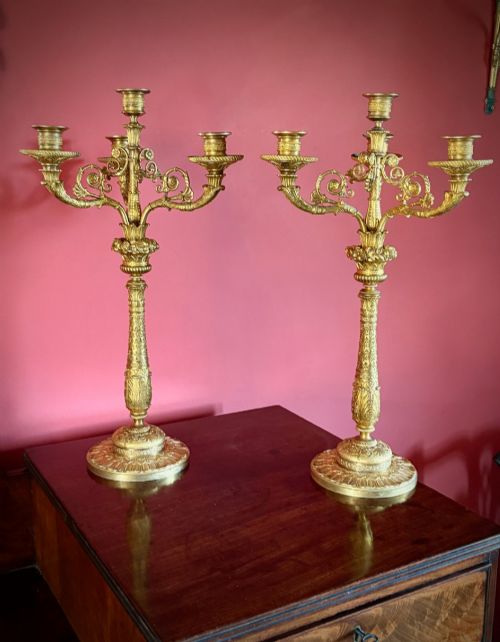
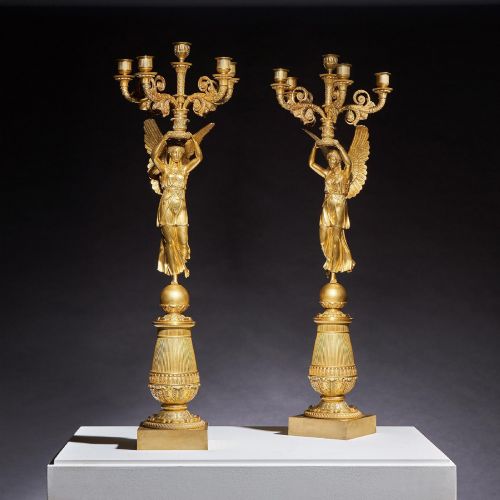
When you search for french empire mantel candelabra, you find heavy metal lighting pieces designed to sit on a fireplace mantelpiece, often paired with matching clock garnitures or centrepieces. These items span periods from the early nineteenth century through the Victorian era, drawing on French Empire, Regency, and Louis XVI styles.
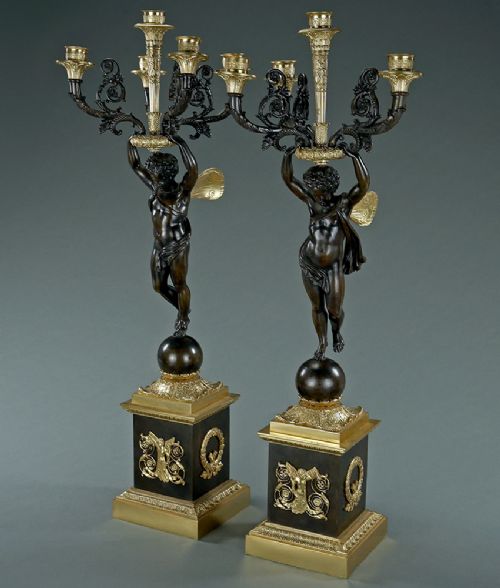
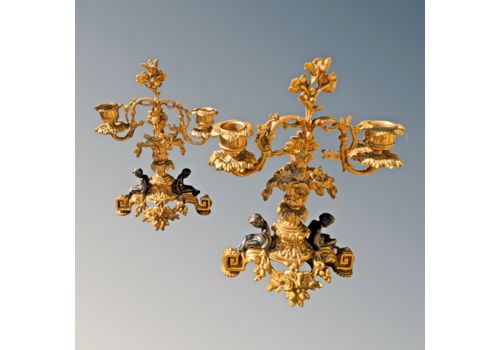
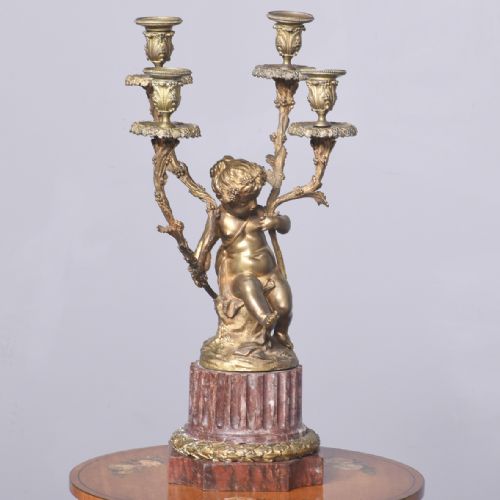
The objects take the form of multi-light candelabra and candlesticks, frequently utilising bronze, ormolu, and marble bases. Many examples incorporate figural elements such as cherubs or classical motifs, reflecting the ornate tastes of the nineteenth century.
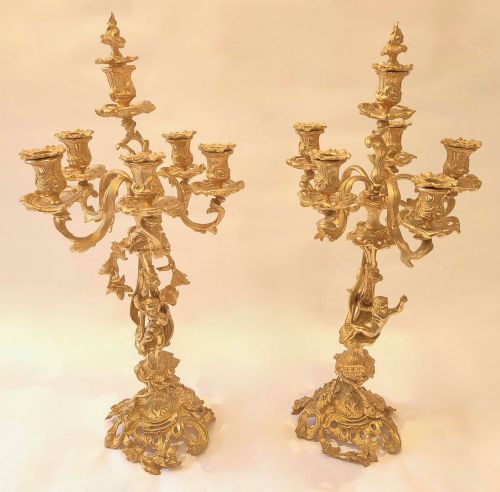
The most common version met on this page is a pair of nineteenth-century gilt bronze or ormolu candelabra, sometimes mounted on marble or slate bases. These pieces capture the formal, decorative character favoured by period makers.
Materials and Technique
The construction relies heavily on bronze, cast and then finished with fire gilding to create the bright ormolu surface, or patinated to a darker tone. Craftsmen combined these metallic elements with natural stone bases made from marble, onyx, or slate.
Makers employed skilled casting and chiselling techniques to achieve sharp detail in the foliage, figures, and classical ornamentation characteristic of the style. Gilding and patination were applied by hand, giving each pair its distinct surface texture and light-reflecting quality.
Cherubs frequently appear perched among the candle arms, reminding us that even the strictest nineteenth-century empire interior had room for a little winged mischief.
Judging Quality
Quality rests on the crispness of the bronze chasing and the depth of the gilding, where superior examples show sharp, deliberate detail in every leaf and facial feature rather than softened edges from worn moulds. The choice and preparation of the supporting stone base also mark the difference between standard and exceptional work.
Proportion and weight distinguish the finer pieces, as higher-grade candelabra feel substantial and maintain balanced symmetry across all arms and candle nozzles. The integration of patinated bronze with bright ormolu requires precise fitting, which separates master workshops from volume production.
Pierre Philippe Thomire·Deniere
The French Empire Mantel Candelabra Glossary
- Ormolu
- Gilded bronze, produced by applying a mercury and gold amalgam to a bronze base and heating it until the mercury vaporised, leaving a durable golden layer.
- Patinated bronze
- Bronze treated with chemical solutions to darken the surface, creating contrast against the bright gilded ormolu details.
- Garniture
- A set of decorative objects designed to be displayed together on a mantelpiece, typically consisting of a central clock flanked by two candelabra or vases.
- Slate
- A fine-grained metamorphic rock used as a heavy, dark base material for nineteenth-century clocks and candelabra.
- Porphyry
- An igneous rock with large crystals, valued for its rich purple or reddish hue and used for decorative bases.
French Empire Mantel Candelabra: Frequently Asked Questions
How do I style french empire mantel candelabra?
Place them symmetrically on a mantelpiece, sideboard, or console table to create a formal focal point. They work well flanked by mirrors or paired with a matching clock garniture.
Keep the surrounding decor relatively uncluttered to let the gilded bronze and marble details stand out without competing for attention.
Were these always sold with clocks?
Not originally, though many survive today as part of complete clock garniture sets that include a central timepiece and two matching candelabra. Candelabra were also produced and sold as standalone pairs.
Over time, owners often grouped compatible pieces together on mantelpieces, creating unified sets from separate items of the same period.
How do I tell an 1815 piece from an 1880 revival?
Early nineteenth-century pieces from the Empire period tend to feature strict neoclassical geometry, military motifs, and precise, heavy-gauge bronze casting. Later Victorian revivals often introduce softer rococo curves, varied stone bases like onyx, and slightly more ornate secondary detailing.
Examining the construction of the screw threads, bronze thickness, and the style of the marble or slate base helps clarify the exact period of manufacture.