
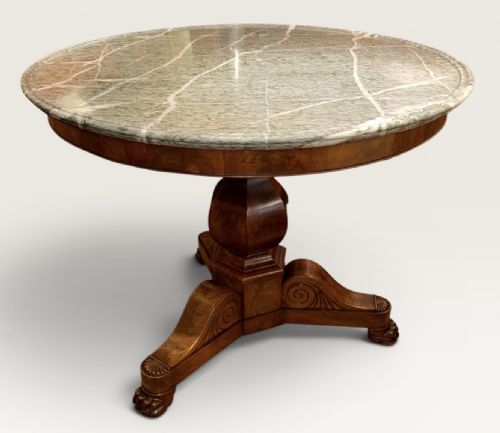


French Empire Hall Table
A french empire hall table brings architectural grandeur to an interior through rich mahogany, cool marble, and gleaming ormolu mounts.
French Empire Hall Table
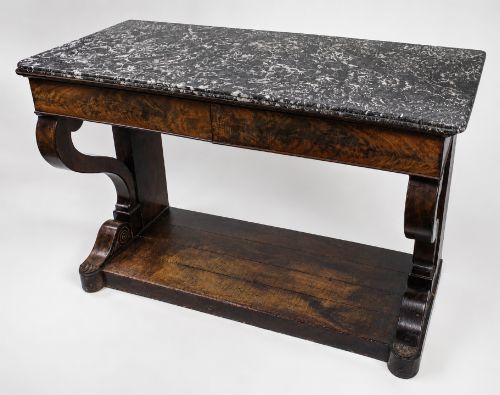
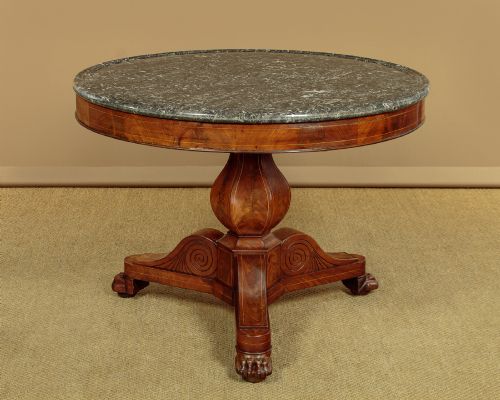
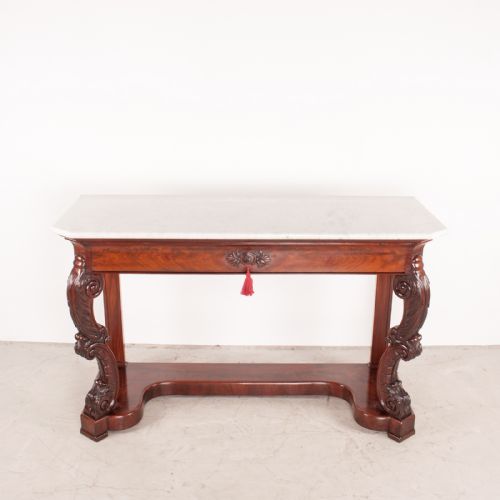
A french empire hall table encompasses console tables, pier tables, and gueridon centre tables originating primarily across the nineteenth century. Buyers seek these pieces for their formal symmetry and imposing presence in entrance halls and reception rooms.
The pieces appearing on this page span the foundational empire period through to later nineteenth-century revivals and charles x variations. Mahogany and walnut form the structural backbone of these tables, frequently paired with heavy stone surfaces.
Console tables designed for placement against walls dominate the selection, often accompanied by round gueridon tables intended for central placement in a room. These forms carry the distinct vocabulary of classical revivalism popular throughout nineteenth-century france.
Materials and Construction
Cabinetmakers utilised dense timbers including flame mahogany, walnut, burr birch, and rosewood to construct the heavy carcasses of these tables. Timber veneers were carefully selected and matched to create striking symmetrical grain patterns across large flat surfaces.
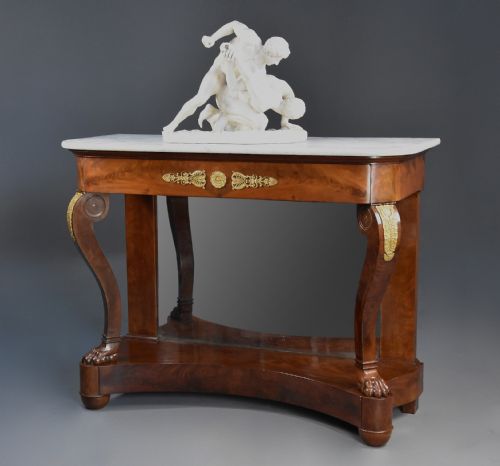
Heavy marble slabs, ranging from white carrara to fossil and porphyry varieties, form the operational tops designed to withstand daily use. Cast ormolu, gilt bronze, and brass mounts provide structural highlights and classical decorative contrast against the dark timber bases.
Listings feature mahogany, walnut, and rosewood timbers combined with carrara, fossil, and porphyry marble tops across nineteenth-century french periods.
Evaluating Craftsmanship
Quality in a french empire hall table rests upon the crispness of the cast metal mounts and the depth of the timber grain. Finer examples display hand-chased ormolu details that integrate seamlessly with the structural woodwork rather than appearing as simple applied decoration.
The weight and selection of the marble top also dictate the tier of a piece, with thick slabs of figured or coloured stone marking superior production. Joinery standard within the carcase determines long-term stability under the heavy downward pressure of these stone surfaces.
Jean Joseph Chapuis
The French Empire Hall Table Glossary
- Gueridon
- A small round table designed to stand in the centre of a room, typically supported by a central pillar or pedestal base. These tables frequently feature inset marble tops.
- Ormolu
- Gilded bronze used for decorative mounts and furniture fittings during the eighteenth and nineteenth centuries. The technique involves applying a finely ground mercury and gold amalgam to cast bronze.
- Console table
- A table designed to stand against a wall, historically supported by brackets or console legs rather than four standard vertical posts. They often serve as pier tables between windows.
- Carrara marble
- A type of white or blue-grey marble quarried in the city of Carrara in the north of tuscany. It appears commonly on the tops of nineteenth-century french tables.
- Restauration period
- A phase in french decorative arts spanning the reigns of louis xviii and charles x, bridging the strict empire style and later Victorian revivals.
French Empire Hall Table: Frequently Asked Questions
Where should I place a french empire hall table?
These tables find their traditional home in entrance halls or grand reception rooms where their linear forms can anchor a blank wall. Console and pier variants sit flush against vertical surfaces, making them suitable for narrow circulation spaces.
Centre tables and gueridons require open floor space to allow movement around the circular top. Pairing them with a central lighting fixture enhances their original function as focal points within a room.
How do I care for the marble top?
Stone surfaces require regular dusting with a soft, dry cloth to prevent grit accumulation. Avoid acidic cleaning agents, vinegar, or citrus solutions, which will etch the polished surface of softer marbles.
Spills should be blotted immediately rather than wiped to prevent staining, particularly on porous stones like carrara or fossil varieties. Periodic application of neutral stone soap helps maintain the original sheen.
How do I identify a charles x period table?
Charles x pieces typically display lighter blonde timbers such as birch or lighter cuts of mahogany, moving away from the darker, more austere military aesthetic of early empire furniture. The decorative carving often incorporates softer floral or architectural motifs.
Pedestals on gueridons from this era frequently feature triangular or platform bases resting on paw feet. Construction methods transition during this period towards machine-assisted cutting while retaining hand-finished details.