


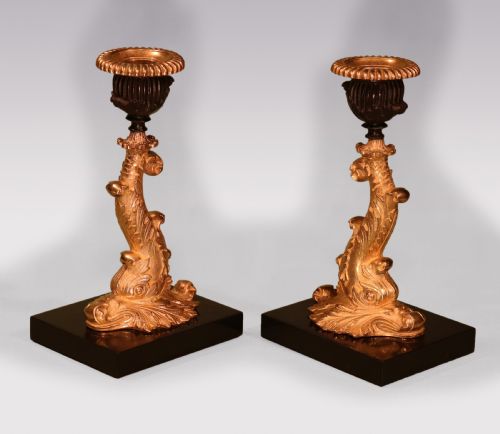

French Bronze Candle Bases
French bronze candle bases offer heavy casting and classical modelling, bringing formal mantelpiece dignity and warm light to a room.
French Bronze Candle Bases
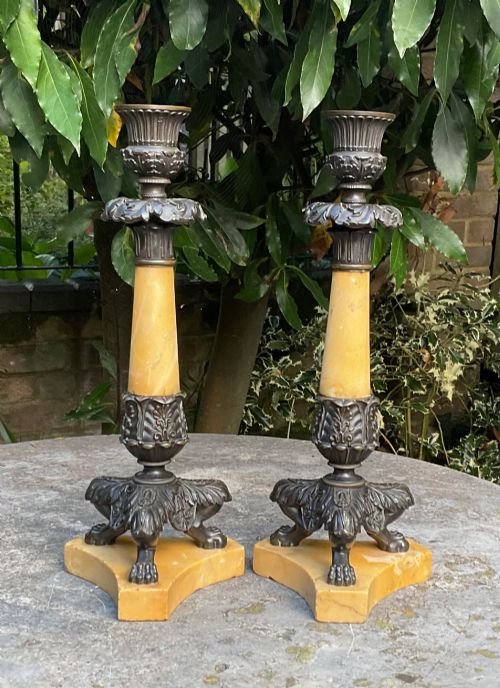
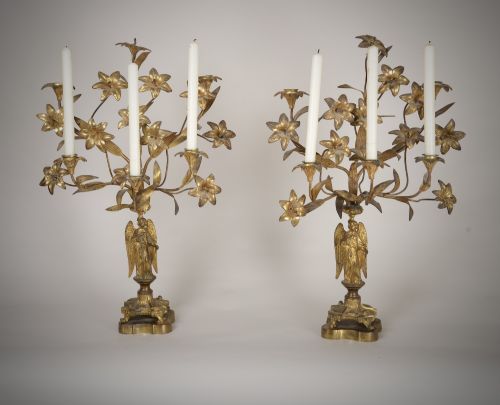
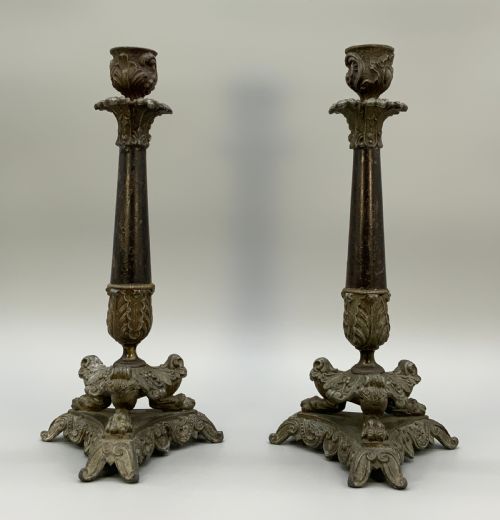
French bronze candle bases take the form of candlesticks, candelabra, and table lights across nineteenth century periods. These pieces range from Regency designs and Louis XVI style works to Gothic revival and French Empire forms.
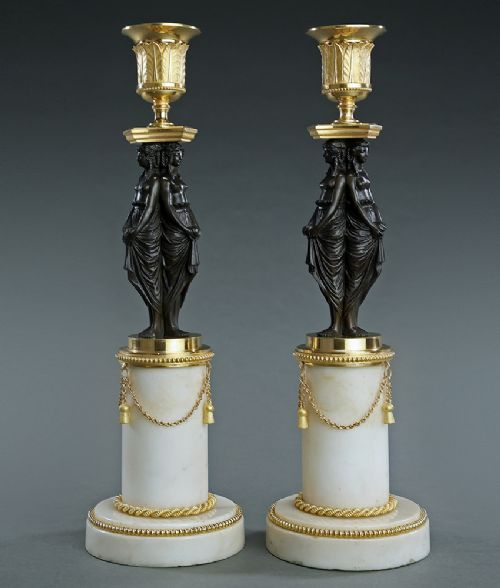
Most examples appear as matched pairs featuring patinated bronze or gilt bronze mounted upon marble, onyx, or porphyry plinths. Sculptural figures such as putti, cherubs, and caryatids frequently support the candle sockets.
Grand Tour pieces and Greco Roman designs sit alongside heavy gilded ormolu arrangements. Buyers select these items for their decorative presence on sideboards and tables.
Materials and construction
Foundry workers cast bronze and brass components before applying patination or mercury gilding to create ormolu finishes. Cast metal often combines with carved white marble or onyx plinths to give the pieces structural weight.
Chasing and hand finishing define the metal surface work, sharpening the details on figures and acanthus leaf mounts. Ormolu elements contrast against dark patinated bronze sections to highlight the neoclassical or rococo revival motifs.
Listings feature nineteenth century periods including Regency, 1800, 1860, 1870, 1880, and 1890 alongside Louis XVI styles.
Judging quality in bronze candle bases
The integration between metal mounts and stone bases indicates workshop standards. Heavy marble or porphyry plinths fitted flush with finely pinned bronze mounts separate the finer nineteenth century productions from simpler commercial castings.
Claude Clodion·Thomas Hope·Dugourc
The French Bronze Candle Bases Glossary
- Ormolu
- Gilt bronze produced by applying a mercury and gold amalgam to a bronze object before firing. This technique creates a durable, rich golden surface typical of luxury French lighting.
- Patinated bronze
- Bronze treated with chemical solutions to darken or colour the surface. It provides a dark contrast against bright ormolu mountings.
- Candelabra
- A branched candlestick holding multiple lights. These branch arrangements often feature removable socket sections.
- Caryatid
- A sculpted female figure serving as an architectural support. They appear regularly on neoclassical candle stems.
- Porphyry
- A hard igneous rock with purple or red crystals. It serves as a dense, decorative plinth material for grander pieces.
French Bronze Candle Bases: Frequently Asked Questions
How do I clean gilt bronze?
Dust surfaces gently with a soft dry brush to prevent dirt accumulation in recessed chased areas.
Avoid abrasive polishes or chemical cleaners that strip the original mercury gilding from the bronze.
Are these bases wired for electricity?
Some pieces adapt to table lamps while others retain their original candle sockets.
Conversion methods vary between listings, so check whether wiring runs internally through the bronze stem.
What is the difference between ormolu and brass?
Ormolu consists of a gold layer amalgamated onto a bronze substrate by fire gilding. Brass is a copper and zinc alloy showing uniform yellow metal throughout.
Nineteenth century French workshops reserved ormolu for high status decorative mounts.
How do I date a nineteenth century bronze?
Examine the casting method, wear patterns on the base, and stylistic revival cues. Regency and Empire pieces show different decorative syntax compared to late century Louis XVI style work.
Marble plinth thickness and assembly screws also offer clues to the manufacturing decade.