
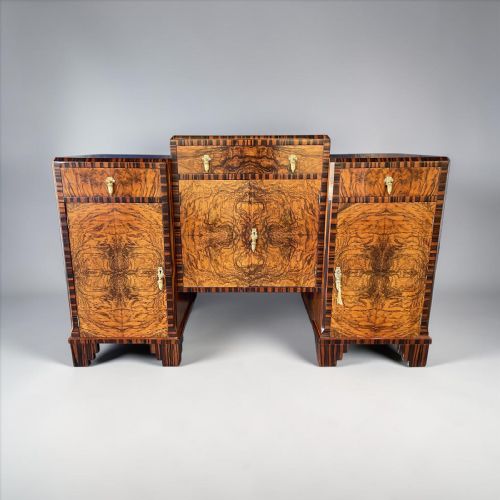
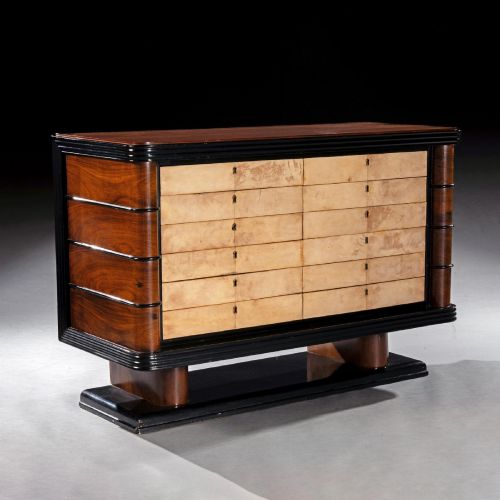
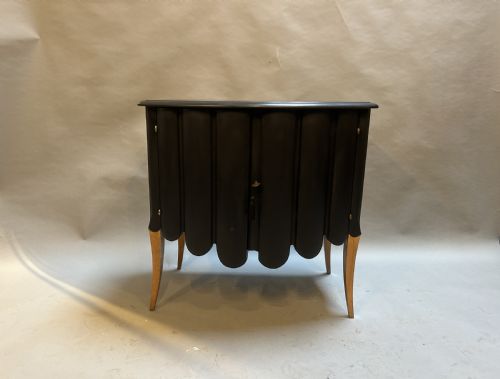


French Art Deco Sideboard
A french art deco sideboard brings bold geometric lines and rich timber into a dining room, combining practical storage with striking modernist design.
What these pieces are
When you search for a french art deco sideboard, you encounter substantial storage furniture designed during the interwar and mid-century periods. These items encompass sideboards, side cabinets, enfilades, and buffets originating from France, dating principally from the nineteen-thirty and nineteen-forty decades.
The most common formats on this page are walnut and oak sideboards featuring the characteristic symmetry and linear emphasis of the art deco style. Many examples incorporate architectural proportions, serving as both functional servers and dominant decorative statements within a room.
Beyond standard sideboards, the category includes related forms such as marble top breakfront cabinets, side cabinets, and specialist items like mirrored plateau de buffet trays. These variations demonstrate the breadth of domestic furniture production during the height of the movement.
How they were made
Construction relies on a combination of solid timbers and decorative veneers, utilising walnut, oak, ebonised wood, and rosewood. Craftsmen often applied parquetry patterns to create complex geometric surfaces across the main body of the buffet.
Metal and stone components frequently complement the woodwork, incorporating brass, bronze mounts, and gilt bronze details alongside polished marble tops. Glass elements also appear, particularly in mirrored trays and specialised cabinet sections.
Retail Price Guide 2026
Typical UK retail prices for french art deco sideboard, calculated from the Sellingantiques database of over a million retail prices indexed since 2003. This retail price guide relies exclusively on Sellingantiques data; no external sources or auction records are used, so the figures do not describe the wider market.
Early dining protocols demanded mirrored trays atop the sideboard specifically to bounce candlelight across the evening roast.
What varies in quality
The distinction between standard production and exceptional work rests on the complexity of the timber selection and the integration of specialist materials. Pieces utilising intricate walnut parquetry or fine marble tops demonstrate a higher tier of workshop execution than simpler solid timber carcasses.
The sophistication of metal mounts, such as bronze or gilt bronze hardware by notable designers, elevates the stature of a sideboard. Furthermore, documented attributions to master makers distinguish the finest examples from anonymous workshop output.
Charles Dudouyt·Gaston Poisson·Jacques Adnet·Jules Leleu
The French Art Deco Sideboard Glossary
- Enfilade
- A long sideboard or buffet featuring a continuous line of doors or drawers, typically designed for dining rooms.
- Parquetry
- A geometric mosaic of wood pieces used for decorative veneering on furniture surfaces.
- Breakfront
- A piece of furniture where the central section projects forward from the side sections.
- Cerused oak
- Timber treated with a finishing technique that highlights the grain with a contrasting colour fill.
- Plateau de buffet
- A decorative mirrored tray designed to sit atop a sideboard for displaying glassware or silver.
Frequently Asked Questions
What rooms suit a french art deco sideboard?
These sideboards function primarily in dining rooms as serving surfaces and storage for tableware, linens, or glassware. Their strong architectural presence also allows them to anchor large living spaces or grand hallways.
The substantial proportions and decorative timber surfaces mean they command attention as standalone statement furniture. They pair well with both period modernist interiors and contemporary minimalist spaces seeking a strong focal point.
How do I care for walnut and oak surfaces?
Regular dusting with a soft, dry cloth protects the polished timber and veneer surfaces from abrasive particles. Avoid placing items with high moisture or heat directly onto the wood or marble tops without protective coasters.
Maintaining a stable indoor humidity prevents the natural timber and parquetry from warping or cracking over time. Periodic application of appropriate furniture wax preserves the lustre of walnut, oak, and ebonised finishes.
How do I distinguish nineteen-thirty pieces from nineteen-forty pieces?
Pieces from the nineteen-thirty period often exhibit the opulent materials and exuberant geometry typical of high art deco, including rosewood and elaborate parquetry. Items from nineteen-forty frequently reflect the more restrained, robust oak construction associated with designers like Charles Dudouyt.
Examining the structural framing and secondary timbers helps clarify the decade of production. Stylistic shifts from luxurious gloss finishes to matte, heavier oak forms mark the transition through these decades.
What is the function of a marble top sideboard?
The marble top provides a durable, heat-resistant surface historically utilised for resting hot serving dishes during meals. It also introduces a contrasting stone texture against the warm tones of walnut, oak, or ebonised wood.
In contemporary settings, this stone surface offers practical resilience for daily decorative display. It combines utility with the luxurious material palette characteristic of French modernist design.