
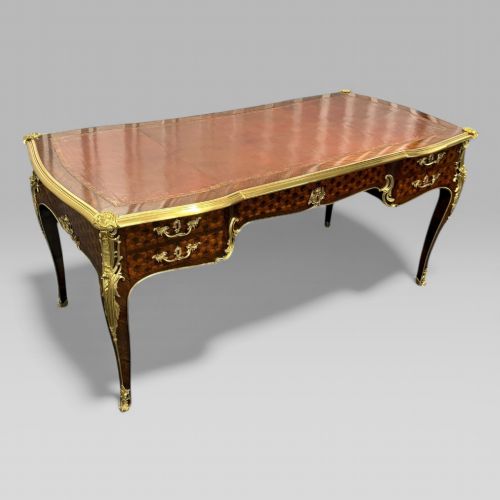
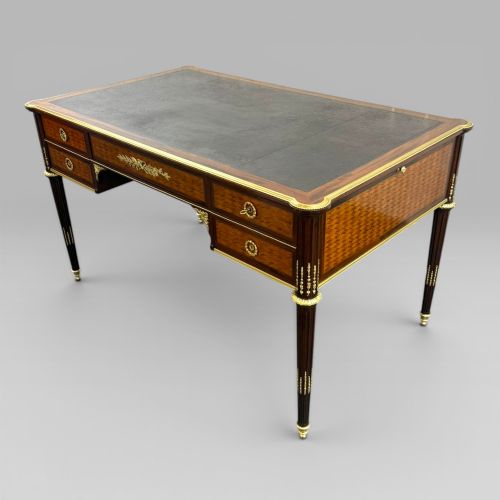


Francois Linke Desk
A francois linke desk brings grand French revival elegance to a study through exquisite ormolu mounts and fine timbers.
Francois Linke Desk
When you search for a francois linke desk, you are looking at sophisticated French cabinet-making from the nineteenth century, often drawing heavily on Louis XV and Louis XVI revival aesthetics. These pieces typically take the form of a bureau plat or centre table, designed to command a room with elaborate mounts and refined silhouettes.
You are most likely to meet nineteenth-century examples on this page, spanning styles from French Rococo revival to Louis XVI style. They combine practical writing surfaces with the decorative ambition characteristic of the period's master workshops and their followers.
Materials and construction
These desks and tables rely on a foundation of quality timbers such as kingwood, mahogany, rosewood, and satine, frequently arranged in geometric parquetry patterns. Artisans shaped these woods into graceful curves and clean lines, applying traditional joinery suited to high-status French furniture.
Gilt bronze and ormolu mounts define the visual impact of the pieces, framing drawers, corners, and legs with cast bronze ornamentation. Leather inserts often provide the practical writing surface atop the bureau plat forms.
Judging quality
The distinction between a standard nineteenth-century revival piece and the work of the master workshop lies in the crispness of the ormolu chasing and the precision of the parquetry inlay. Finer examples display deeply detailed bronze mounts that fit the timber contours seamlessly without gaps.
Selection of timber veneer grain and the fluidity of the overall silhouette separate authentic signed pieces or direct workshop output from later tributes or items made in the manner of the maker.
François Linke·Edwards and Roberts
The Francois Linke Desk Glossary
- Bureau plat
- A flat-topped freestanding writing table, usually featuring drawers in the frieze and standing on cabriole or tapered legs. This form is central to French nineteenth-century elite interior decoration.
- Ormolu
- Gilt bronze ornamentation applied to furniture, clocks, and lighting. The term derives from the French for ground gold, describing the mercury-gilding technique used on antique pieces.
- Parquetry
- Geometric patterns formed by fitting small pieces of veneer together on a surface. It showcases the maker's skill with contrasting timbers like kingwood, mahogany, and rosewood.
Francois Linke Desk: Frequently Asked Questions
What is a bureau plat?
A bureau plat is a freestanding writing desk with a flat top, commonly fitted with drawers along the frieze. It was designed to sit in the centre of a room rather than against a wall.
These desks feature finished backs and elaborate mounts so they look correct from every angle in a grand interior.
How do I style a french desk?
Pair the desk with a traditional leather-upholstered chair and position it where light from a window crosses the writing surface. Give the piece breathing room to showcase its ormolu mounts and parquetry.
Keep surrounding furniture balanced by choosing pieces from the same nineteenth-century revival period or complementary classical aesthetics.
What woods are used on these desks?
Makers utilised exotic and domestic hardwoods including kingwood, mahogany, rosewood, and satine. These timbers were selected for their grain patterns and suitability for detailed veneer work.
Parquetry arrangements combined these woods to create contrasting geometric patterns across the top and sides.
How can I tell the period?
Examine the timber preparation, the construction of the drawer linings, and the casting quality of the gilt bronze mounts. Nineteenth-century pieces often combine machine precision with hand-chased finishing.
Style markers like Louis XVI tapered legs or Louis XV curves give further clues to the specific revival aesthetic being followed.