


Framed River Valley Painting
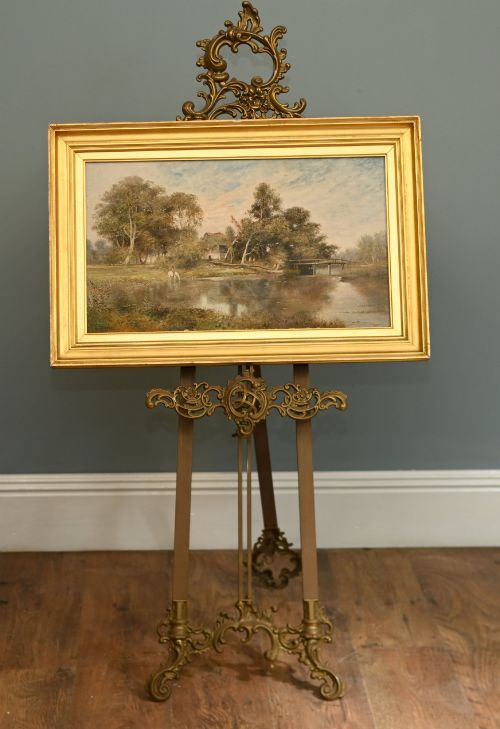
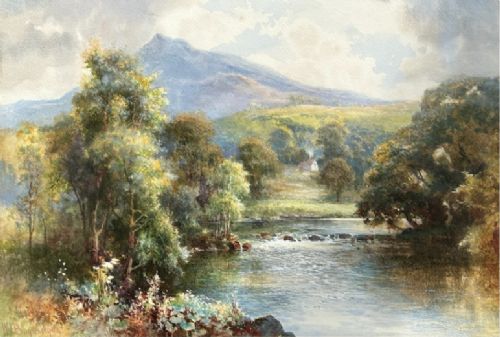
These framed river valley painting works capture natural waterways and pastoral scenery, offering collectors charming historical views.
Framed River Valley Painting
A framed river valley painting depicts natural waterways, pastoral settings, and rural scenery captured across various historical periods. The examples found on this page span the nineteenth century, the Victorian era, the Edwardian period, and the early twentieth century.
Buyers will encounter both oil paintings and watercolours on canvas, paper, or panel. These works range from Welsh and Scottish landscapes to scenes set along the Thames, French rivers, and Devon waterways.
The styles represented include Victorian Naturalism, the Scottish School, British Impressionism, and French Impressionism. Many of these pieces retain their original frames, often finished in gilt or gilt wood.
Materials and techniques
Artists working on these landscapes utilised oil paint or watercolour applied to canvas, paper, or wood panels. Many works were created plein air or finished in the studio using traditional brushwork techniques.
The supports vary from stretched canvas to heavy watercolour paper and wooden panels, framed in wood and gilt mouldings appropriate to their period.
Children fishing at dusk and geese on the river populate these historic valleys, proving that nineteenth-century artists also struggled with chatty wildlife.
Quality and execution
The distinction between standard works and finer pieces lies in the handling of light, atmospheric depth, and the precision of the brushwork. Master painters capture the specific topographical details of locations such as North Wales or the Scottish Highlands with greater nuance.
Condition and originality also influence the standing of a piece, particularly the survival of the original gilt wood frame and the stability of the canvas, panel, or watercolour paper.
William Joseph Boyes·William George Tennick·Clarence Henry Roe·William Mellor·George Melvin Rennie·Reginald Grange Brundrit·Edmond Defonte·Henry Sykes·Cornelius Pearson·Charles Branwhite
The Framed River Valley Painting Glossary
- Watercolour
- A painting method in which the paints are made of pigments suspended in a water-based solution. It is typically applied to paper surfaces.
- Gilt wood
- Wood that has been treated with a thin layer of gold leaf or gold paint. Frames of this material are common on nineteenth-century landscape works.
- Plein air
- A French expression which means painting outdoors. This technique allows artists to observe direct effects of light on landscape scenery.
- Canvas
- A heavy woven fabric used as a surface for oil paintings. It is typically stretched over a wooden frame before painting.
Framed River Valley Painting: Frequently Asked Questions
What periods do these paintings come from?
The works originate from the nineteenth century, the Victorian and Edwardian eras, and the early twentieth century up to the 1930s. They reflect artistic styles ranging from Victorian Naturalism to early twentieth-century impressionism.
Collectors can identify the period through a combination of the framing materials, the type of canvas or paper used, and the specific signature or style of the artist.
Are these works signed by the artists?
Many of the landscape paintings feature signatures or attributions to recognised nineteenth and early twentieth-century artists. Documentation often includes specific geographical locations within the titles.
Signatures can appear in the corners of the canvas or watercolour paper, sometimes accompanied by dates or inscriptions detailing the Welsh, Scottish, or English scenes depicted.
What mediums were used for these river scenes?
Artists utilised both oil paint and watercolour to render these valley landscapes. Supports include stretched canvas, heavy paper, and wooden panels.
Oil paintings often feature rich textures on canvas or panel, whilst watercolours display delicate washes on paper, typically preserved behind glass within their original frames.
How should I display a framed painting?
These framed works suit traditional wall art displays in residential interiors. They should be hung away from direct sunlight and excessive moisture to protect the canvas, paper, and gilt wood frames.
Maintaining a stable room temperature helps preserve both the paint layers and the antique wooden framing materials over time.