



Framed Renaissance Revival Portrait
A framed renaissance revival portrait brings nineteenth-century interpretations of sixteenth-century masters into domestic spaces.
Framed Renaissance Revival Portrait
A framed renaissance revival portrait draws upon earlier sixteenth-century visual traditions, reimagined primarily during the nineteenth century and Victorian periods. Buyers search for these pieces to introduce classical depth, historical weight, and rich portraiture into interior spaces.
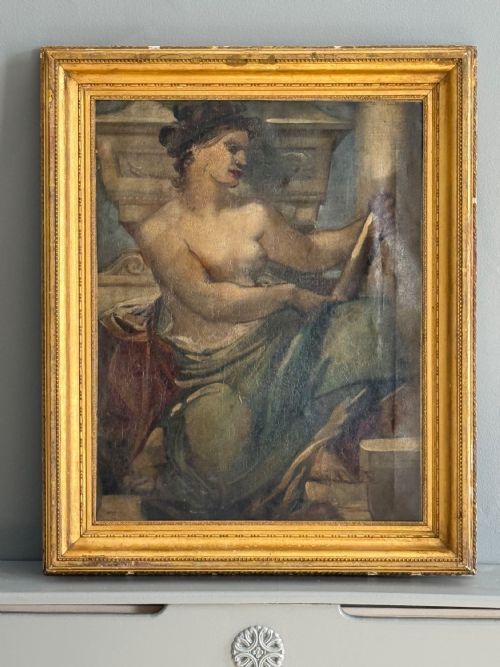
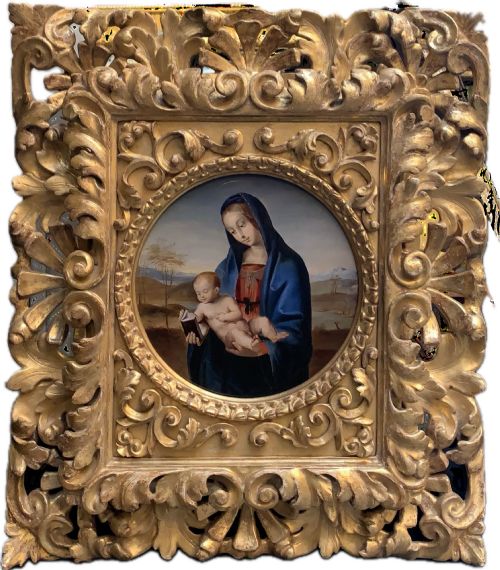
The selections on this page encompass various mediums, including oil paintings on canvas, enamel work on copper, porcelain plaques, and detailed drawings. Many compositions directly reference masterworks by Raphael or Holbein, executed through nineteenth-century revivals of Italian and Northern Renaissance styles.
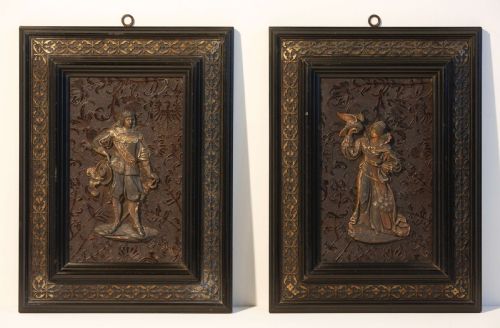
Forms vary from large oil canvases to oval porcelain plaques housed in ornate ormolu frames, alongside carved walnut wall mirrors incorporating classical figures. Each piece reflects the nineteenth-century fascination with historical artistic tropes, adapted for domestic display.
Materials and construction
Works in this category rely heavily on traditional supports such as wood panels, stretched canvas, and copper plates. Artists applied oil paints or fired enamels to achieve the rich tonal gradations characteristic of the revival aesthetic.
Frames are integral to the presentation, utilising giltwood, gilded timber, walnut, and ormolu. Metal elements such as white metal and gilded bronze relief plaques further demonstrate the varied craftsmanship employed to house these portraits.
One portrait captures a Renaissance lord with such stern conviction he might well disapprove of your modern television setup.
Factors of quality
Quality rests upon the fidelity of the execution and the depth of the painting technique, separating routine decorative copies from works with genuine artistic presence. The handling of light, shadow, and facial expression dictates how successfully a piece channels its sixteenth-century inspiration.
The standard of the framing significantly influences the overall merit of the piece. Heavy carved walnut, fire-gilded ormolu, and well-preserved giltwood enhance the visual authority of the portrait within.
The Framed Renaissance Revival Portrait Glossary
- Renaissance Revival
- An artistic movement spanning the nineteenth century that revived the forms, ornaments, and painting styles of the fifteenth and sixteenth centuries. It heavily influenced architecture, furniture, and decorative arts.
- Ormolu
- Finely ground high-carat gold applied to a bronze base, commonly utilised for decorative furniture mounts and elaborate picture frames during the nineteenth century. It provides a bright, durable metallic finish.
- Enamel Painting
- A technique where powdered glass is fused to a metal substrate, such as copper, through high-temperature firing. This process produces durable coloured surfaces with a glossy sheen.
- Giltwood
- Wood that has been treated with a thin layer of gold leaf or gold powder. It appears frequently on nineteenth-century frames designed to catch and reflect ambient light.
Framed Renaissance Revival Portrait: Frequently Asked Questions
What periods do these portraits date from?
The majority of pieces date from the nineteenth century, reflecting Victorian revivals of earlier sixteenth-century aesthetics. Some items incorporate direct stylistic nods to earlier Renaissance periods or later twentieth-century interpretations.
Dates range across the Victorian era, with specific pieces linked to decades such as the eighteen-forties and eighteen-eighties. The overarching style remains firmly rooted in nineteenth-century historicism.
Are these original sixteenth-century artworks?
Most works are nineteenth-century interpretations or copies executed after earlier masters like Raphael and Hans Holbein. They represent the period's intense interest in historic artistic traditions rather than original Renaissance production.
While occasionally referencing sixteenth-century figures or compositions, the physical materials and execution methods point directly to nineteenth-century workshop practices.
What framing materials are common?
Frames frequently utilise carved walnut, giltwood, gilded timber, and ormolu mounts. These materials were chosen to complement the historical gravity of the portraits.
Ornate framing is a defining characteristic of the style, often featuring classical motifs that mirror the artwork contained within.
How do these pieces function in modern interiors?
These portraits serve as striking focal points for wall display, working well within traditional or eclectic domestic schemes. Their rich frames and classical subjects add immediate texture and historical narrative to a room.
Due to the variety of formats, including wall art, porcelain plaques, and oil paintings, they adapt easily to different scales of wall space.