
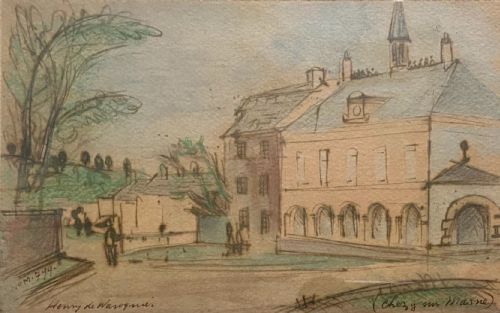


Framed Architectural Watercolour Drawing
A framed architectural watercolour drawing brings historical buildings and classical facades directly to the wall with crisp detail and delicate wash.
Framed Architectural Watercolour Drawing
A framed architectural watercolour drawing captures building elevations, townscapes, and classical ruins through careful ink work and translucent pigment on paper. These works range from grand continental vistas and English market crosses to specific historic structures like cathedrals and country houses.
Most examples encountered here span the nineteenth and twentieth centuries, executed by named artists, British school painters, or travellers on the Grand Tour. The framing typically incorporates wood, glass, and sometimes giltwood to protect the delicate works on paper.
Buyers seek these pieces to add academic rigour, historic depth, and precise draughtsmanship to an interior scheme. They record vanished streetscapes and celebrated monuments with an immediacy that prints alone rarely achieve.
Materials and technique
Artists built these compositions upon paper supports, laying down initial guidelines in pencil and ink to establish precise perspective before applying washes of watercolour. Crayon and mixed media occasionally supplement the pigment to add texture and shadow to stonework and foliage.
The finished works find protection beneath glass within wooden and giltwood frames. This traditional mounting preserves the fragile paper and water-soluble pigments from atmospheric moisture and handling.
Several drawings capture precise details of historic Dutch and British architecture, preserving long-gone street corners and civic market crosses in delicate wash.
Assessing quality
Quality rests upon the sureness of the initial draughtsmanship and the precision with which perspective is handled. Works that capture fine masonry details and spatial depth without stiffness stand apart from ordinary topographical sketches.
The clarity of the ink and the preservation of the watercolour washes dictate the visual impact of the piece. Strong provenance, whether through a recorded artist or a documented subject like a known cathedral or historic hall, elevates the standing of the work.
Henry de Waroquier·Stanley Orchart·J W Hogley·Pio Panfili·Fred Lawson·George De Paris·Margaret Thompson
The Framed Architectural Watercolour Drawing Glossary
- Grand Tour
- A cultural journey through Europe undertaken by wealthy young men in the eighteenth and nineteenth centuries, often resulting in commissioned watercolours of classical ruins.
- Wash
- A thin, translucent layer of watercolour pigment spread evenly across paper to create skies, shadows, or stone surfaces.
- Monochrome
- A drawing executed in a single colour, frequently black or brown ink, often enhanced with subtle grey or sepia washes.
- Elevation
- An architectural drawing that shows the exterior facade of a building flatly and to scale, rather than in perspective.
Framed Architectural Watercolour Drawing: Frequently Asked Questions
How do I hang these safely?
Keep watercolours away from direct sunlight to prevent the pigments from fading over time. Ensure the room has stable humidity levels to protect both the paper and the wooden frame.
Use secure picture hooks suited to the weight of the frame and glass. Hang them at eye level where the fine ink lines and washes can be examined closely.
How are periods identified?
Dates often rely on artist biographies, inscriptions on the reverse, or stylistic clues within the clothing and architecture depicted. Eighteenth-century neoclassical works differ visibly from mid-twentieth-century townscapes.
Framing materials and backing papers also provide helpful chronological indicators. Original framing often stays with the watercolour from its creation.
Are these original works?
The selection consists primarily of unique hand-drawn and painted works on paper. Artists used ink, pencil, and watercolour directly on the sheet rather than producing mechanical reproductions.
Some related prints appear in the records, but the core focus remains on bespoke painted architectural studies. Each hand-painted sheet possesses distinct brushwork and individual character.
What subjects are common?
Common subjects include Gothic cathedrals, continental street scenes, classical ruins from the Grand Tour, and English country houses. Artists recorded both famous civic monuments and vernacular town architecture.
These pieces reflect the personal travels or professional interests of the artists who rendered them. They serve as historical records of buildings as they appeared in the nineteenth and twentieth centuries.