


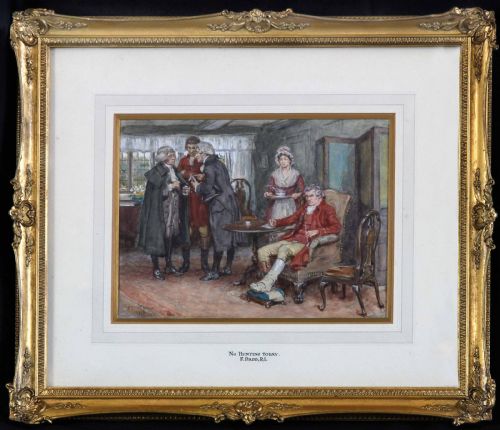
Fox Hunting Watercolour
A fox hunting watercolour captures the thunder of hooves and the flash of scarlet across the countryside, bringing the tradition of the chase directly to your walls.
Fox Hunting Watercolour
A fox hunting watercolour represents a distinct branch of British sporting art, capturing hounds in full cry, mounted riders taking fences, and sweeping rural landscapes. You will encounter works rendered on paper, ranging from intimate monochrome studies to vibrant multi-figure compositions.
The pieces available span from the Victorian period through the Edwardian era into the early twentieth century, alongside mid-century interpretations. Framed artwork forms the primary offering here, preserved behind glass in wood and gilt mounts.
Subject matter varies from quiet moments at covert side to the frantic energy of the full chase, signed by notable sporting artists or presented through traditional British sporting styles.
Materials and Technique
Artists executed these works primarily using watercolour pigment and gouache on paper, sometimes combining pencil with transparent washes to map out horses, hounds, and riders before applying colour. Some examples utilise aquatint prints as a base, hand-finished in watercolours to achieve depth and detail.
Framing materials reflect the period of production, featuring timber mouldings such as oak alongside gilt accents designed to complement the palette of the painting.
Listings feature works spanning the Victorian period, Edwardian era, and the early twentieth century, executed on paper and framed under glass.
Quality and Execution
Quality in these watercolours rests upon the artist's command of anatomy and movement, particularly the depiction of horses in stride and hounds working the line. Superior works convey the speed and atmosphere of the field with fluid brushwork, whereas lesser examples rely on stiff figures and static compositions.
The handling of light and background landscape further separates accomplished practitioners from jobbing illustrators, with the best pieces integrating riders and terrain into a unified narrative.
Basil Nightingale·Charles Clifford Turner·John Sanderson Wells·Charles Johnson Payne Snaffles·Thomas Ivester Lloyd·William J Hodgson·Frank Dadd·Henry Alken·C Cantelo·Charles Hunt·E B Herberte
The Fox Hunting Watercolour Glossary
- Full Cry
- The point in the hunt when hounds have found the fox and chase it with unified voices. This moment is the most frequently depicted subject in sporting art.
- Gouache
- An opaque watercolour paint containing pigment mixed with a binding agent and white filler. It provides solid blocks of colour and highlights against translucent washes.
- Aquatint
- A printmaking technique that produces tonal areas resembling watercolour washes. These prints were frequently hand-finished with actual watercolours to add individual colour.
- Sporting Art
- A genre dedicated to the depiction of field sports, horses, and hounds. It forms a cornerstone of British visual culture from the eighteenth century onward.
Fox Hunting Watercolour: Frequently Asked Questions
How do I date a fox hunting watercolour?
Dating relies on signatures, artist lifespans, and stylistic markers such as costume and framing materials. Victorian and Edwardian works often display specific clothing and mounting techniques characteristic of their decade of production.
Paper stock and handwriting on the reverse can provide further clues, though many pieces carry explicit dates or artist signatures that simplify attribution.
Are these paintings original works?
The selection includes both original hand-painted watercolours and period aquatint prints that have been hand-finished with watercolour pigments. Individual listings specify whether a work is an original painting or a finished print.
Close inspection under glass often reveals brushstrokes and paper texture that distinguish unique watercolours from printed editions.
How should I frame and hang them?
These watercolours require protection from direct sunlight to prevent the pigments and paper from fading over time. Conservation framing with acid-free mounts helps preserve the integrity of the paper.
Hanging them away from moisture and heat sources ensures the wood frames and glass-fronted artworks remain stable for decades.
What subjects besides the chase appear?
Artists frequently recorded preparatory scenes such as meets at country houses, portraiture of individual riders, and quiet landscape studies of the countryside. Some compositions focus on the hounds alone or genre scenes related to rural life.
These varied subjects offer a broader view of rural traditions beyond the high drama of the gallop.