


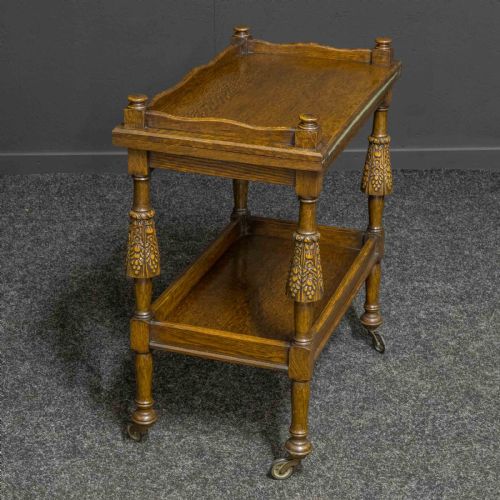
Folding Tier Side Table
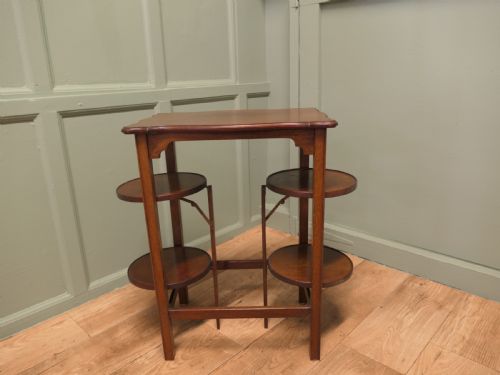
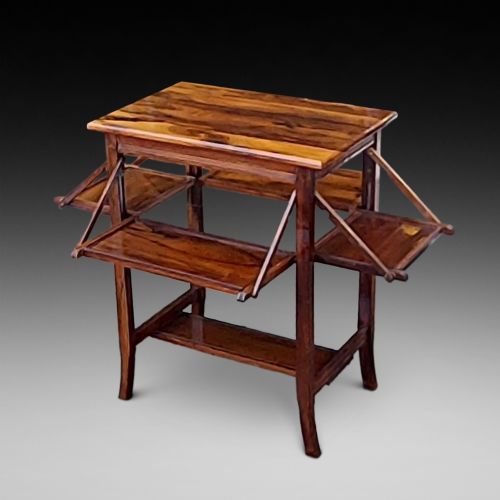
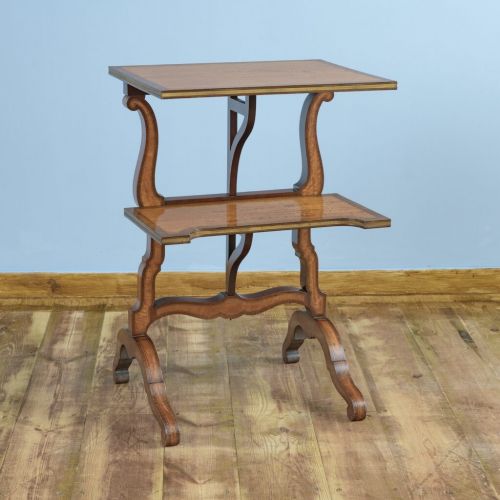
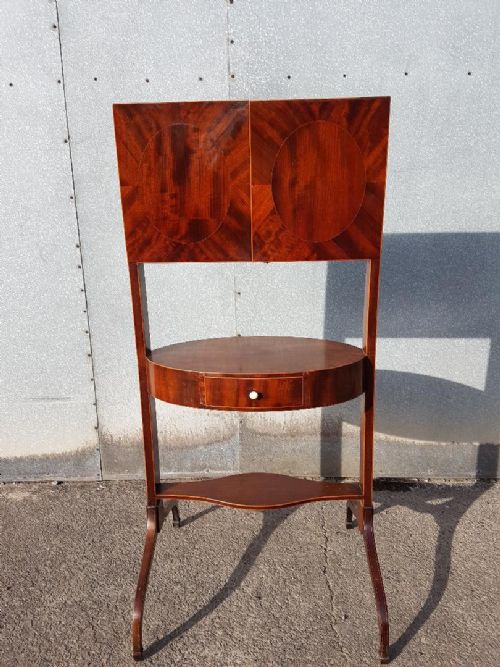
These folding tier side table examples offer clever multi-level surfaces that collapse for compact storage.
Folding Tier Side Table
A folding tier side table brings together multi-level surfaces and space-saving mechanisms in forms ranging from Georgian dumb waiters to Edwardian tea tables. Buyers search for these pieces when they need versatile furniture that alters its footprint to suit the room.
The selections on this page span several centuries, with George III period circular designs and Victorian Sutherland tables appearing most frequently alongside Edwardian campaign pieces and Art Deco metamorphic variants. These utilitarian items served dining rooms and drawing rooms alike, functioning as serving stands, tea tables, or occasional surfaces.
Makers such as Whytock and Reid of Edinburgh and Morison of Edinburgh contributed refined iterations in mahogany and walnut, while attributed pieces like the satinwood folding tea table associated with Maison Giroux show finer cabinet-making. Common forms include two-tier and three-tier drop-leaf servers and foldover card tables.
Materials and construction
Mahogany, walnut, and satinwood dominate the construction, often enhanced by boxwood inlay and supported by brass hardware on campaign-style or metamorphic hinges. Cabinet-makers selected these dense timbers to withstand the regular movement of folding leaves, tier rotations, and drop-leaf actions without losing structural integrity.
Joinery techniques focus on mobility, incorporating drop leaves, folding shelves, and pivoting tiers that collapse flat or swing inward. Turning, edge-banding, and veneering provide decorative finish to the functional skeletons of dumb waiters and tea trolleys.
Some tables folded flat so thoroughly they could hide behind a grandfather clock during quiet afternoons.
Assessment of quality
Quality rests in the precision of the folding mechanism and the rigidity of the tiers when locked into position. Superior examples operate smoothly without wobble at the joints, whereas lesser pieces show wear in the pivot points and hinges from decades of frequent reconfiguration.
The selection of timber grain and the crispness of boxwood inlay distinguish standard production pieces from workshop-attributed items. Richly figured mahogany and well-matched walnut veneers elevate a standard tea table into a sophisticated interior furnishing.
Maison Giroux·Whytock and Reid of Edinburgh·Morison of Edinburgh
The Folding Tier Side Table Glossary
- Dumb Waiter
- A tiered serving stand designed to hold food or tableware without the need for a servant present. These pieces often feature pivoting or folding tiers that collapse when not in use.
- Metamorphic
- Furniture that transforms from one type of object into another, such as a card table converting into a larger surface or a tea trolley shifting form.
- Sutherland Table
- A narrow drop-leaf table with exceptionally wide leaves and slender folding legs. When collapsed, the piece takes up minimal floor space against a wall.
- Drop-Leaf
- A table top configuration featuring a fixed central section and hinged flaps that raise and lower on pivoting brackets or swing legs.
- Boxwood Inlay
- Contrasting light-coloured wood inserted into recesses in a darker timber surface to create linear or geometric decorative patterns.
Folding Tier Side Table: Frequently Asked Questions
What is a folding tier side table used for?
These pieces served historical households as auxiliary surfaces for tea, dining, or card games, providing extra table space when entertaining guests.
Today, owners utilise them in living areas and dining rooms as flexible side tables that fold down to save floor space when not required.
How do you operate a metamorphic table?
Metamorphic tables rely on hinged leaves, pivoting surfaces, or folding frames that lift and lock into alternative configurations by hand.
Moving the mechanisms requires gentle handling to guide the timber joints along their intended tracks without straining the brass fittings.
What timber was used most often?
Mahogany appears most frequently across Georgian and Victorian examples, prized for its durability and rich dark grain under polish.
Walnut and satinwood also feature prominently in later Victorian and Art Deco pieces, often paired with boxwood inlay for decorative contrast.
How can I tell a Georgian piece apart from an Edwardian one?
Georgian pieces generally showcase solid mahogany construction with simpler, functional lines built for serving food or holding tea wares.
Edwardian iterations often lean towards lighter satinwood or oak, incorporating broader decorative elements influenced by earlier revival styles.