
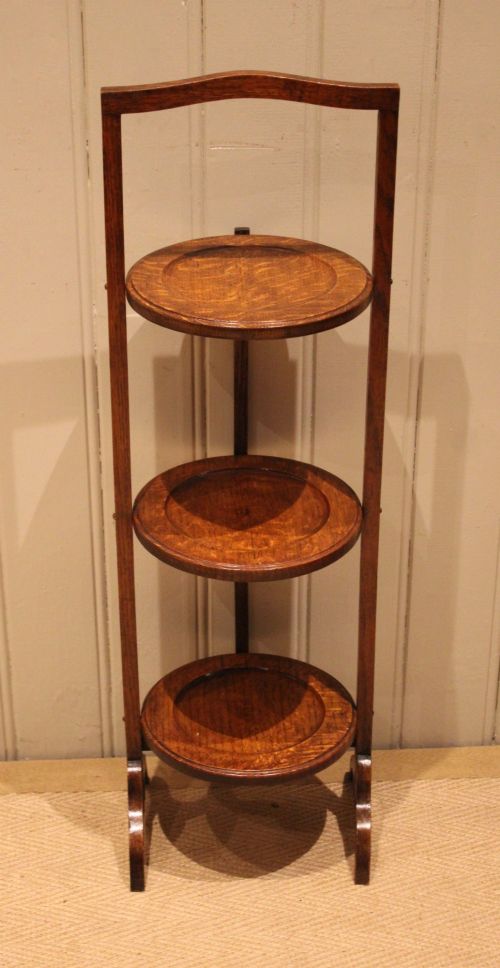
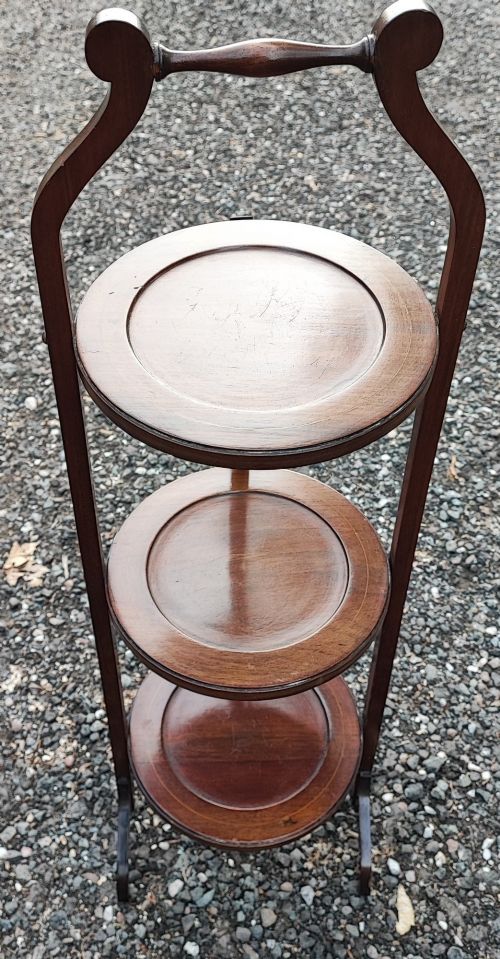


Folding Dumb Waiter
A folding dumb waiter offers tiered convenience for serving, collapsing neatly when the room needs its floor space back.
Folding Dumb Waiter
When you search for a folding dumb waiter, you are looking at practical tiered serving furniture designed to collapse or fold away when not in service. These items span periods from the eighteenth century through to the Edwardian era, taking the form of circular or octagonal drop-leaf tiers supported on folding frames.
The versions most commonly met on this page include Georgian and George III designs alongside Edwardian mahogany cake stands and tier tables. Such pieces function as serving stands, side tables, and occasional tables that accommodate afternoon tea or dinner service without cluttering the room.
How they were made
Cabinet makers constructed these folding pieces primarily in solid and veneered mahogany, occasionally utilising rosewood, oak, or satinwood for contrasting visual depth. Boxwood stringing and delicate inlay work frequently demarcate the edges of the tiers, adding refinement to utilitarian pieces.
Brass hinges and pivoting joints allow the shelves to drop or fold flat against the central support structure. Felt linings occasionally protect the folding surfaces where tiers meet during operation.
Materials appearing across the inventory include solid mahogany, rosewood, oak, boxwood inlay, and brass hardware.
What varies in quality
The distinction between standard production and superior craftsmanship lies in the crispness of the joinery and the ingenuity of the folding mechanism. A well-executed hinge operation remains firm and true, allowing shelves to drop smoothly without lateral wobble.
Timber selection and decorative detail also dictate worth, where figured mahogany grain and precise boxwood inlay elevate a functional serving stand into an accomplished example of period cabinet work.
Gillows
The Folding Dumb Waiter Glossary
- Drop-leaf
- A hinged table or shelf section that folds down to save space when the piece is not in use.
- Tiered table
- Furniture built with multiple stacked surfaces rising one above another to display items or serve food.
- Inlay
- Contrasting wood or material set flush into the surface of a piece to create decorative patterns.
- Sheraton Revival
- A late nineteenth and early twentieth century design movement that reinterpreted the light, classical furniture forms of the eighteenth century.
Folding Dumb Waiter: Frequently Asked Questions
How do I fold this dumb waiter?
Most folding designs rely on brass hinges or pivoting joints that permit the circular or octagonal shelves to drop vertically against the central column.
Lifting the retaining arms or releasing the support catches allows the tiers to fold flat for compact storage.
Are these pieces stable when open?
Period folding mechanisms incorporate sturdy struts and locking brackets to ensure the tiers remain level during service.
Properly adjusted brass fittings prevent the shelves from sagging under the weight of plates or tea sets.
What rooms suit a tiered stand?
These adaptable tables fit comfortably beside seating in a drawing room or function as auxiliary service stations in a dining space.
Their narrow footprint makes them particularly useful in corners where traditional side tables would block movement.
How do I date a Georgian piece?
Examination of the timber grain, hand-cut joinery, and the patination of the brass hardware reveals the eighteenth-century origins of a piece.
Georgian examples typically display heavier mahogany construction and simpler structural lines than later revival iterations.