


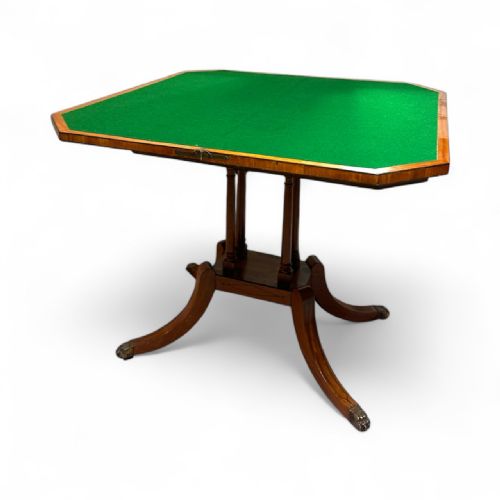


Fold Over Corner Table
These fold over corner table pieces are versatile antique furnishings designed to fit snug against a room junction while expanding for play or tea.
Fold Over Corner Table
A fold over corner table represents a clever domestic solution from past centuries, engineered to occupy unused room junctions while offering a larger surface when opened. Buyers searching for a fold over corner table typically encounter examples spanning the eighteenth and nineteenth centuries, taking the form of card tables, games tables, and tea tables.
The selection ranges from George II and George III mahogany designs to Regency satinwood and rosewood pieces, alongside Dutch marquetry and Victorian variants. These objects served the polite social rituals of their eras, functioning as compact ledges day-to-day before unfolding to accommodate card players or tea drinkers.
Makers across the Georgian, Regency, and Victorian periods adapted this specific footprint to various wood types and decorative schemes. Whether utilising Cuban mahogany or inlaid brass, each piece balances architectural placement with practical transformation.
How they were made
Cabinetmakers constructed these tables using solid woods and figured veneers such as mahogany, rosewood, satinwood, walnut, and fruitwood over secondary timbers. Surfaces often incorporated intricate decorative techniques like marquetry or brass inlay, while interiors frequently featured wool baize playing surfaces and carved counter wells.
The defining mechanism relies on pivoting or hinged top leaves supported by swing legs or concertina frames to bear the weight of the unfolded leaf. Joinery techniques from the eighteenth and nineteenth centuries ensured the hinged sections aligned flat and stable when opened for use.
Listings span the eighteenth and nineteenth centuries, encompassing George II, George III, Regency, and Victorian periods alongside Dutch Neoclassical styles.
What varies in quality
Quality reveals itself in the choice of timber and the precision of the veneer work, particularly on complex marquetry or contrasting satinwood and rosewood banding. Finer examples display superior figure in the mahogany and meticulous integration of brass inlay.
The execution of the folding mechanism and the stability of the support frame dictate the structural merit of the piece. Superior construction ensures the top sits completely flush in both closed and open positions without strain on the hinges.
The Fold Over Corner Table Glossary
- Baize
- A coarse woollen fabric, often green, used to line the playing surfaces of card and games tables. It provided a soft texture for handling cards and dampening sound.
- Marquetry
- The art of applying pieces of veneer to a structure to form decorative patterns and pictures. It frequently appeared on Dutch tables using various exotic woods.
- Cuban mahogany
- A dense, dark timber prized by eighteenth-century cabinetmakers for its rich grain and ability to take a sharp carved edge. It represents a hallmark of superior furniture from that era.
- Counter well
- A small recessed compartment carved into the interior of a games table to hold gaming counters or coins. These wells sit beneath the folding top.
- Concertina frame
- An expandable wooden framework that opens out to support the pivoting leaf of a card table. It provides balanced weight distribution compared to a single swing leg.
Fold Over Corner Table: Frequently Asked Questions
What is a fold over corner table used for?
These tables served primarily as space-saving furniture that fitted neatly into room corners while offering an expanded surface when needed. Owners unfolded the top leaf for card games, tea drinking, or general entertaining.
Once the social gathering concluded, the top folded back down and the table returned to its compact footprint against the wall. This dual functionality made them essential items in period parlours and drawing rooms.
How do I identify a Georgian fold over table?
Georgian examples, particularly from the George II and George III eras, typically feature dense mahogany timbers, restrained proportions, and classic carving details such as claw and ball feet or straight legs. The joinery employs period techniques and timber selections standard to the eighteenth century.
Later Regency variants often introduce contrasting satinwood and rosewood veneers alongside brass inlay. Examining the secondary timbers and the construction of the folding mechanism helps confirm the period.
Where should I place a corner table?
As the name suggests, these pieces are designed to anchor into the junction of two walls, making efficient use of awkward or dead space in a room. They sit comfortably in hallways, drawing rooms, or dining areas.
When positioned in a corner, they occupy minimal floor space while remaining accessible for opening when guests arrive. Their finished backs and sides allow them to integrate smoothly into period and modern interiors alike.
What woods were used in these tables?
Cabinetmakers utilised a range of native and imported timbers, with mahogany dominating eighteenth-century production. Cuban mahogany provided a particularly rich grain and heavy structure for tea and card tables.
By the Regency and Victorian periods, makers incorporated rosewood, satinwood, walnut, and fruitwood, often accented with boxwood stringing and brass inlay. Interior surfaces frequently featured wool baize to protect the wood during card games.