
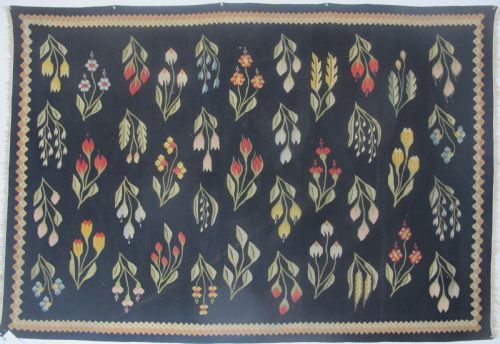
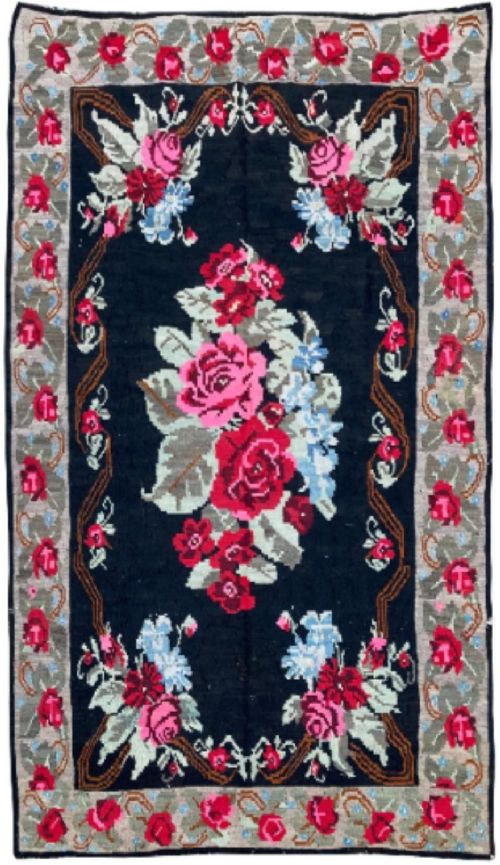
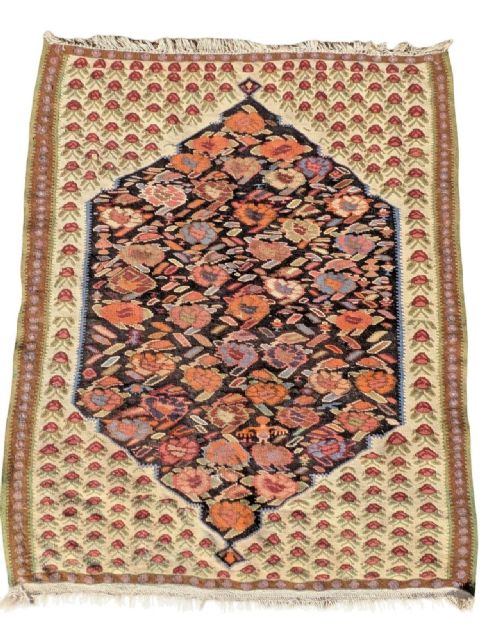


Floral Wool Kilim
These floral wool kilim pieces bring rich garden motifs and woven warmth into a room.
Floral Wool Kilim
A floral wool kilim represents a flat-woven textile tradition spanning Eastern Europe and Persia, shaped by folk art and regional rug-making practices. Buyers hunting for a floral wool kilim encounter flatweave carpets and tapestries designed with botanical patterns rather than geometric medallions.
The selections here run from Bessarabian and Moldovan traditions to Caucasian, Persian, and Balkan pieces. Bessarabian works dominate the selection, bringing dark grounds and naturalistic floral sprays into domestic spaces.
What Varies in Quality
The finesse of the floral drawing distinguishes standard examples from exceptional ones, with superior pieces showing subtle shading in petals and leaves. Tighter weave density secures the wool structure, ensuring the flat-woven surface retains its definition under footfall.
Preservation of original dye saturation and intact borders elevate a piece, while balanced composition marks the work of skilled regional weavers.
Several Bessarabian pieces secretly double as room-warming wall art.
The Floral Wool Kilim Glossary
- Kilim
- A flat-woven textile produced without a pile, traditionally used as a rug, carpet, or wall hanging. These pieces rely on warp and weft interlace.
- Bessarabian
- A regional style originating from historical Bessarabia, known for dark backgrounds paired with naturalistic floral bouquets.
- Flatweave
- A textile construction method where the weft threads are beaten tightly over the warp to create a smooth surface without vertical pile.
- Tapestry
- A form of textile art traditionally used for wall hanging, though applied here to flat-woven decorative floor and wall coverings.
Floral Wool Kilim: Frequently Asked Questions
Where do floral wool kilims originate?
These pieces originate primarily from Eastern European regions such as Bessarabia, Moldova, and the Balkans, alongside Persian weaving centres like Bidjar and Karabagh.
Each region infuses the floral wool kilim with local artistic traditions, resulting in distinct botanical arrangements and colour palettes.
How should I clean a kilim?
Gentle surface cleaning and professional textile washing preserve the wool fibres and natural dyes of these delicate flatweaves.
Avoid harsh scrubbing or excessive moisture to protect the structural integrity of the cotton and wool weave.
Are these pieces suitable for floors?
Many of these flat-woven textiles function effectively as area rugs in spaces with moderate foot traffic, adding colour and texture to wooden floors.
Using an appropriate underlay helps secure the kilim and reduces friction against the floorboards.
How do I date an antique kilim?
Dating relies on stylistic markers, wool characteristics, dye analysis, and structural evidence recorded across nineteenth and early twentieth century examples.
Changes in regional weaving patterns and the introduction of specific synthetic dyes help narrow the production era.