




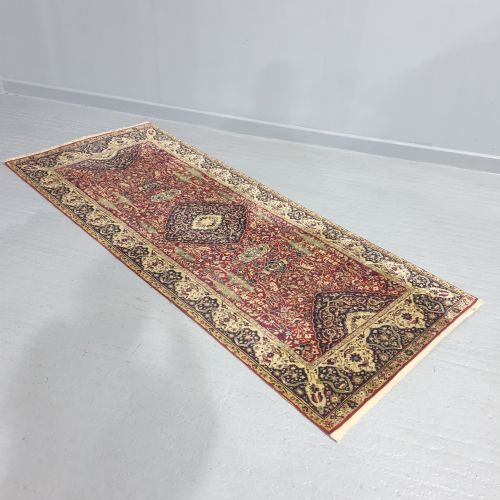


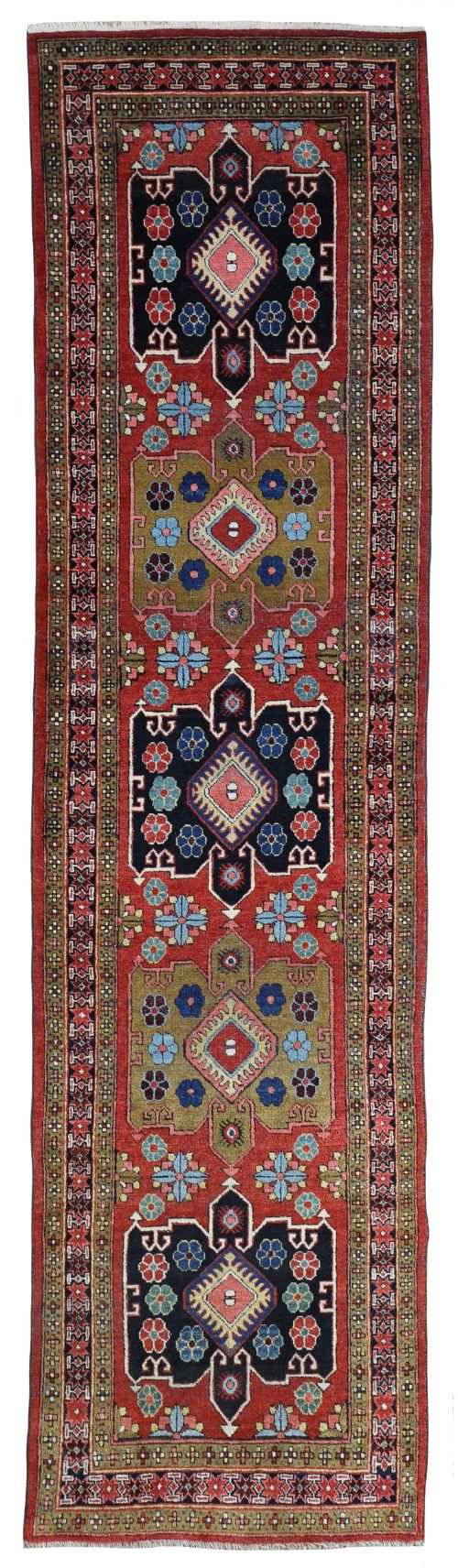


Floral Wool Hallway Runner
A floral wool hallway runner brings warmth and pattern to long spaces through traditional weaves.
Floral Wool Hallway Runner
A floral wool hallway runner is a long, narrow carpet designed specifically for corridors and passageways, utilising durable pile to withstand heavy foot traffic. Buyers searching for a floral wool hallway runner will encounter pieces originating from Persian, Caucasian, and Ottoman or Turkish weaving traditions, spanning the late nineteenth and early twentieth centuries.
The format typically presents elongated proportions, often measuring metres in length while remaining narrow enough to fit standard corridors. Regional workshops across Persia and the Caucasus produced these carpets with distinct botanical motifs, ranging from stylized lattice patterns to French-inspired rose designs.
Materials and construction methods
These runners are constructed primarily from wool pile knotted onto cotton foundations, a combination that provides both resilience and structural stability for long narrow formats. Natural dye traditions and hand-knotting techniques ensure that the dense pile retains its integrity and colour depth over decades of use.
Weavers utilised hand-spun wool for the surface pile, allowing the material to age gracefully and develop a characteristic patina in high-traffic areas. The foundation warps and wefts rely on cotton to maintain the straight edges and rigid proportions necessary for narrow hallway carpets.
Floral Wool Hallway Runner Retail Price Guide 2026
Typical asking prices for floral wool hallway runner among the pieces listed under this phrase on Sellingantiques today, from the lower quarter to the upper quarter. They describe what is for sale here now, not the wider market.
Some nineteenth-century weavers borrowed French rose patterns to satisfy export demands, creating an unexpected botanical dialogue.
Factors determining quality
Quality in these runners rests upon knot density, the precision of the botanical drawing, and the condition of the wool pile across the entire length. Finer examples exhibit meticulous execution of intricate floral motifs, such as the Mina Khana pattern or naturalistic roses, with clear delineation of design elements.
The integrity of the side cords and original end finishes also distinguishes superior pieces from heavily restored or trimmed examples. A well-balanced composition that maintains its narrow proportions without distortion reflects skilled workshop production.
The Floral Wool Hallway Runner Glossary
- Runner
- A long, narrow carpet format traditionally used in hallways, corridors, and staircases. These pieces measure significantly longer than they are wide.
- Pile
- The vertical or inclined loop of yarn that forms the usable surface of a carpet. In these pieces, the pile is woven from wool.
- Warps
- The stationary foundation threads stretched vertically on the loom before knotting begins. Cotton is commonly utilised for this structural element.
- Weft
- The horizontal threads passed through the warps to bind the knots in place. This material works alongside the warp to secure the wool pile.
- Mina Khana
- A traditional recurring floral lattice pattern frequently found in Persian weaving. The motif arranges stylized blossoms within a geometric grid.
Floral Wool Hallway Runner: Frequently Asked Questions
Where should I place a runner?
These long narrow carpets suit hallways, corridors, and entrance spaces where linear floor coverage is required. Their proportions fit domestic passageways naturally while protecting timber floors.
Ensure the dimensions match your corridor width, leaving a balanced margin of exposed floor on either side for the best visual result.
How do I care for wool pile?
Regular gentle vacuuming without a rotating brush roll helps remove grit from the wool pile. Professional cleaning should be undertaken periodically by specialists in antique textiles.
Keep the runner out of direct, continuous sunlight to protect the natural dyes used in the floral designs from premature fading.
Are these runners durable?
Wool pile combined with a sturdy cotton foundation creates a robust textile designed for high-traffic areas. The natural lanolin in traditional wool helps repel dirt and resists daily wear.
Using an appropriate underlay beneath the runner prevents slipping and cushions the weave against hard flooring surfaces.
How do I identify regional styles?
Regional attribution relies on specific design vocabulary, such as the rose motifs of Caucasian Karabagh or the structured geometry of Bidjar and Heriz pieces. Colour palettes and border arrangements also point to specific weaving centres.
Examining the knotting structure and the materials used in the foundation provides further clues to the origin of the textile.