
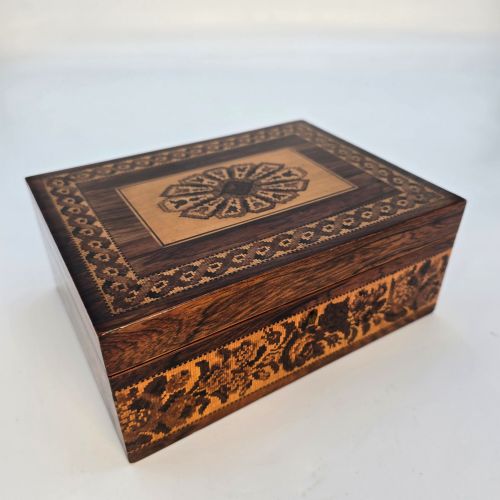


Floral Marquetry Box
These floral marquetry box pieces combine meticulous inlaid timber work with practical utility, offering collectors enduring appeal for storage.
What They Are
The forms recorded on this page include stationery cabinets and music boxes. These items serve both a functional purpose and act as decorative objects for a desktop or parlour table.
Originating from the nineteenth and early twentieth centuries, these boxes showcase traditional cabinet-making skills. The Edwardian stationery cabinets and Victorian music boxes demonstrate the period preference for intricate surface decoration.
How They Were Made
The construction of these items relies on solid timber carcases faced with fine veneers. Walnut and rosewood provide a rich foundational background for the contrasting timber inlays.
Marquetry decoration involves assembling thin slices of dyed and natural woods, including boxwood and ebonised wood, to form floral pictorial motifs. These complex patterns are then glued onto the surface of the box.
Hardware components such as brass hinges, locks, and key-wound mechanisms are integrated into the woodwork. Mechanical elements inside the music boxes require precise engineering alongside the exterior cabinetry.
Some boxes hide intricate melodies inside apparently simple wooden stationery cabinets.
What Varies in Quality
The standard of a floral marquetry box depends heavily on the precision of the veneer cutting and the variety of woods employed. Finer examples display tight joints in the floral patterns without visible gaps or excessive filler.
Mechanical complexity and tonal clarity distinguish the music boxes within the range. Pieces bearing specific maker attributions, such as those by Nicole Freres, reflect higher standards of movement construction and musical arrangement.
Nicole Freres
The Floral Marquetry Box Glossary
- Marquetry
- The art of applying pieces of veneer to a structure to form decorative patterns and pictures. This technique defines the surface ornamentation of the pieces.
- Stationery cabinet
- A desk accessory fitted with internal divisions for writing paper, envelopes, and inkwells. These enclosures protect correspondence while keeping desks tidy.
- Ebonised wood
- Timber treated to resemble ebony through a staining and polishing process. This dark finish provides a stark visual contrast against lighter floral inlays.
- Key wound
- A mechanical movement powered by a removable key rather than a permanent winding lever. This system is typical of nineteenth-century musical boxes.
Frequently Asked Questions
What is a floral marquetry box?
A floral marquetry box is a wooden container decorated with pictorial veneer work depicting flowers and foliage. These items were produced during the nineteenth and early twentieth centuries for domestic use.
Such containers take forms like music boxes or stationery cabinets, combining utility with decorative woodcraft.
How do I date a floral marquetry box?
Dating these objects involves examining the timber species, construction methods, and hardware styles used in the piece. Victorian examples often feature heavier proportions, whereas Edwardian pieces display lighter decorative treatments.
Reference to maker signatures on internal movements also helps establish a precise period of manufacture.
How were music boxes used?
Music boxes served as a form of home entertainment before the widespread availability of recorded sound. Owners wound the internal cylinder using a key to play pre-programmed tunes.
They sat upon tables in parlours and drawing rooms as both musical instruments and decorative furnishings.
How do I care for inlaid wood?
Inlaid wooden items require stable environmental conditions away from direct sunlight and excessive heat. Maintaining moderate humidity prevents the delicate veneers from lifting or cracking over time.
Gentle dusting with a dry cloth preserves the polished surface without damaging the historic finish.