


Floral Inlay Hall Table
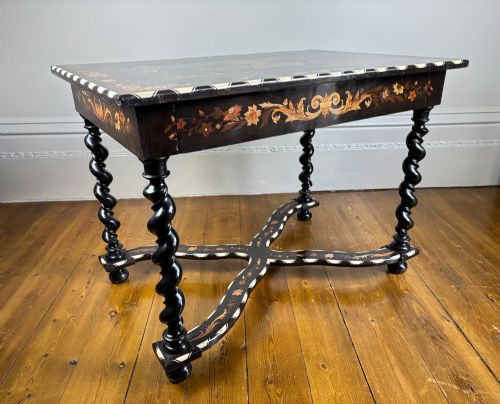
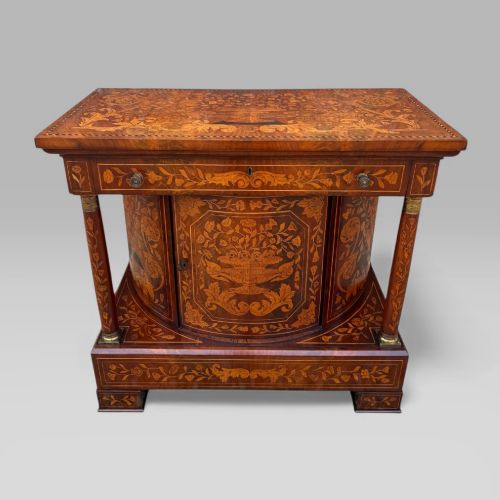
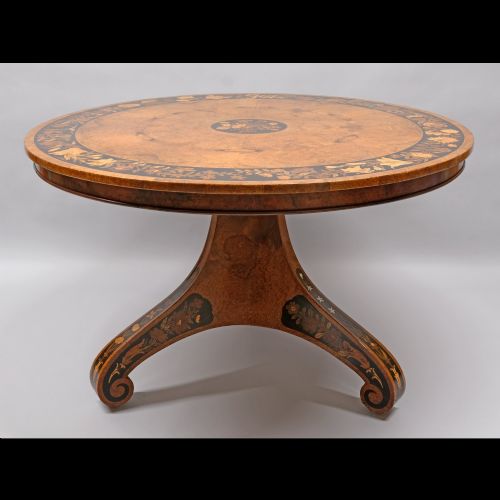
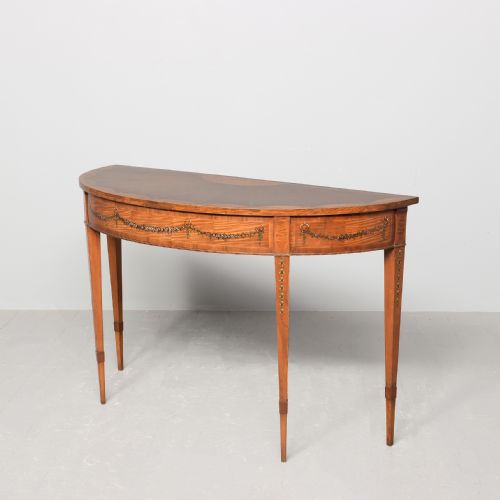
These floral inlay hall table examples bring together centuries of cabinet-making skill, offering refined surfaces and floral marquetry.
Floral Inlay Hall Table
A floral inlay hall table combines practical entryway placement with elaborate floral decoration across the surface and top. When exploring a floral inlay hall table, you encounter diverse forms ranging from compact occasional tables to console and centre pieces.
The pieces span the eighteenth and nineteenth centuries, incorporating periods such as Georgian, Victorian, and Edwardian designs. Makers utilised forms like demi-lune, serpentine, and rectangular tables to suit narrower entrance spaces.
Origin influences the character significantly, with Dutch Baroque and English neoclassical traditions appearing across the selection. Each piece functions as a decorative surface while fulfilling the traditional role of a hallway table.
What Varies in Quality
The precision and complexity of the floral marquetry dictate much of the piece's refinement, with tighter joints and varied timber tones marking superior examples. Simpler geometric borders contrast against elaborate pictorial flower arrangements.
Choice of secondary timbers and the depth of the cabinet-making underneath the veneer differentiate standard production from high workshops. The sophistication of the overall silhouette, whether serpentine, demi-lune, or straight-legged, impacts the visual balance.
Periods represented span from the eighteenth-century Georgian era through the Victorian and Edwardian decades.
Holmes Baldock·Ince and Mayhew
The Floral Inlay Hall Table Glossary
- Marquetry
- A technique where pieces of veneer are fitted together to form decorative patterns or pictures on a carcase. It differs from inlay by covering the entire surface in a mosaic of wood.
- Demi-lune
- A half-moon shape used for console and side tables designed to sit flush against a wall. This profile saves floor space in narrower hallways.
- Serpentine
- A curved outline featuring a convex centre flanked by concave curves, creating a gentle undulating edge. This shape demands high skill from the cabinet-maker.
- Ebonisation
- A chemical or finishing process that darkens light timber to imitate ebony. It provides a stark background for contrasting floral inlay.
- Lowboy
- A small table with drawers, typically raised on four legs, serving as a dressing or writing surface. Eighteenth-century examples often display rich walnut and marquetry.
Floral Inlay Hall Table: Frequently Asked Questions
Where should I place a floral inlay hall table?
These tables suit narrow entranceways, hallways, and landings where surface space is needed without blocking movement. Their decorative tops make them effective focal points beneath a mirror or painting.
Choose a location away from direct sunlight and strong heat sources to protect the delicate wood veneers and marquetry details over time.
How do I care for the inlaid surface?
Dust the timber gently with a dry, soft cloth and avoid chemical polishes that can lift the fine veneer edges. Maintaining stable room humidity prevents the fruitwood and brass inlay from shrinking or loosening.
Use coasters and protective mats if placing lamps or objects on the top to guard the antique polish against marks.
What is the difference between marquetry and inlay?
Marquetry involves assembling a complete picture or pattern from various veneers before gluing it onto the carcase as a single sheet. Inlay refers to cutting recesses directly into the solid wood and fitting contrasting materials into those cavities.
Both techniques appear on these tables, sometimes combined to create layered floral designs.
How can I tell a Georgian table from a Victorian one?
Georgian pieces often display lighter proportions and neoclassical restraint, utilising mahogany or walnut with understated floral motifs. Victorian examples tend to be heavier, frequently employing burr walnut and more exuberant, dense marquetry.
Construction methods and secondary woods inside the drawers also help indicate the correct period of manufacture.