




Floral Inlay Games Table
These floral inlay games tables bring together centuries of cabinetmaking skill and social history.
Floral Inlay Games Table
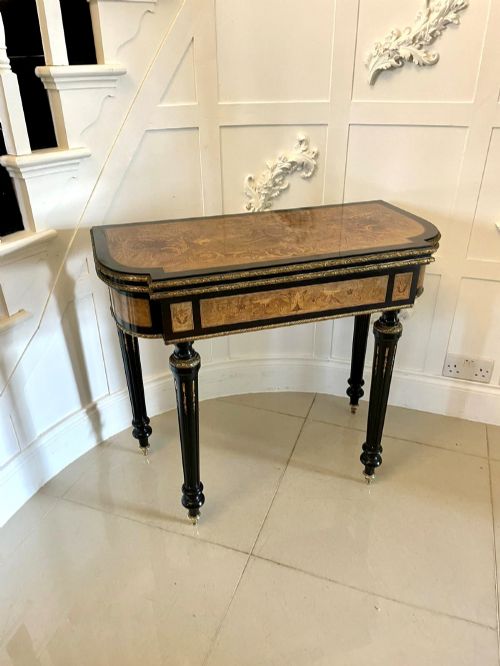
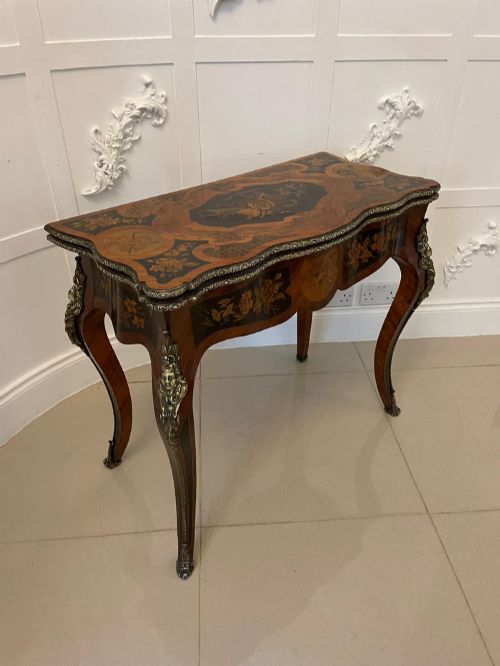
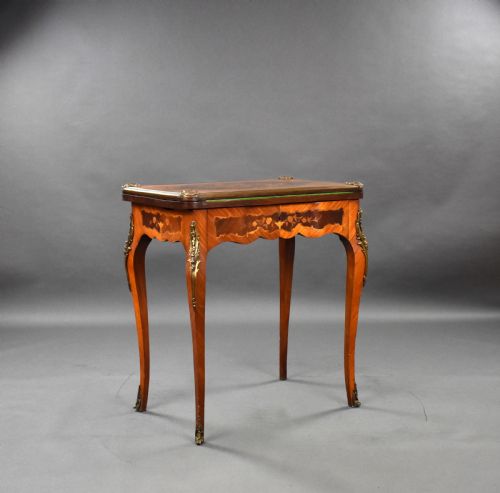
A floral inlay games table combines a folding top for cards or board play with intricate marquetry depicting botanical subjects. These pieces span several distinct periods from the eighteenth century through the Victorian era.
The versions most frequently met on this page are Victorian productions in burr walnut or French examples using kingwood and walnut. Formats range from serpentine card tables to Dutch marquetry folding surfaces.
Origins vary across English workshops, continental European centres including Dutch cabinetmakers, and regional specialisms such as Anglo-Indian production.
Materials and construction methods
Cabinetmakers constructed these pieces using a foundation of solid timbers like walnut, overlaid with decorative veneers such as burr walnut and kingwood. Floral marquetry was built up by hand-cutting delicate pieces of fruitwood and other fine materials to fit flush within the surface.
Metal mounts in ormolu and brass hardware often reinforce structural corners and frame the folding tops. These combined elements required precise joinery to ensure the folding mechanisms operated smoothly without warping the inlaid panels.
Listings feature walnut, burr walnut, kingwood, and fruitwood marquetry across Victorian and Dutch pieces.
Assessing quality in construction and design
The distinction between standard and superior pieces rests on the precision of the marquetry cutting and the choice of burl veneers. Finely detailed floral motifs demand meticulous hand-fitting of contrasting woods.
Secondary enrichment such as cast ormolu mounts and heavy brass framing elevates the overall execution. The balance of the proportions when the table is opened for play indicates the care taken by the original maker.
Henry Dasson
The Floral Inlay Games Table Glossary
- Marquetry
- Decorative veneer work formed by fitting together small pieces of wood, bone or shell to create pictorial patterns. This technique defines the floral surface decoration on these tables.
- Ormolu
- Gilded bronze used for decorative mounts and framing on furniture. It adds metallic contrast to the timber surfaces.
- Kingwood
- A dense, richly grained exotic timber utilised for high-end cabinetmaking. Its dark tones provide a strong visual border for lighter marquetry.
- Burr walnut
- Wood grain taken from the growth growths of a walnut tree, producing a swirling pattern. It serves as a favored background material for Victorian inlaid tops.
Floral Inlay Games Table: Frequently Asked Questions
How do these tables open for play?
Most examples feature a folding top that rotates on a pivot or lifts on hinges to reveal a baize-lined surface underneath. The rear legs frequently swing outward to support the open leaf.
This clever mechanism allows a compact console or side table to transform instantly into a stable playing surface for cards or chess.
Where were these pieces made?
Production spans several regions, with strong representation from Victorian English workshops and continental European centres. Dutch cabinetmakers produced distinct floral marquetry designs across the eighteenth and nineteenth centuries.
French makers also contributed heavily to this style, utilising exotic woods and gilt-bronze mounts during the revival periods.
What timber is beneath the veneer?
Cabinetmakers typically built the main carcase using stable secondary woods such as oak, pine or plain walnut. The decorative exterior surfaces then received the expensive burr walnut or fruitwood veneers.
This method prevented warping while presenting a luxurious finish to the visible exterior of the piece.
How do I care for the inlaid surface?
Maintain the finish by keeping the timber away from direct sunlight and sudden changes in room temperature. Regular dusting with a soft, dry cloth protects the delicate fruitwood marquetry from abrasion.
Apply a quality wax sparingly when the wood appears dry to nourish the grain without buildup.