
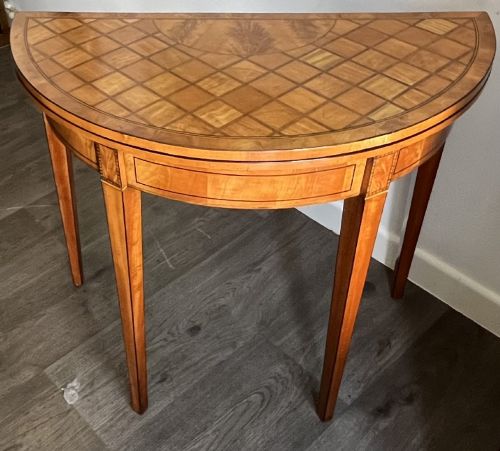
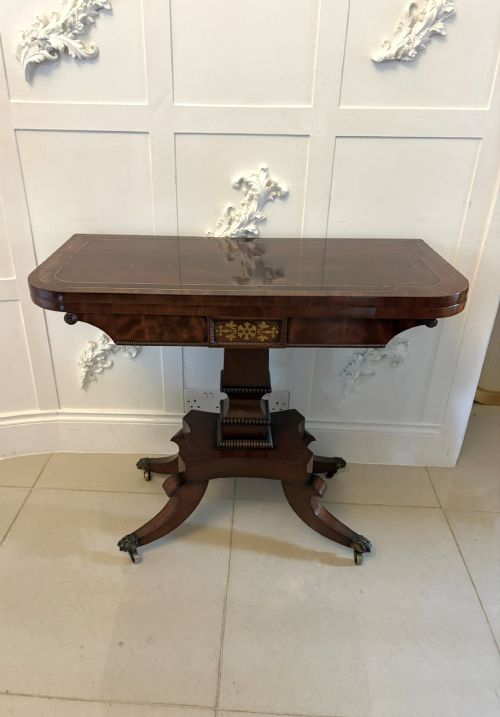
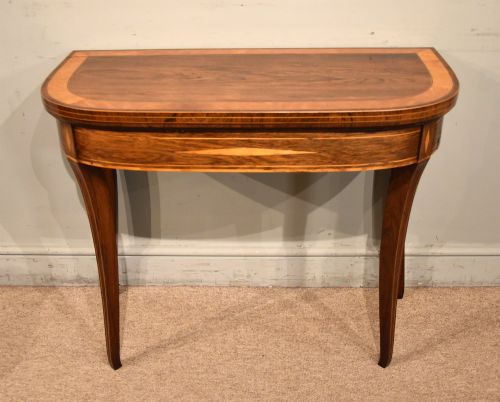
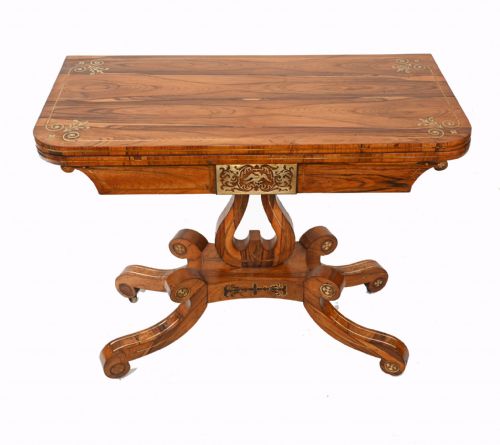
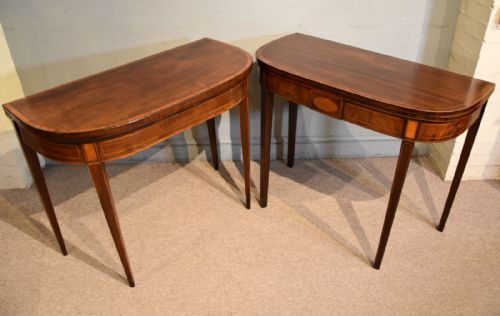
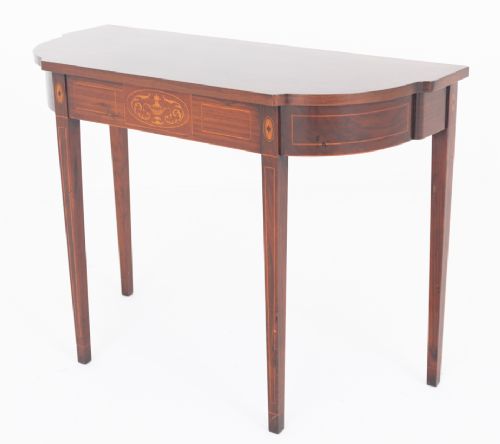


Georgian Marquetry Card Table
A georgian marquetry card table brings folding utility and intricate timber veneers into the room, built for evening games and elegant display.
Georgian Marquetry Card Table
A georgian marquetry card table combines a fold-over top with detailed inlaid woodwork, appearing across styles from George III Neoclassical to Sheraton Revival. These pieces function as console or side tables when closed, opening to reveal a baize-lined playing surface for cards.
Most examples rely on mahogany or satinwood as a primary timber, supplemented by fruitwood and boxwood inlay. Formats range from demi-lune shapes to rectangular concertina-action tables spanning the eighteenth century through later revivals.
How they were made
Cabinet makers built these tables using solid mahogany or satinwood for the structural frames, applying contrasting veneers to the top and frieze. Marquetry designs were hand-cut from thin sheets of dyed and natural timbers, then fitted into recessed channels within the primary wood.
Brass hinges, swing legs and concertina actions supported the folding leaves, allowing the tables to double in surface area when opened. Fine stringing in boxwood and fruitwood defined the borders and geometric panels of the top.
Object forms include demi-lune, console and concertina-action games tables with geometric and floral marquetry.
What varies in quality
The precision of the marquetry cutting and the choice of contrasting timbers dictate the visual strength of the piece. Finer examples display crisp floral or classical motifs in satinwood, rosewood and fruitwood without gaps in the inlay.
Structural integrity depends on the mechanism of the folding leaf, whether through a swing leg, pivoting rule joint or concertina action. The balance of the timber grain and the crispness of the edge stringing separate standard workshop production from finer cabinet work.
The Georgian Marquetry Card Table Glossary
- Marquetry
- Decorative inlay technique using thin veneers of various coloured woods to form pictorial or geometric patterns on a surface. It differs from parquetry by depicting organic or figurative designs rather than repeating geometric tiles.
- Demi-lune
- Half-moon shape common in card and console tables designed to stand flat against a wall when closed. This form allowed the table to occupy minimal space until opened for play.
- Concertina action
- Table frame construction that expands outward like an accordion to support the folding top evenly on all four sides. This mechanism required skilled joinery to operate smoothly.
- Stringing
- Thin lines of contrasting timber inlaid into channels around the edges of table tops and drawer fronts. It frames the primary wood and provides a crisp linear border.
- Satinwood
- Hard, yellowish timber prized for its lustrous grain and smooth texture, frequently utilised in eighteenth-century and revival marquetry. It took polish exceptionally well and contrasted sharply with darker woods like mahogany.
Georgian Marquetry Card Table: Frequently Asked Questions
What is a concertina action table?
A concertina action table uses an expanding frame that pulls outward to support the folding leaf on all four sides when opened.
This sophisticated mechanism keeps the table stable during play and hides the extra legs neatly within the apron when closed.
How do I tell a card table from a tea table?
Card tables and tea tables often share identical folding demi-lune or rectangular forms, but card tables frequently retain traces of baize or green cloth inside.
Many examples serve both purposes depending on the surface lining and the depth of the frieze.
Where should I place a demi-lune table?
A demi-lune table sits flat against a hallway or living room wall as a console when closed.
Pulling it into the centre of the room reveals the inlaid top and provides space for evening card games.
What woods were used for inlay?
Cabinet makers utilised boxwood, fruitwood, satinwood and rosewood to create contrasting floral and geometric marquetry patterns.
Dark mahogany typically formed the primary background timber while lighter woods made up the detailed foliage and borders.