
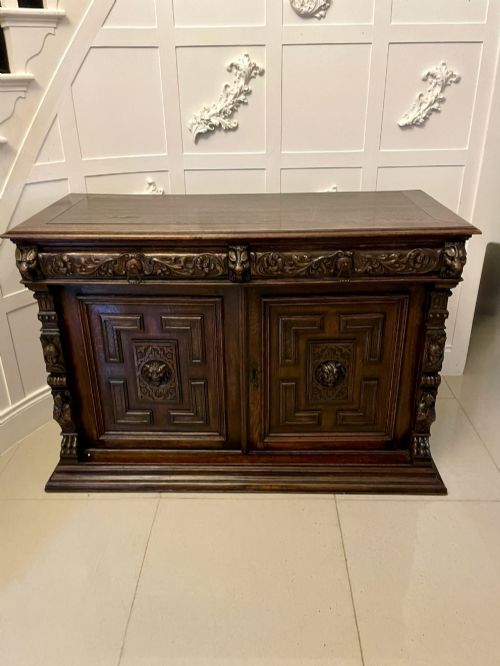
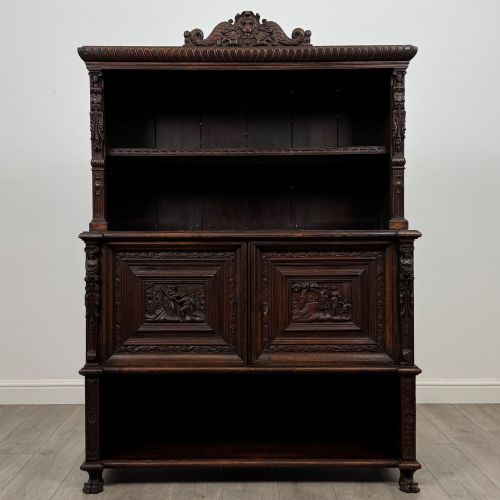
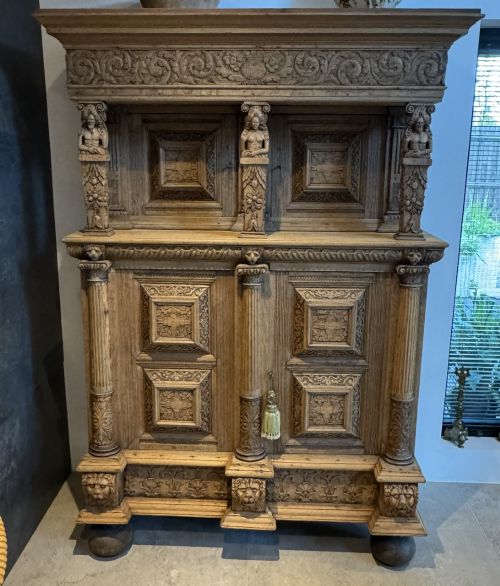


Flemish Oak Cabinet
These heavy, carved items bearing the search phrase flemish oak cabinet bring continental weight and deep relief into a room.
Flemish Oak Cabinet
When you search for flemish oak cabinet, you encounter dark, heavily carved storage pieces originating from continental workshops across several centuries. The selection ranges from compact table cabinets and corner units to large sideboards, armoires and cabinets on stand.
The pieces appearing most frequently date from the nineteenth century, often reflecting Victorian revivals of earlier Renaissance and Baroque styles. Earlier examples from the seventeenth and eighteenth centuries also surface, alongside occasional sixteenth century pieces.
Forms include sideboards, hall cupboards and bookcase combinations equipped with panelled doors, mirror backs or stained glass. They serve as commanding focal points while offering substantial enclosed storage for a dining room or hall.
How they were made
Makers built these pieces primarily from solid oak, sometimes combining it with fruitwood inlay, rosewood or ebony for decorative contrast. Structural stability relied on traditional joinery to support the dense weight of the timber.
Metal components in brass and iron provided functional hardware such as hinges, handles and locks. Glazing appeared in specific variations using glass or stained glass panels within the wooden framework.
Carving defined the surface work, utilising high-relief techniques to create lion masks, figures and scrollwork characteristic of the Flemish Baroque and Renaissance revivals.
Listings span from the sixteenth century to the late nineteenth century, encompassing Renaissance, Baroque and Victorian revival styles in solid oak.
What varies in quality
The depth and crispness of the carving distinguish finer pieces from simpler production work. Master carvers achieved three-dimensional figures and intricate background texturing that ordinary workshops simplified.
The selection of timber and secondary woods affects the overall substance and stability of the piece. Dense, well-figured oak with careful matching across panels indicates a higher grade of manufacture.
The integration of original hardware, such as brass drop handles and functional locks, preserves the integrity of the piece. Later replacements or mismatched components alter the character and historical consistency.
The Flemish Oak Cabinet Glossary
- Cabinet on stand
- A raised storage section supported by an open framework or lower stand structure. This form lifts the main display area off the floor.
- Flemish Baroque
- A sculptural style of design originating in Flanders during the seventeenth century. It utilises exuberant curves, dramatic movement and deep relief carving.
- Kast
- A large, two-door continental wardrobe or cupboard of sturdy construction. These pieces often feature architectural cornices and heavy mouldings.
- Renaissance Revival
- A nineteenth-century movement that reinterpreted sixteenth-century classical motifs, symmetry and column supports. It dominated much of the Victorian production seen here.
- Stained glass
- Coloured glass panels held together by lead cames within cabinet doors. This technique introduces subdued light and colour into the enclosed shelving.
Flemish Oak Cabinet: Frequently Asked Questions
How do I date a flemish oak cabinet?
Dating relies on examining the construction methods, timber preparation and stylistic clues within the carving. Nineteenth-century revival pieces often display machine-sawn backing boards and softer mechanical relief work.
Seventeenth and eighteenth-century examples show hand-planed surfaces, pegged joints and ironwork forged by hand. Comparing the decorative vocabulary to known period styles helps narrow the decade of production.
Where should I place a heavy oak cabinet?
These large storage units require a solid wall capable of supporting their considerable weight and visual mass. Dining rooms, wide hallways and spacious libraries suit their proportions best.
Keep them away from direct heat sources and strong sunlight to prevent the solid oak panels from drying out and splitting over time.
What is the difference between a sideboard and a cabinet on stand?
A sideboard sits directly on the floor as a single continuous piece of furniture designed for serving and dining storage. It combines cupboards and drawers within one block.
A cabinet on stand separates the primary storage volume from the ground by mounting it atop a distinct base with legs or stretchers, creating a lighter visual profile.
How do I care for antique oak furniture?
Maintain the timber by applying a quality beeswax occasionally to nourish the dry oak and preserve the rich patina. Avoid modern liquid polishes containing silicone, which can build up and dull the surface.
Dust regularly with a soft, dry cloth to keep debris out of the deep crevices of the relief carving.