


Flat Woven Tapestry Rug
A flat woven tapestry rug brings texture and pattern to a floor through centuries-old traditions of non-pile textile production.
Flat Woven Tapestry Rug
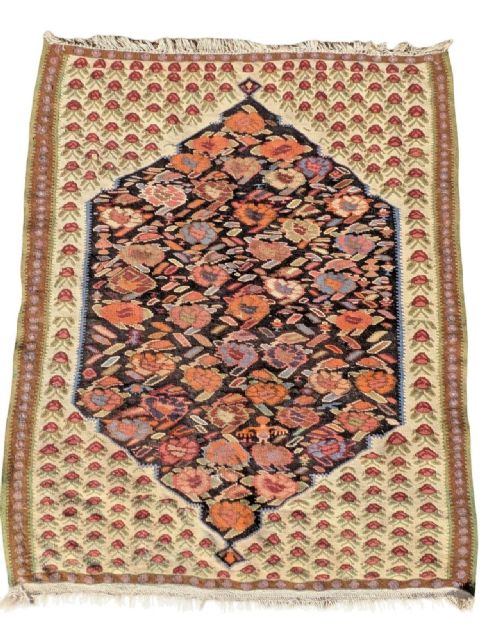
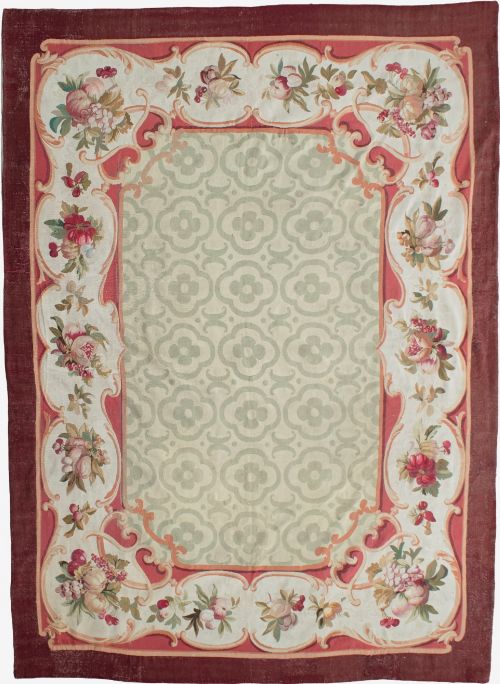
A flat woven tapestry rug encompasses a variety of non-pile textile forms, including carpets, kilims, cushions, and panels originating from European and regional weaving traditions. When exploring a flat woven tapestry rug on this page, buyers frequently encounter Bessarabian kilims and French Aubusson examples dating from the mid-nineteenth century onwards.
The selection ranges from tribal Caucasian and Anatolian traditional pieces to Portuguese needlepoint and Persian-influenced kilims. These textiles served both functional floor-covering purposes and decorative domestic roles across diverse historical interiors.
Materials and construction methods
The pieces listed on this page rely primarily on wool and cotton foundations, utilising flatweaving techniques that interlace warp and weft threads without creating a pile. Artisans constructed these textiles through meticulous hand-weaving methods, producing reversible structures or precise tapestry surfaces.
Regional workshops and nomadic makers employed durable natural fibres to achieve the detailed floral motifs, geometric medallions, and banded designs seen across the inventory.
The listings here span eight decades from 1850 to 1940, showcasing wool and cotton textiles from Bessarabia, France, Persia, and the Caucasus.
Factors influencing quality
Quality in these textiles rests upon the tightness of the weave, the precision of the design execution, and the condition of the material over time. Superior examples maintain structural integrity alongside well-preserved coloration, reflecting the skill of the original weaver.
The complexity of the regional pattern - whether a classical French Rococo floral composition or a scarce tribal design - also distinguishes finer specimens from standard decorative pieces.
The Flat Woven Tapestry Rug Glossary
- Kilim
- An un-knotted flatwoven textile produced across Eastern Europe, Anatolia, and the Caucasus. These pieces use slit-tapestry techniques to form sharp geometric or floral patterns.
- Aubusson
- A French tapestry weave named after the town of production, known for imitating high-warp looms. These carpets and rugs typically display European floral and architectural motifs.
- Soumak
- A wrapping technique where weft threads are looped around warp threads to create a sturdier, textured surface. This method appears frequently in Caucasian and Persian tribal pieces.
- Khorjin
- A traditional woven bag or saddlebag face produced by nomadic groups. Surviving panels often survive as decorative cushions or small wall hangings.
Flat Woven Tapestry Rug: Frequently Asked Questions
What is a flat woven tapestry rug?
A flat woven tapestry rug is a textile created without a pile, relying on the interlacing of warp and weft threads to form patterns. These pieces include European Aubusson carpets, Bessarabian kilims, and tribal flatweaves.
They offer a lightweight alternative to knotted carpets while delivering complex decorative schemes.
How do I care for my rug?
Protect these textiles by placing them in low-traffic areas and using appropriate underlays to prevent sliding. Vacuum gently using a flat suction attachment without rotating brushes.
Keep them away from direct sunlight to preserve the natural dyed wool and cotton fibres over time.
Where were these rugs made?
The pieces originate from diverse regions, including France, Bessarabia, Persia, Anatolia, and the Caucasus. Each area developed distinct weaving traditions and characteristic colour palettes.
European workshops favoured floral Rococo styles, whereas nomadic groups produced geometric and tribal designs.
How do I date an old rug?
Dating relies on stylistic analysis, material examination, and structural characteristics typical of specific decades between 1850 and 1940. Natural dye analysis and regional weaving patterns help narrow the period of origin.
Comparative study of known workshop outputs and tribal traditions provides further chronological context.