
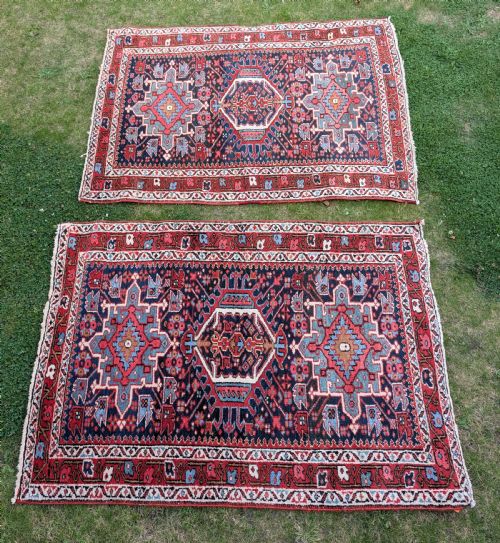


Pair of Wool Carpets
These pair of wool carpets pieces are woven floor coverings that offer matched symmetry and character, making them essential for balanced interior schemes.
Pair of Wool Carpets
A pair of wool carpets brings matched symmetry and rich textile history to domestic spaces, offering twin floor coverings designed to coordinate or mirror one another. Buyers searching for a pair of wool carpets will discover various regional styles, including Persian tribal weaves, Turkmen torba faces, Bessarabian kilims, and Ushak runners.
The selection ranges from Victorian carpet mosaic pictures and Yomut dizlyks to twentieth-century Kashan rugs, Karaja rugs, and prayer rugs. Most examples on this page date from the late nineteenth century through to the 1930s, spanning workshops and nomadic tribes across Central Asia, the Caucasus, and Persia.
Forms extend beyond standard floor rugs to include narrow runners, cushion covers, torba faces, and soumac bags fashioned from textile fragments. This variety allows collectors to furnish long hallways, fireplace flanks, or seating arrangements with authentic matched pairs.
Materials and construction
These textiles are constructed primarily from wool pile spun by hand and knotted or woven onto sturdy cotton foundations. Natural dyes provide the enduring palette seen across the pieces, yielding rich tones that age with considerable grace.
Certain items incorporate wood and gilt elements, particularly in framed pictorial works, whilst others utilise flatweave techniques such as kilim and soumac construction. Weavers employed traditional hand-knotting and flatweaving methods passed down through generations in tribal and village workshops.
Listings feature pieces spanning the Victorian era through to the 1930s, incorporating wool, cotton, and natural dyes across Persian and Turkmen tribal styles.
Distinctions in quality
Quality in these textiles rests upon the fineness of the knotting density, the clarity and complexity of the tribal motifs, and the integrity of the wool pile. Superior pieces display crisp geometric or pictorial designs executed with well-preserved natural dyes that retain their depth.
The survival of original edges, complete backs on bags, and balanced proportions across both items elevate a pair above matched fragments or heavily restored examples. Consistency in colour saturation and even wear across both pieces dictate the upper tier of the range.
The Pair of Wool Carpets Glossary
- Kilim
- A flatwoven textile produced without a pile, traditionally utilised as a rug or hanging. These pieces rely on warp and weft interweaving to form sharp geometric patterns.
- Soumac
- A brocade-like flatweaving technique where the working threads are wrapped over the warp threads before continuing. This method creates a thicker, more durable fabric with a textured surface.
- Torba
- A small tent bag or storage sack produced by Turkmen tribes, often featuring distinctive guls. Surviving faces are frequently mounted or preserved as decorative textiles.
- Gul
- A primary octagonal or medallion motif repeated across Turkmen carpets and tribal trappings. Each tribal group utilises distinct gul variations to signify lineage and origin.
Pair of Wool Carpets: Frequently Asked Questions
How do I clean antique wool carpets?
Vacuum gently using suction only without a rotating brush bar to protect the delicate wool pile and structural foundation.
Professional specialist cleaning is advised for accumulated dirt, whilst immediate blotting handles liquid spills without rubbing the fibres.
Are matched pairs from the exact same loom?
Matched pairs often share identical tribal motifs, dimensions, and dye batches because weavers produced them concurrently for specific domestic or ceremonial settings.
Minor variations in hand-spun wool and execution remain normal indicators of authentic manual production rather than factory uniformity.
Can narrow runners withstand heavy hallway traffic?
Wool runners with a dense pile handle moderate domestic footfall effectively when paired with a quality underlay to prevent shifting.
Fragile flatweaves or older pictorial fragments require careful placement in low-traffic areas to preserve their structural integrity.
How do I identify a tribal origin?
Specific knotting structures, characteristic colour palettes, and distinct geometric motifs such as specific guls point directly to regional groups like the Yomut, Tekke, or Shahsavan.
Comparing border bands and secondary filler ornaments helps separate Persian village output from Central Asian nomadic weaving.