

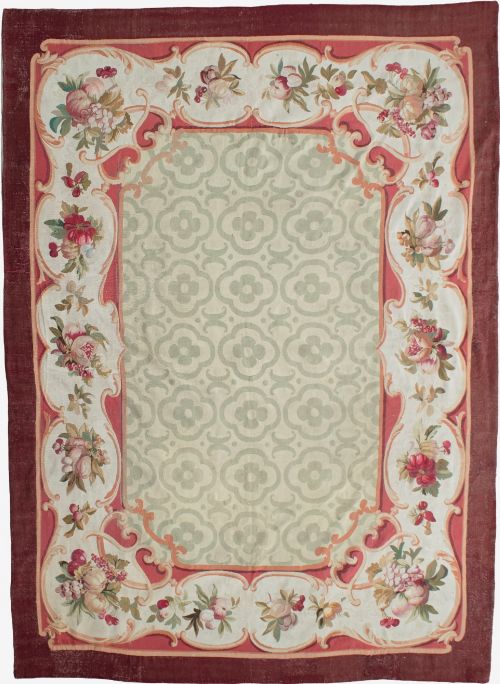


Flat Weave Wool Tapestry
A flat weave wool tapestry brings texture and history to a floor or wall, offering durable craftsmanship shaped by diverse regional traditions.
Flat Weave Wool Tapestry
When buyers search for a flat weave wool tapestry, they encounter textiles constructed without a pile, relying on the interweaving of warp and weft threads to create pattern and form. These pieces span utility and decoration, originating from various international weaving traditions rather than a single workshop. The selection regularly includes kilims, cushions, and rugs representing distinct cultural techniques from the nineteenth and early twentieth centuries.
The objects on this page appear in several regional styles, most notably Bessarabian kilims, French Aubusson carpets, and tribal pieces from Persian, Anatolian, and Caucasian origins. Buyers meet numerous Bessarabian kilims alongside Aubusson rugs and smaller items such as Pirot and Sarkoy kilims or Shahsavan sumac panels. These diverse forms reflect the widespread practice of flat-woven textile production across Europe and the Near East during the Victorian and Edwardian eras.
Materials and construction
The primary materials recorded in these listings are wool and cotton, utilised to build sturdy foundations and detailed surface patterns. Wool provides the flexible, resilient body for the motifs, while cotton often supports structural elements within specific regional traditions.
Weavers constructed these pieces using flat-weaving methods, such as slit-tapestry techniques seen in kilims or needlepoint stitching found in Portuguese and French examples. Sumac and specialised wrap techniques also appear, adding raised textural details to the otherwise flat surfaces.
Listings feature pieces dated between 1850 and 1940, utilising wool and cotton across rug, cushion, and panel formats.
Markers of quality
Quality in these textiles rests upon the precision of the weave and the tightness of the structural foundation. Tighter interlacings of wool and cotton produce stronger, more resilient textiles that hold their geometric or floral patterns with greater clarity over decades of use.
The integrity of the design execution and the preservation of the original materials define the upper tier of these pieces. Textiles retaining clear regional motifs, balanced compositions, and robust edge finishes demonstrate superior workmanship from their respective periods of origin.
The Flat Weave Wool Tapestry Glossary
- Kilim
- An un-pile flat-woven carpet or rug produced in countries of the former Ottoman Empire, Persia, and Central Asia. They are known for geometric patterns created by interweaving warp and weft threads.
- Aubusson
- A style of French carpet and tapestry traditionally woven in the Creuse valley, utilising fine wool and cotton to render classical floral or architectural scenes.
- Sumac
- A flat-weaving technique where coloured weft threads are wrapped around the warp threads before being passed back, creating a durable textured surface.
- Mafrash
- A traditional tribal storage bag or panel, often woven in sumac technique by Shahsavan or South Caucasian groups.
- Bessarabian
- A style of European flat-woven kilim characterised by dark grounds and naturalistic floral designs, originating from the region between the Prut and Dniester rivers.
Flat Weave Wool Tapestry: Frequently Asked Questions
What is a flat weave wool tapestry?
A flat weave wool tapestry is a textile made without a pile, created by tightly interweaving coloured wool and sometimes cotton threads on a loom. These pieces include kilims, rugs, and decorative panels.
They function historically as floor coverings, wall hangings, or functional containers like storage bags, reflecting distinct regional weaving traditions from the nineteenth and twentieth centuries.
How do I care for a wool tapestry?
Protecting a flat weave textile involves gentle vacuuming without a beater bar and keeping the piece out of direct sunlight to prevent fading. Professional cleaning suited for antique wool is recommended when necessary.
Rotating the piece periodically ensures even wear across the surface, particularly if placed in a high-traffic area or exposed to directional light.
Where were these textiles made?
The pieces originate from diverse geographic areas, including Anatolia, the Caucasus, Persia, and Eastern Europe. Each region developed distinct motifs and colour palettes using local materials.
For instance, Bessarabian examples feature dark floral patterns, while Caucasian and Persian pieces often display geometric or tribal symbols.
How do I distinguish regional styles?
Distinguishing styles relies on observing the specific colour combinations, border designs, and structural techniques used in the weave. Bessarabian works lean toward naturalistic flora, whereas tribal pieces emphasise geometric repetition.
Reference materials and expert examination help identify whether a textile belongs to Aubusson, Anatolian, or Shahsavan traditions based on structural traits.