
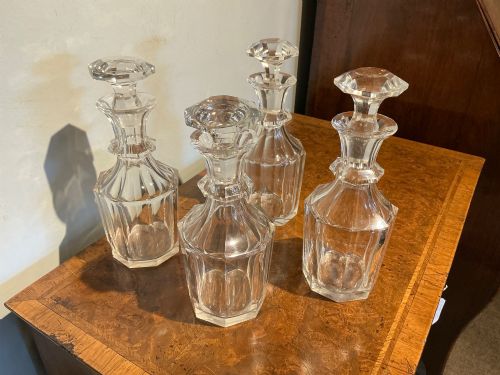
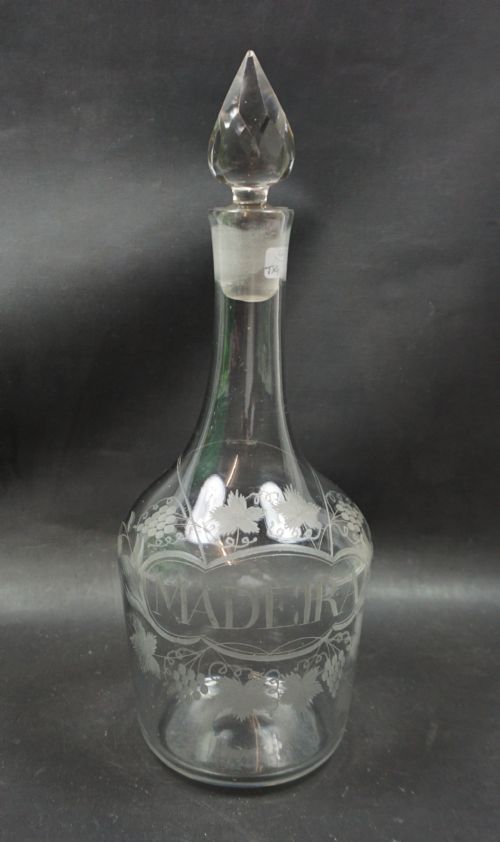


Faceted Crystal Decanter
A faceted crystal decanter catches the light from every angle, bringing heft and brilliance to a sideboard or dining table.
Faceted Crystal Decanter
A faceted crystal decanter is a heavy, light-refracting vessel designed to hold and serve spirits, wine, and liqueurs. These pieces range from substantial Victorian table decanters to geometric Art Deco sets and tall Edwardian spirit bottles.
The most common examples encountered here date from the Victorian and Edwardian eras, alongside pieces from the 1920s and 1930s. They appear as individual bottles, matched pairs, or complete drinking sets with matching glasses.
Beyond standard spirit and wine bottles, the category encompasses smaller scent bottles, liqueur decanters, and silver-collared barware. Forms stretch from classic bell shapes and shoulder decanters to angular modernist silhouettes.
How They Were Made
These vessels rely on lead crystal, clear cut glass, and standard glass shaped by blowing and heavy mechanical cutting. Deep geometric facets are ground into the body by hand using abrasive wheels, creating sharp planes that catch the light.
Many examples incorporate secondary materials such as sterling silver collars, mounts, and enamel details. Locking mechanisms by makers like Betjemann Brothers integrate metal hardware directly into the neck and shoulders of the glass body.
Faceted Crystal Decanter Retail Price Guide 2026
Typical asking prices for faceted crystal decanter among the pieces listed under this phrase on Sellingantiques today, from the lower quarter to the upper quarter. They describe what is for sale here now, not the wider market.
Listings span the nineteenth and twentieth centuries, featuring lead crystal, cut glass, and sterling silver mounts across Victorian, Edwardian, and Art Deco styles.
What Varies in Quality
Quality rests in the crispness of the cutting and the clarity of the material itself. Sharp, deep facets reflect light cleanly, whereas softer edges indicate hurried or later production.
The integration of metalwork dictates upper tiers of execution. Hallmarked silver collars, fitted locks, and intact stoppers matching the original body separate standard vessels from finer service pieces.
Karl Palda·Val Saint Lambert·Betjemann Brothers·Moser Glass
The Faceted Crystal Decanter Glossary
- Lead crystal
- Glass containing metal oxides that increase weight, refractive index, and acoustic resonance. This material allows for deeper and sharper cutting than standard soda-lime glass.
- Shoulder decanter
- A form characterised by a broad, flat shoulder and a tapering body designed to sit securely in a cellarette or on a tray. This shape provides stability during transport.
- Decanter set
- A matched group comprising a central vessel accompanied by several matching glasses or liqueur bottles. These assemblies often sit within a fitted tray or stand.
- Silver collar
- A metal band fitted around the neck of a bottle, frequently bearing hallmarks that indicate the assay office and year of manufacture. It protects the rim and secures stoppers or locking mechanisms.
- Ewer
- A jug-shaped vessel with a rounded body and a formal handle, used alongside traditional decanters for pouring liquids. The form frequently appears in Edwardian table service pieces.
Faceted Crystal Decanter: Frequently Asked Questions
How do I clean inside a decanter?
Residue and staining inside the body respond best to warm water and specialised cleaning beads rather than harsh abrasive tools.
Careful rinsing prevents thermal shock to the heavy glass walls.
Are stoppers original to the decanter?
Original stoppers share the exact cut pattern, glass tone, and wear patterns of the main body. Interchangeable replacements often sit loosely or display mismatched facet alignments.
Matching the ground glass peg to the neck ensures proper sealing.
How do locking decanters work?
A hinged metal collar wraps around the neck and secures with a small key-operated lock. This mechanism prevented unauthorized access to spirits in domestic settings.
Silver mounts often bear maker marks and hallmarks near the locking hinge.
Can these vessels hold wine daily?
Heavy lead crystal safely stores spirits and wine for serving during meals or formal gatherings. Traditional forms suit whiskey, port, and Madeira.
Long-term storage over many months is generally avoided to protect delicate vintage flavours.