




Extending Dining Table Ends
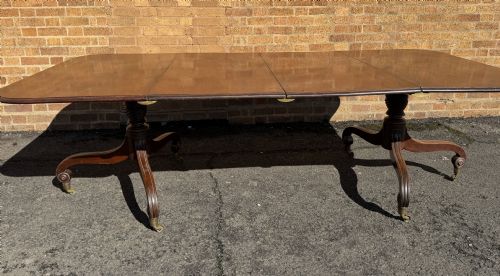
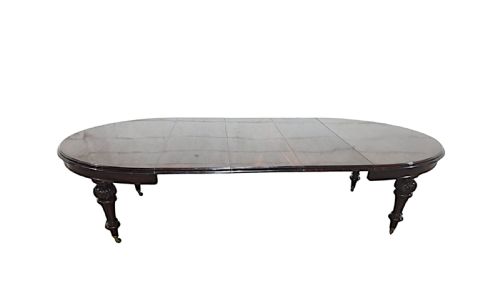
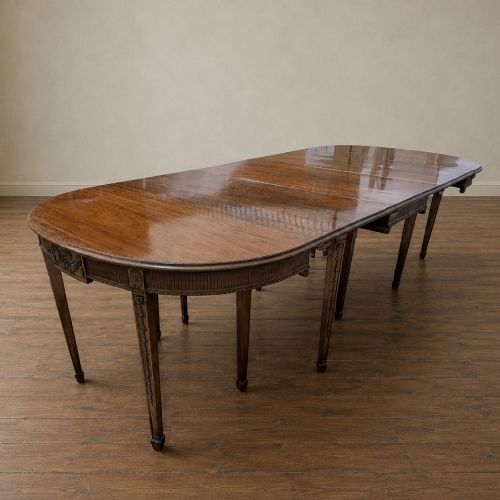
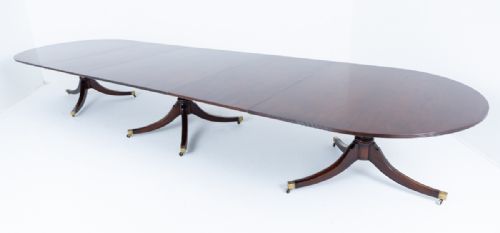
Extending dining table ends offer versatile forms and practical scales for large gatherings, usually appearing as mahogany D-ends with extra leaves or drop-leaf sections.
Extending Dining Table Ends
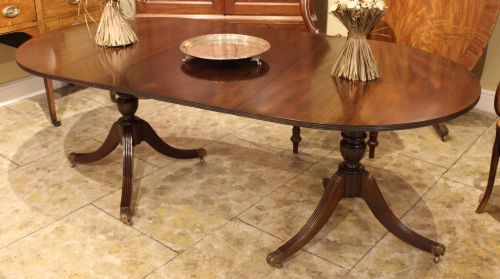
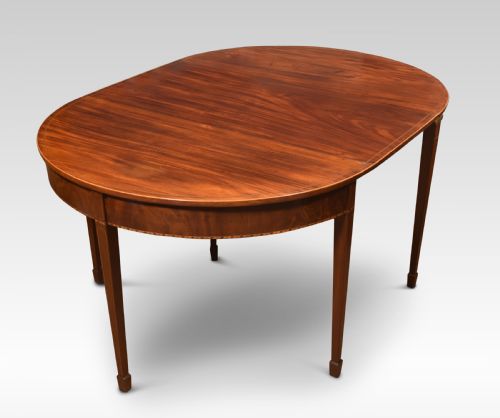
Extending dining table ends include D-end tables, console tables, and drop-leaf tables designed to create large seating capacities. These pieces primarily date from the Georgian, Regency, and Victorian periods, with some Edwardian and early twentieth-century examples.
Buyers frequently encounter twin-pillar mahogany tables, console tables that pair together, and drop-leaf formats equipped with extra leaves. These configurations allow tables to adjust for everyday dining or seat up to twenty-two guests.
The materials and styles span George III, George IV, and Neoclassical designs, often featuring fruitwood, boxwood inlay, and satinwood inlay alongside solid mahogany. Console tables often function separately as side furniture until united for a meal.
How they were made
Cabinet makers utilised solid mahogany and fruitwood, constructing tops that often paired D-end sections with drop-leaf mechanisms or extra leaves supported by pillars.
Surface decoration frequently incorporated boxwood inlay and satinwood inlay to create contrasting borders on the timber tops and friezes.
Some console tables split apart to become breakfast ends, proving that eighteenth-century furniture possessed a modular ambition.
What varies in quality
Quality differences emerge in the selection of timber figures, the precision of boxwood and satinwood inlay work, and the structural integrity of the pillar supports or drop-leaf hinges.
Refinement in proportion and the sophistication of the styling, such as Neoclassical or Grand Regency details, distinguish standard utility pieces from workshop productions attributed to makers like William and Gibton or Robert Adam.
William and Gibton·Robert Adam·Waring and Gillow
The Extending Dining Table Ends Glossary
- D-End table
- A table with one curved semicircular end resembling the letter D, designed to stand against a wall or join with other sections to form a long dining table. These sections often contain drop leaves or take extra insertable leaves.
- Console table
- A table fixed to a wall or freestanding on legs, shaped with a flat top and often built in pairs to serve as serving tables or combine into a dining arrangement.
- Drop-leaf table
- A table with a fixed centre section and hinged flaps on either side that fold down when not in use. These mechanism types allow for flexible room layouts.
- Pillar dining table
- A table supported by one or more central pedestals or columns, frequently resting on splayed legs with brass castors. This design provides unobstructed legroom around the perimeter.
Extending Dining Table Ends: Frequently Asked Questions
How do D-end tables connect together?
D-end tables typically use brass clips, pegs, or rule joints to secure separate sections and extra leaves in place.
This system allows the tables to separate into console units when a full dining length is not required.
What periods do these dining tables cover?
The available tables span the Georgian, Regency, Victorian, and Edwardian eras, with specific pieces dating from the late eighteenth century into the early twentieth century.
George III, George IV, and Neoclassical styles dominate the craftsmanship of these periods.
Can these tables accommodate large dinner parties?
Many of these extending tables incorporate multiple extra leaves or twin-pillar formats designed to seat between eight and twenty-two people.
Their modular D-end and drop-leaf configurations adapt easily to varying room dimensions and guest numbers.
What woods are used in their construction?
Mahogany serves as the primary timber, complemented by fruitwood in farmhouse examples.
Cabinet makers added boxwood inlay and satinwood inlay for decorative contrast on the table borders.