
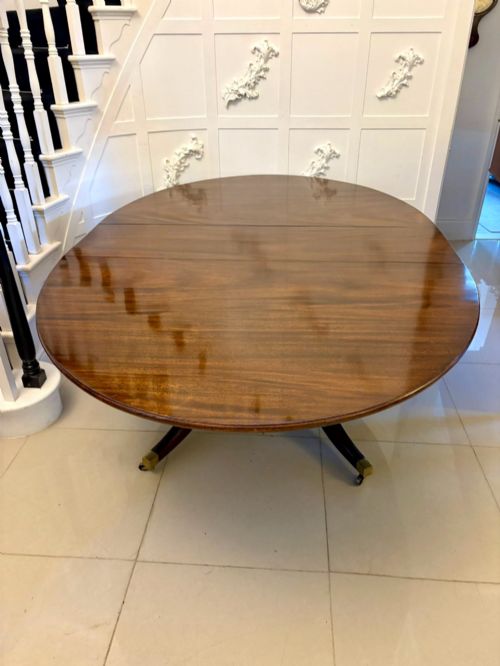
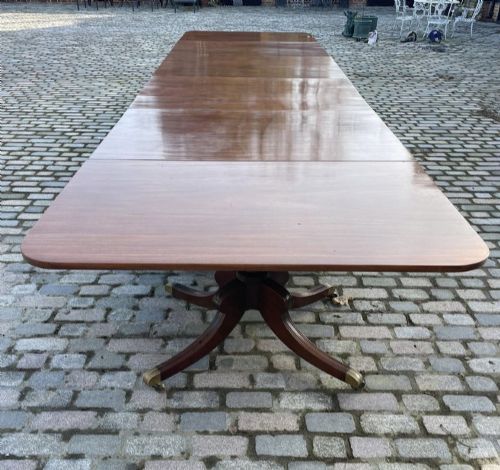
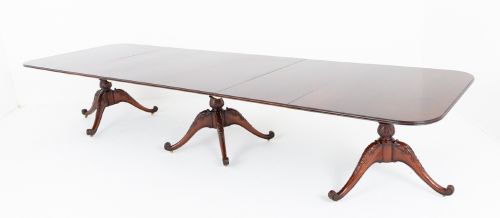
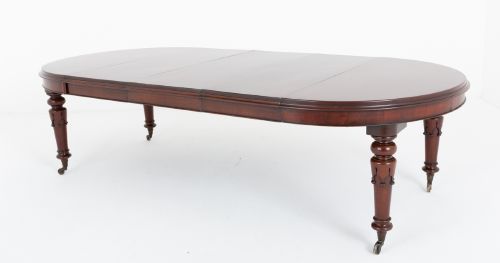
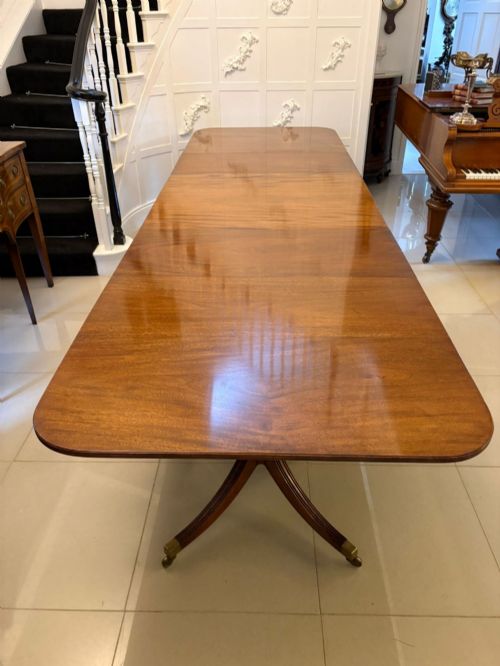
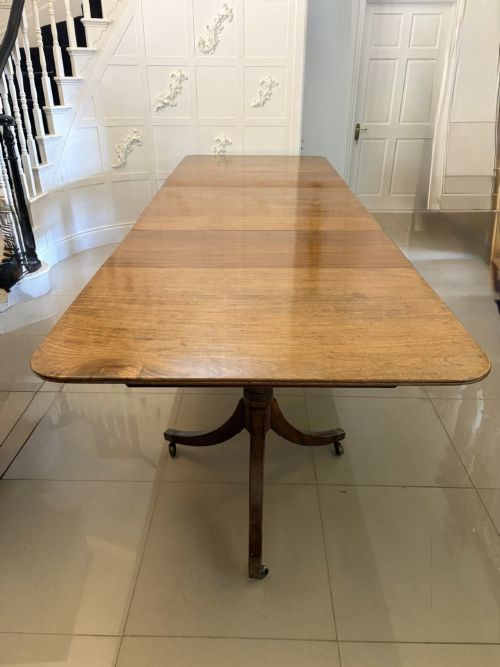
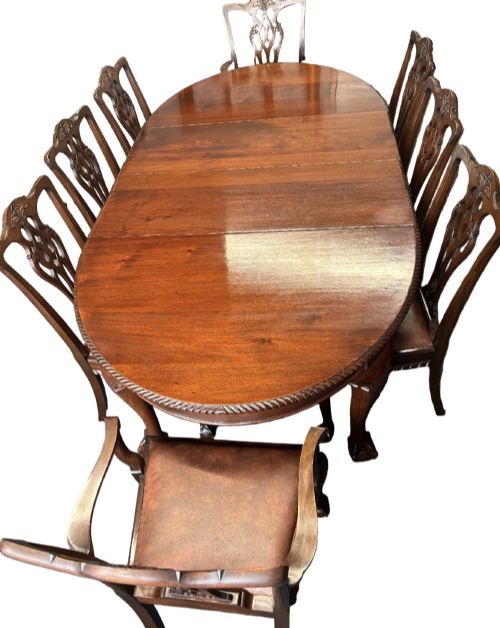

Extended Mahogany Dining Table
An extended mahogany dining table brings historic presence to a room, offering adaptable seating through clever mechanisms built by master cabinetmakers.

Extended Mahogany Dining Table
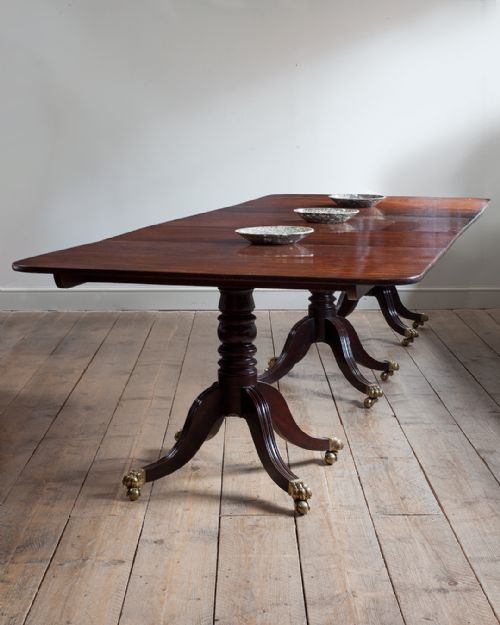
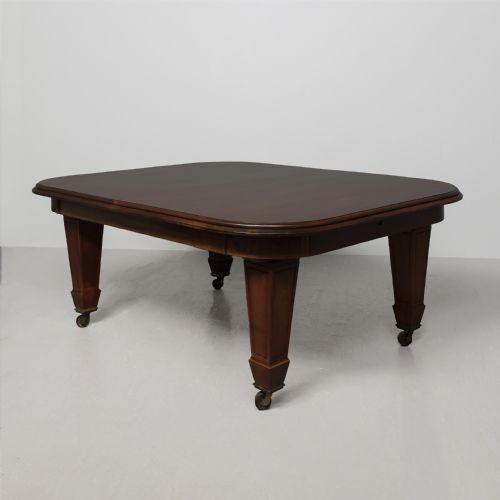
An extended mahogany dining table provides a grand setting for large gatherings, appearing primarily in multi-pillar formats or wind-out designs across Georgian, Regency, and Victorian periods.
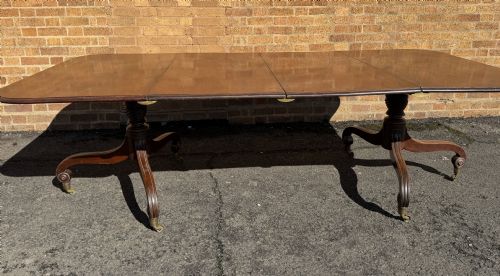
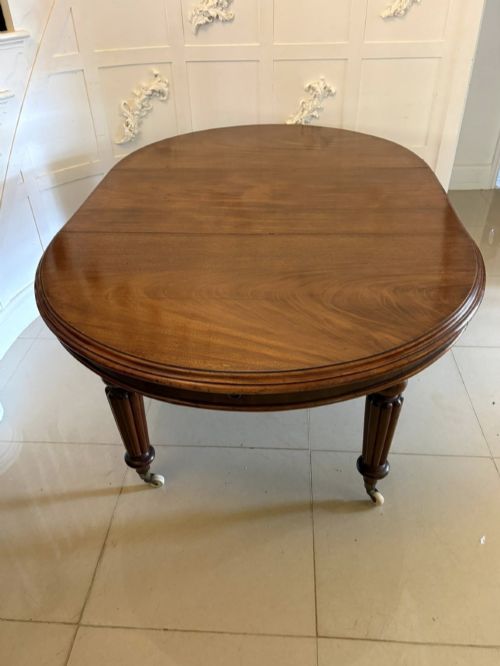
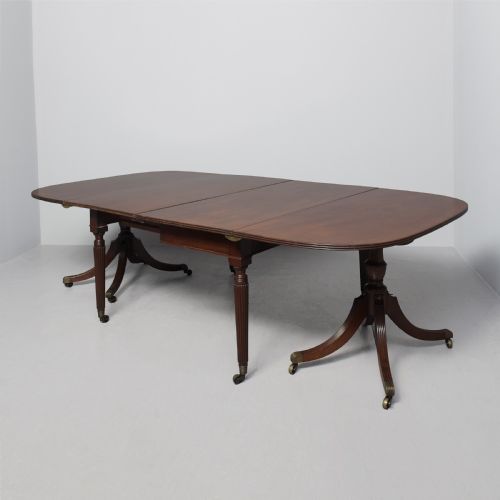
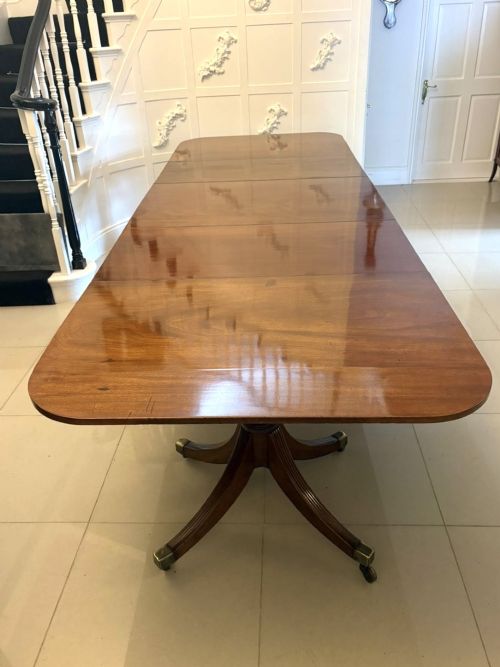
Buyers seeking an extended mahogany dining table frequently encounter twin-pillar and triple-pedestal arrangements, alongside George III, William IV, and Edwardian revivals.
These pieces range from versatile smaller scales to vast banquet tables spanning multiple leaves, reflecting the changing social demands of the nineteenth and early twentieth centuries.
Materials and Construction
Cabinetmakers constructed these tables using solid and figured mahogany, often pairing dense timbers with brass castors to ease movement across heavy floorboards.
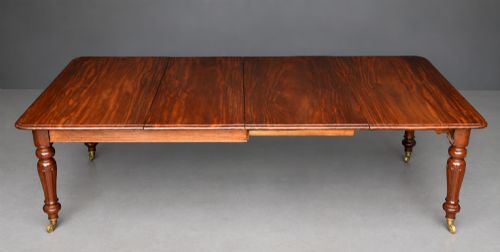
Mechanisms rely on internal winding systems, drop-in leaves, and heavy pillar supports that distribute weight evenly when the table reaches full capacity.
Materials appearing across the inventory include solid mahogany, figured mahogany, brass hardware, and ceramic castors.
Judging the Standard of Construction
Quality rests in the grain matching across added leaves, the stability of the central pedestals, and the precision of the extending mechanism.
Superior examples exhibit refined timber selection, such as figured mahogany, and robust secondary framing that maintains rigidity when fully extended.
Gillows of Lancaster·Thomas Butler of London·Wylie and Lochead Glasgow
The Extended Mahogany Dining Table Glossary
- Wind-out
- A mechanical system operated by a handle that expands the frame to accept extra leaves. This mechanism relies on a central screw rod.
- Pedestal
- A central column support resting on splayed legs, commonly found in multi-pillar dining tables. These columns often feature brass castors.
- Leaf
- A removable section of timber inserted to lengthen the surface area of the table. Multiple leaves allow the furniture to adapt for different numbers of guests.
- D-End
- A table end shaped in a semicircle, forming a rectangular surface when joined with matching sections. These ends detach during the extension process.
Extended Mahogany Dining Table: Frequently Asked Questions
How do wind-out mechanisms operate?
A detachable handle turns an internal screw mechanism, drawing the table ends apart to create space for additional leaves.
This metal gearing system ensures the top moves smoothly without straining the outer frame or the pedestal joints.
How many leaves can these tables take?
Depending on the length of the base and the number of pedestals, tables accept anywhere from one to five extra leaves.
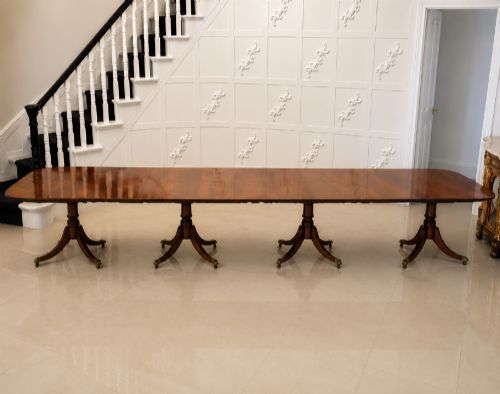
Larger banquet tables utilise four pedestals to support significant lengths for seating up to twenty-four people.
What is a multi-pillar dining table?
A multi-pillar table uses two, three, or four separate wooden columns rather than four corner legs to support the top.
This design prevents legs from obstructing diners and allows the table to lengthen substantially while maintaining structural balance.
How do I identify a Regency style table?
Regency and Regency Revival pieces typically feature pillar supports, reeded legs, and brass toe-caps with castors.
These tables often showcase figured mahogany timber with dark, rich tones developed over decades of polishing.