






Ernest Higgins Rigg Artwork
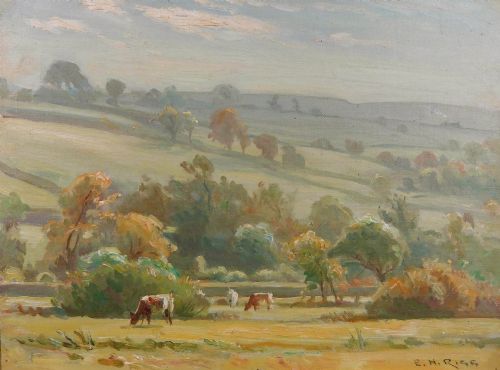
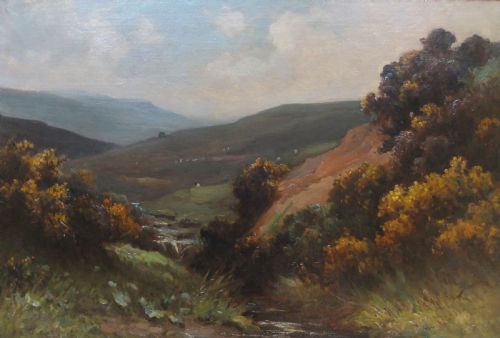
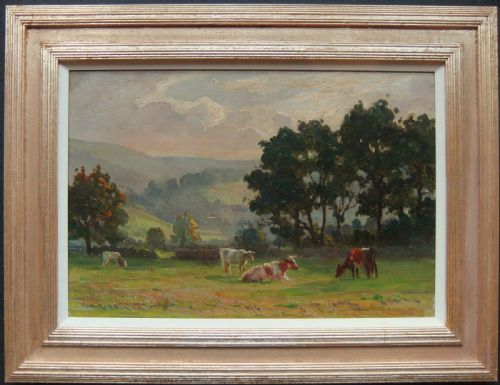
Ernest Higgins Rigg artwork captures British Impressionism through oil paintings depicting Yorkshire landscapes, gardens, and rural life from the early twentieth century.
Ernest Higgins Rigg Artwork
When you search for ernest higgins rigger artwork, you encounter oil paintings executed on canvas, board, and timber supports. The pieces predominantly record rural scenes, moorland streams, and village views from the nineteen hundreds, nineteen tens, and nineteen twenties.
The subjects centre on northern locations such as Swaledale, Staithes, Letchworth, and Salcombe. Landscapes dominate the selection, alongside specific depictions of gardens, farm buildings, and local horses.
What varies in quality
Quality rests in the vigour of the brushwork and the management of natural light across the canvas or board. Works depicting specific regional topography with confident impasto hold greater visual presence than simpler compositions.
The preservation of the original oil paint surface and the stability of the timber or canvas support influence the overall integrity of each piece.
Current listings span three distinct decades: nineteen hundred, nineteen ten, and nineteen twenty, executed entirely in oil paint.
Ernest Higgins Rigg
The Ernest Higgins Rigg Artwork Glossary
- Oil paint
- A slow-drying paint made by combining pigment particles with a drying oil, typically linseed oil. This medium allows for rich colour depth and textured application.
- Canvas
- A closely woven fabric used as a surface for oil painting, usually stretched over a wooden frame. It provides a flexible yet durable ground for brushwork.
- Board
- A rigid flat panel utilised as an alternative support to canvas for oil paintings. These sturdy supports prevent the sagging associated with stretched fabrics.
- British Impressionism
- A painting style developed in Britain during the late nineteenth and early twentieth centuries, characterised by visible brushstrokes and an interest in transient effects of light.
Ernest Higgins Rigg Artwork: Frequently Asked Questions
Who was Ernest Higgins Rigg?
Ernest Higgins Rigg was a painter associated with British Impressionism, known for recording rural landscapes and village scenes, particularly in Yorkshire and surrounding regions.
His output spans the early decades of the twentieth century, capturing vernacular architecture, moorland streams, and domestic gardens in oil paint.
What subjects appear in these paintings?
The works record rural vistas, including moorland streams, valley farms, village gardens, and agricultural horses. Locations such as Swaledale and Staithes feature prominently among the titles.
Skilled handling captures seasonal shifts, from winter snow scenes to lush summer foliage and garden roses.
What materials support the paint?
The oil paint is applied to stretched canvas, rigid boards, and timber panels. Each support offers a different textural interaction with the viscous pigment.
Canvas yields a subtle fabric grain beneath the brushwork, whereas board and timber provide a solid, unyielding ground for impasto application.
How do dates vary across the works?
The available pieces date from the early nineteen hundreds through to the nineteen twenties. This timeframe captures the evolution of the artist's regional focus over two decades.
Early examples sit alongside works produced during the nineteen tens and the post-war period of the nineteen twenties.