



Equestrian Watercolour Painting
An equestrian watercolour painting captures the power and movement of horses through fluid pigments on paper, offering collectors a direct link to traditional sporting art.
Equestrian Watercolour Painting
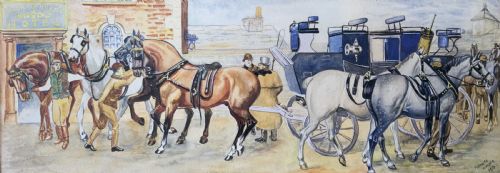
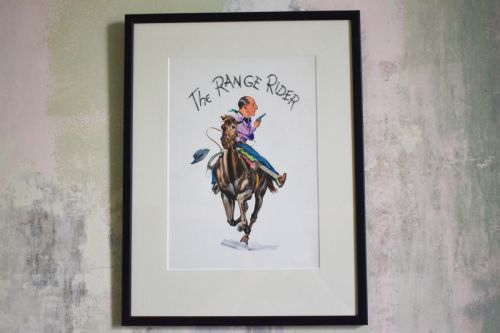
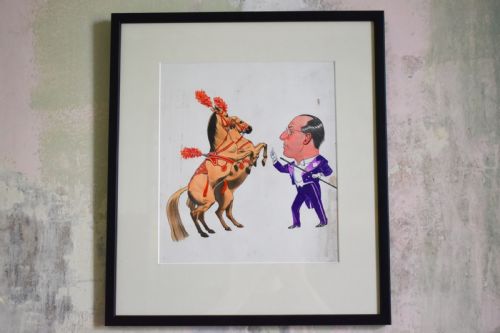
An equestrian watercolour painting focuses primarily on horses, riders, hunts, and racing scenes executed on paper supports.
Buyers encounter works ranging from 19th century Victorian portrayals to early 20th century hunting and military subjects.
Many examples arrive framed under glass, often preserved in period wood frames that complement the delicate media.
Materials and Technique
Artists apply watercolour pigment and gouache onto paper, sometimes combining ink to define sharper details and outlines.
The technique relies on transparent washes of colour to build depth, while bodycolour or gouache provides opaque highlights.
The inventory spans the Victorian era through the mid-20th century, utilising paper, watercolour pigment, gouache, and ink.
Factors of Quality
Quality rests upon the artist's ability to render equine anatomy correctly and convey motion convincingly within the composition.
Condition plays a vital role, distinguishing works with vibrant, unfaded pigments and clean paper from those damaged by light or moisture.
Herman S Melville·John Rattenbury Skeaping·Basil Nightingale·John Augustus Atkinson·Helena Maguire·John Atkinson·Thomas Mackay·Adrian Jones·Charles Clifford Turner·John Sanderson Wells·Snaffles·Tom Carr·Thomas Ivester Lloyd·Charles Johnson Payne·William J Hodgson·Henry Charles Fox·George Cattermole·Frank Dadd
The Equestrian Watercolour Painting Glossary
- Watercolour
- A paint consisting of a solution of colour in water, applied in translucent washes to create luminous effects on paper.
- Gouache
- An opaque watercolour paint mixed with a white pigment, used by artists to add solid highlights and body to a painting.
- Sporting Art
- Depictions of rural sports, horse racing, hunting, and animals, which form a major genre in British painting.
- Framed Artwork
- A piece enclosed within a protective border and glass, ready for hanging on a wall.
Equestrian Watercolour Painting: Frequently Asked Questions
How do I care for my painting?
Keep the artwork away from direct sunlight to prevent the watercolour pigments from fading over time.
Ensure the room maintains stable humidity levels to protect both the paper and the wooden frame.
Were these works meant for framing?
Most works on paper were framed shortly after creation to protect the delicate surface from dust and handling.
Original framing often matches the period of the artwork, adding historical context to the piece.
How do I distinguish between periods?
Victorian examples often feature heavier, more sombre tones and detailed narrative scenes of rural life.
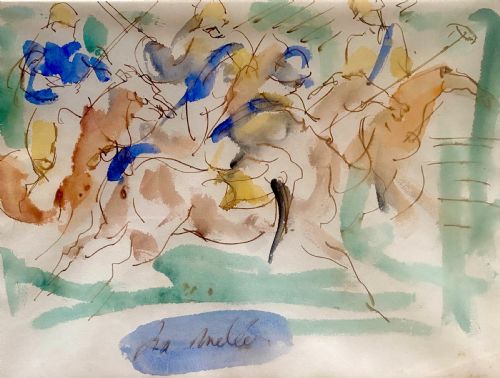
Later 20th century pieces frequently adopt looser brushwork influenced by expressionism and mid-century modern movements.
What subjects are most common?
Hunting scenes, horse fairs, and military cavalry subjects dominate the traditional British sporting art selections.
Individual portraits of horses and racing moments also appear frequently across the early twentieth century works.