




Engraved Hops Barley Glass
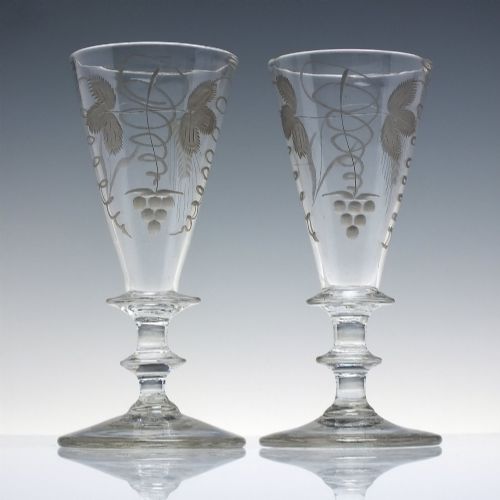
These engraved hops barley glass pieces are drinking vessels bearing agrarian motifs, sought after for their tactile Georgian character.
Engraved Hops Barley Glass
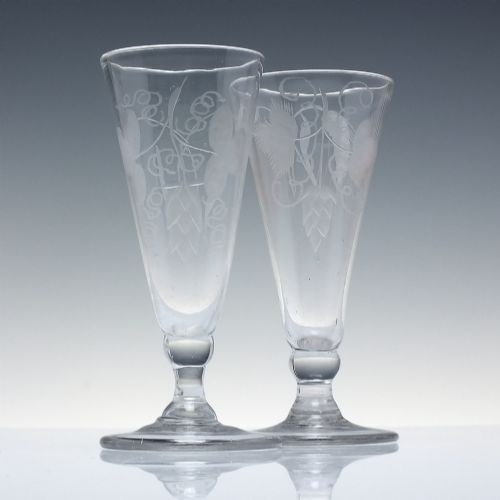
When you search for engraved hops barley glass, you encounter drinking vessels designed for ale, beer, and wine from the eighteenth century onwards. These glasses are defined by wheel-engraved motifs of hop bines and barley ears, celebrating the ingredients of British brewing on clear lead metal.
You are most likely to meet Georgian rummers, ale flutes, and dwarf glasses on this page, spanning the seventeen-fifties to around eighteen-twenty. English traditional forms dominate the selection, appearing with plain, facet cut, or air twist stems.
How they were made
These pieces are formed from lead glass, lead crystal, or flint glass, providing the heavy, clear handle characteristic of the period. Artisans manipulated molten metal into stemware before applying wheel engraving to render the delicate details of hops and barley.
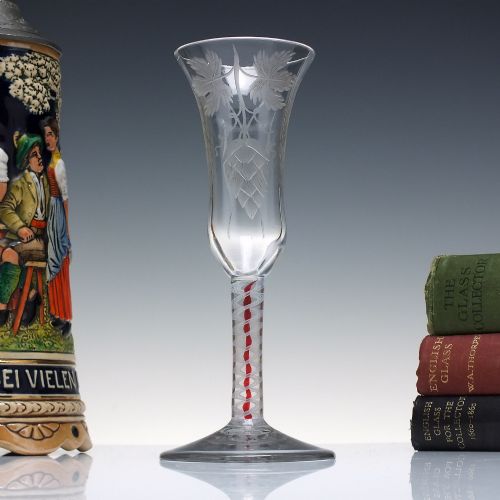
Specialised techniques produced decorative stems, including air twist, opaque twist, and red colour twist variants. Facet cutting was also applied to stems and bowls to catch the light alongside the engraved agricultural scenes.
The listings show pieces spanning from the mid-eighteenth century through to the nineteen-twenties, executed in lead glass, flint glass, and enamel.
What varies in quality
The distinction between standard drinking glasses and finer collector pieces lies in the crispness of the wheel engraving and the complexity of the stem formation. Twist stems and detailed hop and barley motifs require greater skill from the glassmaker.
Weight and metal clarity also separate ordinary glassware from superior lead crystal examples. The depth of the cut and the balance of the proportions determine the overall presence of each piece.
The Engraved Hops Barley Glass Glossary
- Ale Glass
- A tall, slender drinking vessel specifically shaped for consuming ale. These often display the characteristic hop and barley engravings.
- Air Twist
- A decorative stem formation created by drawing out air bubbles trapped within the molten glass. This produces spiral threads running down the length of the stem.
- Opaque Twist
- A stem style featuring white or coloured enamel rods twisted inside clear glass. This technique was widely practiced by eighteenth-century English glasshouses.
- Facet Cut
- Geometric patterns of flat planes ground into the surface of the glass. This method enhances the sparkle of the vessel under candlelight.
Engraved Hops Barley Glass: Frequently Asked Questions
What were engraved hops barley glasses used for?
These vessels served everyday and festive drinking purposes in taverns and homes across Britain. They held ale, beer, and rum during social gatherings and toasts.
The agricultural motifs reflected the contents of the glass, celebrating the domestic brewing industry of the Georgian era and later periods.
How do I date a Georgian ale glass?
Dating relies on observing the form of the bowl, the construction of the stem, and the foot profile. Air and opaque twists generally point to the mid-eighteenth century, while facet cutting often indicates later Georgian periods.
Material composition also offers clues, as lead crystal and flint glass evolved in weight and clarity over the decades.
Are these glasses safe to use today?
While these are genuine antiques from the eighteenth and nineteenth centuries, many owners prefer to display them rather than use them. Hand washing in lukewarm water is essential if handled.
Thermal shock and modern dishwashers will damage the fragile lead metal and historic surfaces of the glass.
What is the difference between an ale flute and a rummer?
Ale flutes feature tall, narrow bowls designed to preserve the head on carbonated brews. Rummers are considerably broader and heavier, built for stronger potations.
Both shapes frequently share the signature hops and barley engraving seen across this selection of glassware.