




English Regency Card Table
An english regency card table is a folding piece designed for evening entertainment, combining architectural grace with clever mechanical utility.
English Regency Card Table
An english regency card table brings together the refined forms of the early nineteenth century, spanning periods from Georgian to William IV. The evidence shows these pieces functioning primarily as card tables, games tables, and console tables, with several examples doubling as tea tables.
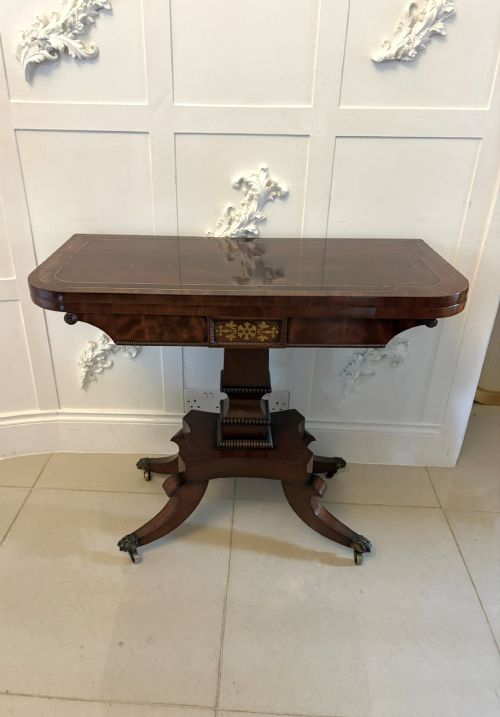
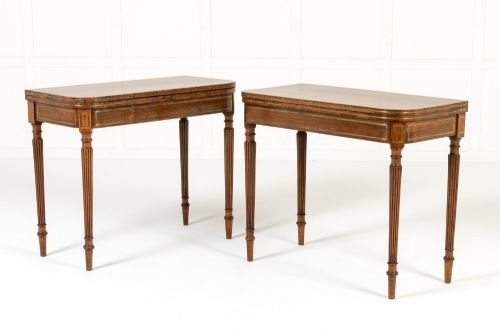
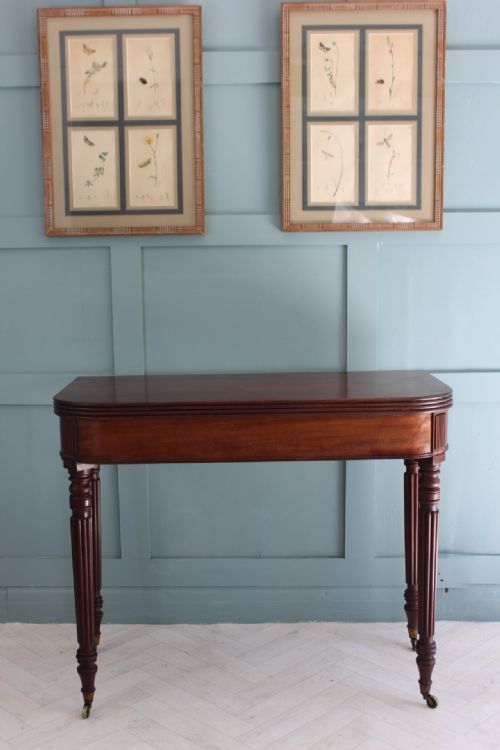
Most pieces seen on this page take the form of fold-over or turnover tops, often presenting a D-shaped profile when closed. Workshops of the period also produced side tables and metamorphic console tables that extend for dining or gaming.
Materials and Construction
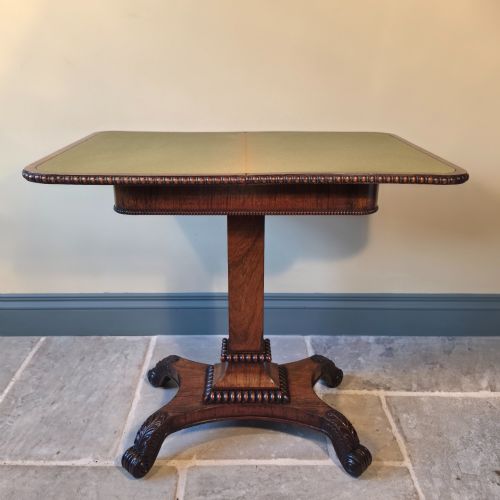
Makers relied heavily on rich timbers such as mahogany and rosewood, frequently enhanced with contrasting boxwood inlay or brass stringing. Selected pieces incorporate palm wood and satinwood to accent the primary surfaces.
Structural joints support the pivoting and folding mechanisms required for a dual-purpose console and games table. Interiors are lined with baize or fabric to provide a stable surface for card games.
The listings combine mahogany and rosewood as the dominant timbers, with boxwood inlay and brass appearing across multiple periods from Georgian to William IV.
Gradations of Merit
The distinction between standard production and the finest work rests upon timber selection and the precision of brass inlay. Pieces attributed to prominent makers demonstrate superior cabinet-making in the execution of pedestal bases and curved D-shaped frames.
Proportion and the integrity of the folding mechanism dictate the standing of an individual table. Finer examples retain original baize linings and crisp boxwood detailing, reflecting the standards of the workshops that produced them.
Gillows·T & G Seddon
The English Regency Card Table Glossary
- Fold Over
- A table top hinged to double in surface area when opened for games or dining. This mechanism defines the primary function of the pieces listed.
- D Shaped
- A semicircular furniture profile popular in the early nineteenth century. Tables of this form sit flat against a wall when closed.
- Baize
- A coarse woollen material used to line the playing surface of games tables. It protects cards during play.
- Console Table
- A decorative table designed to stand against a wall. Many examples in the evidence convert into functional card surfaces.
English Regency Card Table: Frequently Asked Questions
What is an english regency card table used for?
These pieces functioned as dual-purpose furniture for nineteenth-century parlours. Closed, they served as side or console tables against a wall.
Opened, the folding tops provided a stable baize-lined surface for cards and board games during evening gatherings.
How do you date an english regency card table?
Dating relies on identifying period characteristics from the early nineteenth century, spanning the Regency, George IV, and William IV eras. Cabinet-making techniques, timber choices, and specific inlay styles help place the piece.
Attributions to known workshops and comparative analysis with archive records provide further chronological context for individual items.
What timbers were used for these tables?
Makers predominantly utilised mahogany and rosewood for their dense grain and rich appearance. Decorative contrasts were achieved through boxwood inlay, satinwood, and palm wood.
Brass details were frequently incorporated into the timber framing to accentuate the geometric lines of the console.
Are all these tables designed just for cards?
While primarily built as card and games tables, many examples served multiple domestic functions. The evidence records numerous pieces acting as tea tables and extending console tables.
Some metamorphic designs even allowed the furniture to expand for dining use while maintaining a compact profile when closed.