
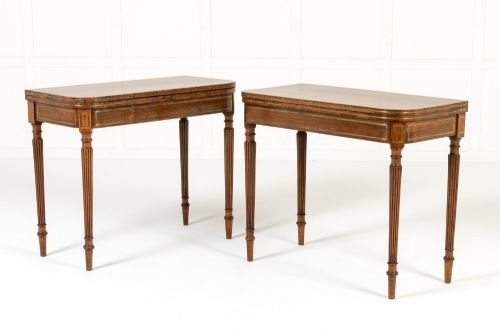
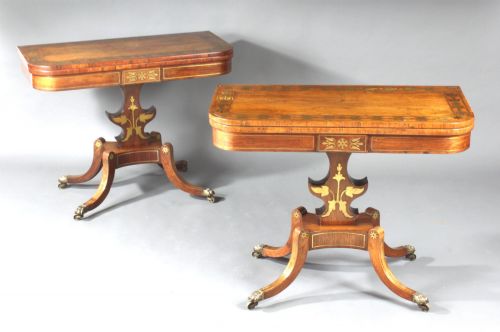
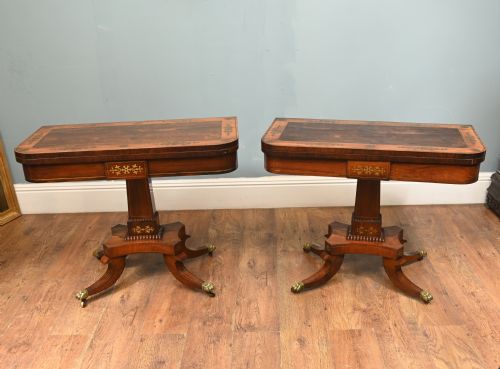


Pair Rosewood Console Tables
Pair rosewood console tables bring striking grain and formal symmetry to a hall or drawing room, whether you choose the crisp brass inlay of the Regency period or later revival forms.
Pair Rosewood Console Tables
When you search for pair rosewood console tables, you encounter matching twin furniture designed to stand against a wall, frequently taking the form of card tables, games tables, and marble-topped console tables. The evidence shows these pieces span the eighteenth century, the nineteenth century, and specific eras such as the Regency and William IV periods, alongside French models and Chinese Hongmu altar tables.
The version you are most likely to meet on this page is the Regency rosewood card table or console table, often featuring figured timbers and brass inlay. Makers and designers such as Gillows, George Oakley, and Donald Ross appear across the records, alongside pieces created in the manner of these workshops or executed in simulated rosewood with parcel gilt finishes.
How they were made
Cabinet makers constructed these tables using dense tropical rosewood and Hongmu, frequently selecting highly figured veneers for the main surfaces and tops. They added contrasting detail through inlaid brass lines, satinwood and boxwood stringing, and intricate marquetry panels.
Structural variety comes from the integration of other materials, such as mahogany carcases, marble tops, mirrored glass backs, and parcel gilt highlights on simulated rosewood frames. French and English workshops relied on precision joinery to ensure the folding tops of card tables and the heavy stone slabs of console tables remained stable.
Materials recorded across the available pieces include rosewood, Hongmu, brass, marble, satinwood, mahogany, boxwood, glass, and mirror.
What varies in quality
The standard of timber selection sets individual examples apart, with richly figured grain and well-matched pairs commanding greater attention than plain or mismatched surfaces. The precision of the brass inlay, marquetry, and boxwood stringing indicates the skill level of the original workshop.
Construction details such as the crispness of carved mounts, the integrity of the marble or timber tops, and attribution to known makers like Gillows or George Oakley elevate certain pieces above standard production models of the nineteenth century.
Gillows·George Oakley·Donald Ross
The Pair Rosewood Console Tables Glossary
- Rosewood
- A dense, heavily figured timber prized for its dark grain and reddish-brown tones. It forms the primary visible surface for much Regency and nineteenth-century cabinet work.
- Hongmu
- A category of dense traditional Chinese hardwoods used in the construction of altar and console tables. It offers natural dark coloration and high durability without reliance on surface veneers.
- Console table
- A wall-mounted or flat-backed table supported by legs or brackets. Traditional examples often feature heavy marble slabs fitted to the upper surface.
- Card table
- A folding table designed for gaming and social use. These pieces typically feature a hinged top that opens to reveal a baize-lined playing surface.
- Marquetry
- The art of applying decorative pieces of veneer to a structure to form intricate patterns and pictures. Workshops utilised contrasting timbers and metals to achieve pictorial depth.
Pair Rosewood Console Tables: Frequently Asked Questions
How are pair rosewood console tables used?
These matching tables serve as symmetrical focal points in entryways, long corridors, and formal living spaces. Many variations incorporate folding tops or flat surfaces designed to hold decorative objects or lighting.
Marble-topped variants offer durable surfaces for everyday use, while card and games tables provide convertible top designs intended for social gatherings.
How do I identify Regency period tables?
Regency pieces often display classical architectural proportions, dark rosewood veneers, and precise brass inlay work. Specific design motifs include crossbanding in contrasting timbers and classically inspired leg forms.
Maker attributions to workshops like Gillows or George Oakley can further confirm the period origin and standard of construction.
What is the difference between console and card tables?
Console tables stand permanently against a wall as fixed decorative or functional furniture pieces, frequently carrying heavy marble tops. Card tables feature hinged tops that open and swivel to reveal an enclosed space and a baize playing surface.
Both forms appear as matched pairs in the records, though card tables offer the mechanical versatility of folding leaves.
Are these tables solid rosewood?
Cabinet makers typically applied fine rosewood veneers over secondary foundational timbers such as mahogany or pine to prevent warping. This technique allowed workshops to display striking wood grain across wide surfaces while maintaining structural stability.
Chinese Hongmu altar tables present an exception, utilising dense solid hardwoods throughout the construction.
How do I care for antique rosewood furniture?
Keep these pieces away from direct sunlight and steady heat sources to protect the sensitive rosewood veneers and prevent timber splitting. Regular dusting with a soft, dry cloth preserves the finish without the need for heavy chemical polishes.
Maintain stable indoor humidity levels to safeguard both the wooden structures and any inlaid brass elements.