


English Leather Footstool
An english leather footstool brings tactile warmth and enduring utility to a room, ranging from buttoned coffee table hybrids to whimsical animal forms.
English Leather Footstool
When you search for an english leather footstool, you encounter a surprisingly diverse selection of low seating and support pieces spanning the nineteenth and early twentieth centuries. These range from substantial buttoned centre stools and window seats to low gout stools and figurative animal hassocks.
The pieces represented on this page draw from Victorian, Edwardian, and early twentieth-century traditions, often utilising traditional frames intended for domestic comfort. Forms vary from simple joint stools with upholstered tops to large country house coffee table conversions covered in hand-dyed leather.
Origins trace directly through British workshops and retail houses, capturing the shift from formal period upholstery to more relaxed country house and novelty designs. You find both architectural seating such as oak joint stools and playful representations of pigs and dogs.
How they were made
Construction relies heavily on traditional timber framing using woods such as oak, walnut, yew, and mahogany to build sturdy structural supports. These frames are then traditionally upholstered utilising materials like wood wool for internal padding beneath the outer leather skin.
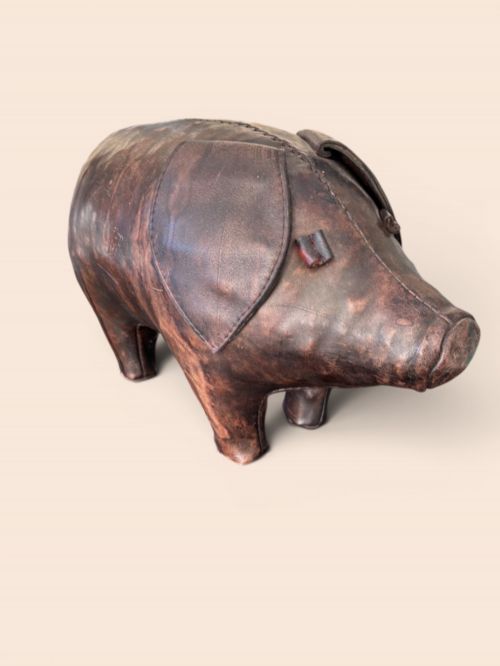
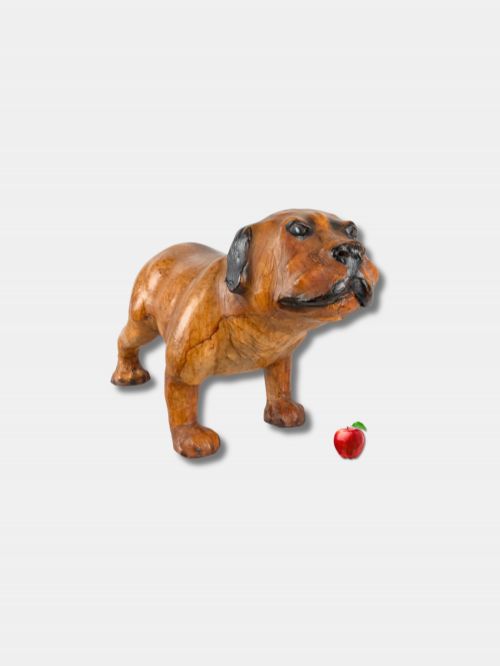
Outer coverings predominantly employ leather, frequently hand-dyed in tan or red shades, and occasionally accented with brass studwork or detailed buttoning. Animal forms such as pigs and dogs are constructed over reinforced armatures to hold their characteristic shapes under weight.
Several leather pigs stand ready to serve as loyal footrests, having guarded British hearths since the 1920s.
What varies in quality
Quality separates through the integrity of the underlying timber frame and the depth of character in the leather upholstery. Superior examples exhibit rich, naturally aged patina on hand-dyed surfaces rather than uniform modern replacements.
The refinement of the carving and the fidelity of the form distinguish standard domestic seating from pieces commissioned through notable retailers or specific workshops. Attention to detail in buttoning, stitching, and brass detailing further elevates the standing of individual pieces.
Omersa Workshop·Liberty's·James Shoolbred
The English Leather Footstool Glossary
- Buttoned
- An upholstery technique where depressions are created by pulling twine or thread tight through the padding and securing it with buttons. This secures the filling and creates a distinctive geometric pattern.
- Joint stool
- A traditional wooden stool constructed with mortise and tenon joints rather than turned legs glued into place. These sturdy pieces date back centuries and served various domestic functions.
- Gout stool
- A small, low footrest designed specifically to elevate and support the foot of someone suffering from gout. They often feature adjustable reading or tilting planes.
- Window seat
- A long, upholstered seat designed to fit within the recess of a bay or large window. These typically feature arms and decorative wooden framing.
- Wood wool
- Fine wood shavings traditionally used as a resilient stuffing material inside upholstered furniture before modern foam alternatives.
English Leather Footstool: Frequently Asked Questions
What is an english leather footstool?
An english leather footstool is a traditional low seating or support piece upholstered in leather, originating from British workshops across the nineteenth and early twentieth centuries.
They encompass everything from formal Victorian buttoned centre stools to playful novelty animal forms created for domestic use.
How do I date an antique footstool?
Dating relies on examining the timber frame, construction techniques, and the style of the upholstery and turnings. Comparing the wood species and hardware helps place the piece within periods like the Victorian or Edwardian eras.
Evidence from archival materials and maker attribution also provides a reliable timeline for specific designs.
How should I care for antique leather?
Antique leather benefits from gentle cleaning and occasional conditioning to maintain suppleness and prevent the historic hide from drying out. Avoiding direct sunlight and excessive heat protects the natural hand-dyed patina.
Harsh chemical cleaners should be avoided to preserve the original surface character built up over generations.