
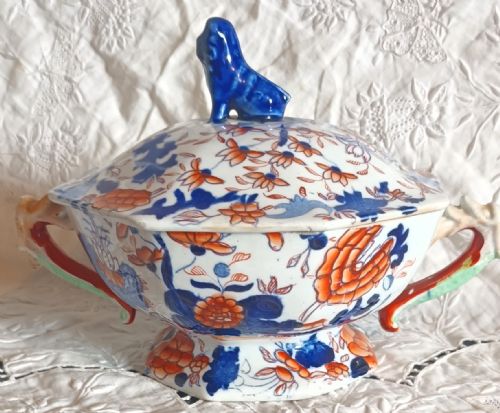


English Ironstone China Tureen
An english ironstone china tureen brings robust utility and vibrant decoration to the table, combining heavy earthenware bodies with striking enamelled patterns.
English Ironstone China Tureen
When searching for an english ironstone china tureen, you encounter sturdy ceramic vessels designed for serving soups, vegetables, or sauces at the dining table. These pieces emerge predominantly from the nineteenth century, encompassing Georgian and Regency periods alongside Victorian examples. The selection includes large covered bowls, vegetable dishes, and paired sauce tureens complete with ladles.
Makers such as Mason's dominate the evidence, producing heavy earthenware wares that mimic oriental porcelain while offering superior durability. Decoration varies from Chinoiserie and Japan Basket motifs to Green Mandarin and Grasshopper patterns. These serving dishes survive either as individual centrepieces or as components of larger dinner services.
How they were made
Potters built these tureens using dense ironstone ceramic, a heavy earthenware developed to resist chipping during daily use. Manufacturers applied thick glaze over the clay body to create a durable, wipeable surface suitable for domestic dining. Artisans then enriched the vessels with hand-applied enamel colours, often incorporating gold leaf or gilding to highlight handles and rims.
Decoration relied on transfer printing combined with hand painting, as seen in complex patterns like Chinoiserie and Green Mandarin. Skilled decorators applied intricate motifs such as the Grasshopper or Japan Basket designs directly onto the fired glaze before a final kiln baking fixed the colours.
Nineteenth-century diners apparently required a dedicated grasshopper on their soup tureen to stimulate the appetite.
What varies in quality
Quality in an english ironstone china tureen rests on the crispness of the transfer print and the skill of the hand-applied enamel work. Finer examples display precise detailing in complex multi-colour motifs, whereas simpler items show looser brushwork. The crispness of moulded details on handles, finials, and foot rims distinguishes superior production.
The preservation of gilt highlights and gold leaf significantly influences desirability among collectors. Heavier, well-balanced bodies with fully intact covers and matching ladles represent the higher tier of survival for nineteenth-century serving vessels.
Mason's
The English Ironstone China Tureen Glossary
- Ironstone
- A dense, heavy earthenware patented in the nineteenth century to provide a durable alternative to porcelain. It resists chipping and forms a strong base for vibrant enamels.
- Chinoiserie
- A European artistic style reflecting Chinese motifs and landscapes. Potters applied these imaginative scenes to tureens using transfer printing and hand colouring.
- Sauce tureen
- A small covered vessel designed specifically for holding and serving sauces or gravies at the table. These often appear as matched pairs accompanied by ladles.
- Gilding
- The application of gold leaf or gold paint to ceramic surfaces. Craftsmen used this technique to accentuate handles, rims, and decorative borders on fine servingware.
English Ironstone China Tureen: Frequently Asked Questions
What is ironstone china?
Ironstone is a heavy, durable earthenware ceramic developed in the nineteenth century to withstand daily dining use.
It provides a strong, opaque body that accepts thick glazes and bright enamel colours effectively.
How were sauce tureens used?
Sauce tureens sat on the dining table to hold warm gravies, sauces, or melted butter during formal meals.
Guests or servants used the accompanying ladle to spoon the contents onto individual plates.
How do I date an ironstone tureen?
Dating relies on identifying maker marks, decorative styles such as Regency Chinoiserie, and recorded production periods.
Nineteenth-century pieces often display specific ironstone patents and distinct transfer-printed patterns.
Can I use these tureens daily?
While ironstone is exceptionally robust, antique tureens feature delicate hand-applied enamels and gold leaf that benefit from gentle handling.
Hand washing preserves the historic glaze and decorative surfaces better than mechanical dishwashing.