
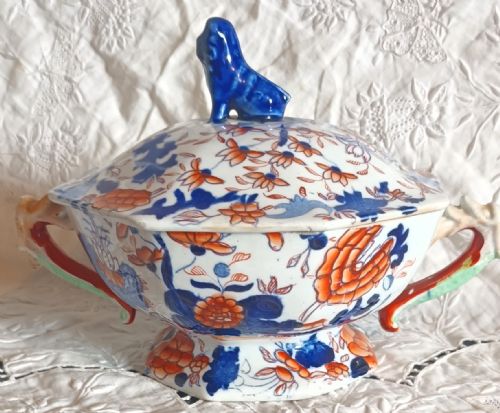


English Imari China Tureen
An English imari china tureen brings vibrant Japanese-inspired palettes and robust ceramic forms together on the dining table.
English Imari China Tureen
When you search for an english imari china tureen, you uncover serving vessels designed for soup, sauce, or vegetables during the Georgian and Regency periods. These pieces combine heavy ceramic bodies with the distinctive cobalt blue, iron red, and gilt decoration borrowed from Japanese porcelain. You are most likely to encounter 19th-century examples, particularly large covered bowls and sauce tureens produced by major Staffordshire makers.
The forms range from substantial vegetable tureens with matching covers to paired sauce tureens complete with ladles. Makers utilised robust ceramic bodies like ironstone and earthenware to withstand regular dining table use. Stylistic influences span from strict Georgian designs to ornate Regency chinoiserie and later Victorian imari patterns.
Many of these tureens form part of larger dinner services, whilst others survive as single decorative bowls or matched pairs. The patterns frequently incorporate floral motifs, baskets, and exotic garden scenes rendered in rich enamel and gold leaf. Surviving pieces demonstrate the enduring popularity of East Asian aesthetics within nineteenth-century British dining culture.
Materials and Construction
Potters shaped these tureens using durable ceramic bodies, predominantly ironstone and earthenware, which provided a sturdy foundation for heavy decoration. The white glaze was applied as an opaque base coat to receive the subsequent hand-painted motifs. This dense ceramic composition helped protect the vessels from thermal shock and everyday wear.
Decoration relied on a precise combination of underglaze cobalt blue, iron-red enamel, and surface gilding. Artisans hand-painted complex geometric and floral patterns directly onto the glazed surface before secondary firing. Gold leaf accents were added to highlight handles, rims, and specific pattern details.
Watch out for the wonderfully energetic grasshopper pattern hiding amongst the traditional floral baskets on these nineteenth-century tables.
Assessing Quality and Execution
The crispness of the hand-painted enamel and the richness of the gold leaf separate standard domestic wares from superior examples. Finely executed pieces display precise cobalt outlines and vibrant iron-red fills that sit cleanly beneath or upon the glossy glaze. Heavier gilding that retains its original burnished lustre indicates a higher grade of production.
Form and sculptural detail also dictate the standing of a tureen, particularly in moulded elements like handles, finials, and feet. Sharp relief work on ironstone bodies shows that the ceramic moulds were fresh and well-maintained. Matched pairs and pieces retaining original covers or ladles carry greater consistency and visual impact.
Mason's·Chamberlain Worcester
The English Imari China Tureen Glossary
- Imari
- A decorative style characterised by the palette of cobalt blue, iron red, and gold, originally inspired by Japanese export porcelain. British potters adopted this colour scheme extensively during the Georgian and Regency periods.
- Ironstone
- A heavy, durable ceramic patented in the early nineteenth century as a tough alternative to porcelain. It formed the robust body for many large dining tureens and serving dishes.
- Chinoiserie
- European artistic interpretations of Chinese and East Asian decorative motifs. This style appears frequently on early nineteenth-century serving vessels through scenic panels and exotic garden borders.
- Sauce Tureen
- A small covered vessel specifically designed for serving gravies or sauces at the dining table. These pieces often include matching ladles and attached underplates.
English Imari China Tureen: Frequently Asked Questions
What is an English imari tureen?
An English imari tureen is a covered ceramic serving dish made in Britain during the nineteenth century, decorated with the characteristic blue, red, and gold palette associated with Japanese porcelain.
These pieces were produced in various sizes for holding soup, vegetables, or sauces during formal meals.
How do I date a tureen?
Dating relies on examining the ceramic body, maker's marks, and stylistic clues such as Regency chinoiserie or Georgian neoclassical forms. Ironstone and earthenware bodies combined with hand-painted iron-red and gilt enamel typically point to the early to mid-nineteenth century.
Comparing the pattern details and glaze characteristics against documented factory output helps narrow the production window.
Were these tureens used daily?
Many of these vessels originated as functional components of large dinner services used for formal dining and entertaining. Their durable ironstone construction allowed them to withstand the rigours of nineteenth-century household service.
Over time, many surviving tureens transitioned from active dining use to display pieces.
How do I care for imari china?
Careful handling and hand washing in lukewarm water with mild soap protect the delicate enamel and gold leaf from degradation. Harsh detergents and modern dishwashers can wear away the surface gilding and damage the historic glaze.
Storing pieces with adequate support for covers and handles prevents accidental chips.