


English Country Floral Painting
These English country floral painting works capture gardens and botanical studies on paper or canvas across several decades.
English Country Floral Painting
An English country floral painting brings domestic gardens and botanical subjects into interior spaces through watercolours and oils on canvas. These works span periods from the Victorian era through the mid twentieth century, reflecting changing tastes in landscape and still life representation.
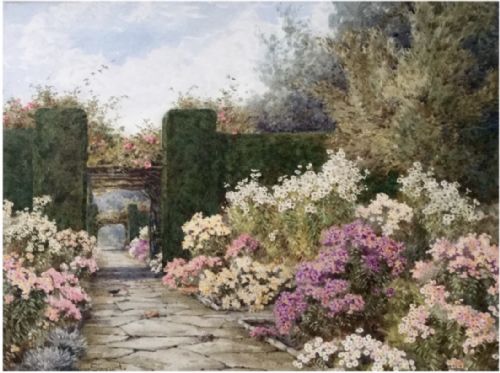
The most frequent examples encountered on this page are watercolours on paper depicting cottage gardens, summer flowers, and still life arrangements. Painters rendered these scenes with attention to seasonal flora, often setting blooms within modest jugs or against mossy banks.
Works range from intimate studies of pansies and primroses to broader compositions of country houses and garden seats. The variety encompasses Edwardian traditional approaches alongside later mid century interpretations of familiar floral themes.
Materials and methods
Watercolour pigment applied to paper forms the basis of many pieces, often paired with pencil underdrawing to establish botanical forms. Artists utilised transparent washes to build luminous petals and foliage.
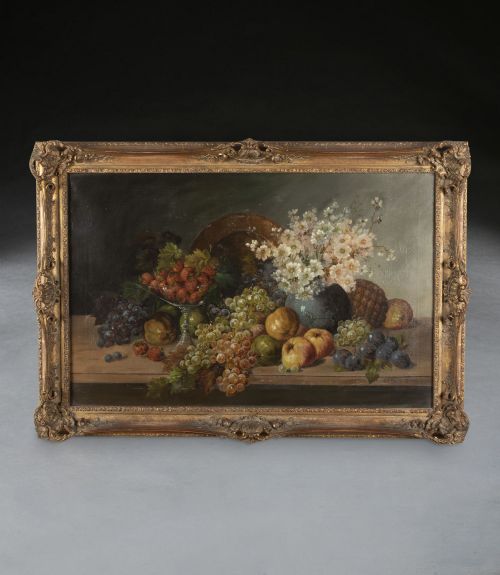
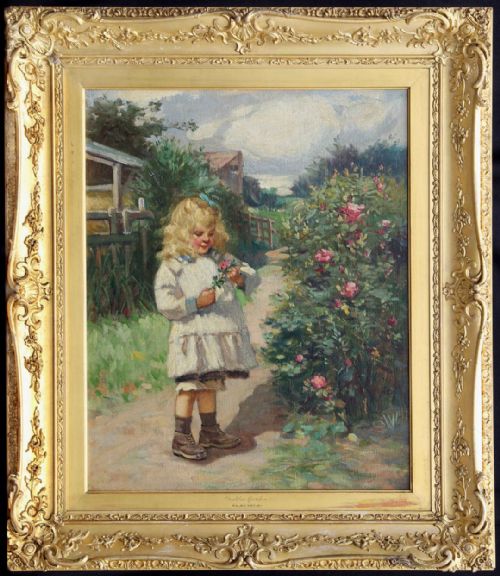
Oil paint on canvas provides an alternative medium for larger landscapes and still life works. This technique allowed painters to layer rich pigments and build texture within garden scenes.
Frames frequently incorporate wood and gilt composition moulding to protect the works on paper and canvas.
Listings feature watercolours and oils on paper and canvas, spanning periods from the Victorian era to the mid twentieth century.
Judging quality
Quality rests upon the artist's handling of light and botanical accuracy within the composition. Stronger watercolours demonstrate confident brushwork and precise control over pigment transparency.
The depth of the colour palette and the preservation of the paper or canvas surface influence the overall impact of the piece. Works that retain vibrant hues without fading or excessive discolouration stand out within the range.
Theresa Stannard·Ernest Higgins Rigg·Grace Hastie·Phyllis I Hibbert·David Woodlock·Marion Broom·Edith Alice Andrews·Beatrice Parsons·John Sherrin·Theresa Sylvester Stannard·George Frederick Nicholls·Ralph Hedley·Lilian Stannard·Fred Merriman·Amy Reeve-Fowkes
The English Country Floral Painting Glossary
- Watercolour
- A paint consisting of colour suspended in a water-soluble vehicle, traditionally applied to paper surfaces in translucent washes.
- Still life
- A painting or drawing depicting inanimate subject matter, typically commonplace objects such as flowers in a jug.
- Gilt composition
- A material used for framing, created from a mixture including chalk and size, finished with a metallic leaf or paint layer.
- Mixed media
- An artwork utilising more than one medium or material on a single surface, combining elements like watercolour and bodycolour.
English Country Floral Painting: Frequently Asked Questions
What periods do these paintings represent?
The works span from the Victorian era and the Edwardian period through to the mid twentieth century. Artists produced these floral and garden scenes across several distinct decades of British art.
Most pieces date from the early decades of the twentieth century, reflecting a sustained interest in domestic garden subjects and traditional watercolour techniques.
How should I display watercolour works?
Works on paper require protection from direct sunlight to prevent the watercolour pigments from fading over time. Glazing with appropriate framing helps safeguard the paper surface from environmental moisture.
Placement in rooms with stable temperature and humidity ensures the longevity of both the painting and its original frame.
What subjects are most common?
Cottage gardens, summer floral arrangements, and still life studies of specific flowers dominate the subject matter. Painters frequently recorded familiar blooms such as pansies, primroses, and wallflowers.
Scenes also extend to country houses, garden seats, and exterior views framed by surrounding foliage and architectural elements.
Are these works signed by the artists?
Many of the watercolours and oil paintings carry the original signature of the artist, often positioned in a lower corner of the composition. Signatures help attribute the pieces to specific painters active during the period.
Documentation associated with each listing identifies the recorded maker where known from the signature or historical attribution.