


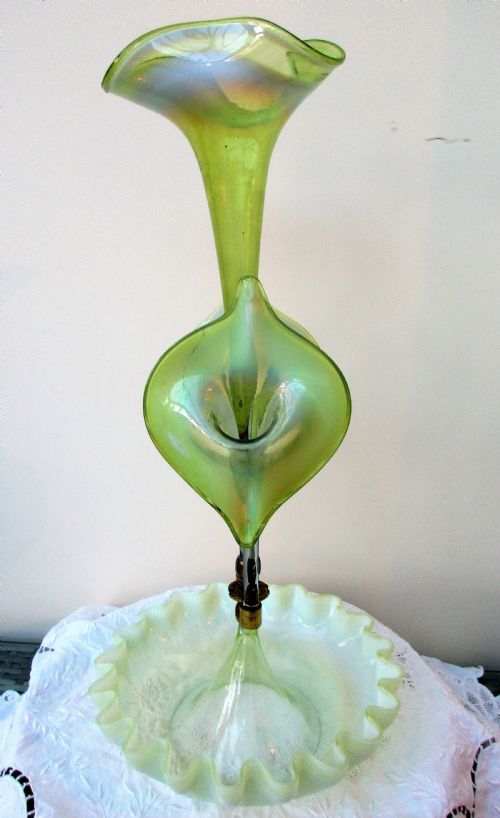
English Art Glass Vase
These English art glass vase examples bring rich colour and tactile surfaces to a room, spanning the Victorian era through Art Deco.
English Art Glass Vase
An English art glass vase combines inventive Victorian forms with the saturated colour palettes of the nineteenth and early twentieth centuries. When searching for an english art glass vase, buyers encounter varied profiles ranging from heavy amethyst vessels and slender lily shapes to large table centrepieces.
The selection on this page draws heavily from the Victorian period, the Arts and Crafts movement, and Art Nouveau design. Makers utilised techniques like cased glass and delicate enamel painting to create dramatic visual depth.
How they were made
Glassmakers built these pieces using layered techniques such as cased glass, where contrasting colours of molten metal fuse together before shaping. Satin glass achieved its distinct frosted texture through acid treatment, while cameo vessels required meticulous carving through successive layers of opaque glass.
Decoration relied on applied enamel, silver overlay, or white cane work embedded within the crystal. Workshops also employed silvered glass and surface etching to catch and refract light across the body of the vase.
Listings feature satin glass, cased glass, and cameo glass across Victorian, Art Deco, and Arts and Crafts styles.
What varies in quality
Quality rests upon the precision of the glassblower's hand and the depth of the material itself. Double walled vessels and complex cameo carvings demand high technical skill, distinguishing ambitious studio work from standard production pieces.
The clarity of the crystal, the crispness of applied enamel details, and the weight of the piece signal superior craftsmanship. Finer examples display balanced proportions and deliberate colour saturation that remains even across the entire form.
Thomas Webb and Sons·Stuart for Liberty·Powell or Nazeing·W.D.B and S
The English Art Glass Vase Glossary
- Cased glass
- Glass made with two or more distinct layers of different colours, often contrasting brightly. This technique allowed makers to carve through the outer layer to reveal the contrasting hue beneath.
- Satin glass
- A type of art glass featuring a velvety, frosted surface texture produced by hydrofluoric acid vapour. It diffuses light softly across the rounded contours of the vase.
- Cameo glass
- Vessels carved from multi-layered glass to create raised white or coloured designs against a contrasting background. This method required exceptional patience and steady handwork.
- Silver overlay
- Sterling silver decoration applied directly onto the exterior of the glass surface in intricate floral or geometric patterns. It creates a striking metallic contrast against deep blue or amethyst backgrounds.
- Epergne
- A decorative table centrepiece featuring a central vase surrounded by smaller attached arms or trumpets for holding flowers. These complex assemblies served as dramatic focal points for dining tables.
English Art Glass Vase: Frequently Asked Questions
How can I tell Victorian pieces from later designs?
Victorian examples often feature heavy satin finishes, complex cased colours, and ornate enamel or cameo work. They lean towards naturalistic floral motifs and rich, opaque tones.
Later pieces from the Art Deco period tend to show cleaner geometric lines and heavier amethyst or crystal forms with minimal surface decoration.
Where should I display an epergne?
An epergne suits a central dining table or a sturdy sideboard where light can pass through its various trumpets and bowls. Because these centrepieces are wide and delicate, they need a secure surface away from busy walkways.
Position the piece where natural daylight hits the coloured glass to showcase its full tonal range throughout the day.
What is double walled glass?
Double walled glass consists of an inner and outer layer fused together during the blowing process, sometimes trapping air or decorative elements between them. This construction adds noticeable weight and optical depth to the vessel.
Makers utilised this method to enhance the refraction of light through bright green or clear crystal bodies.