


Empire Style Seating
Empire style seating brings monumental classical forms and rich giltwood into domestic interiors, offering substantial armchairs and window seats built for presence.
Empire Style Seating
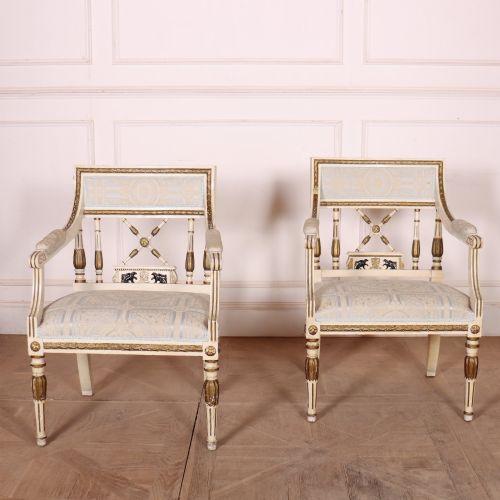
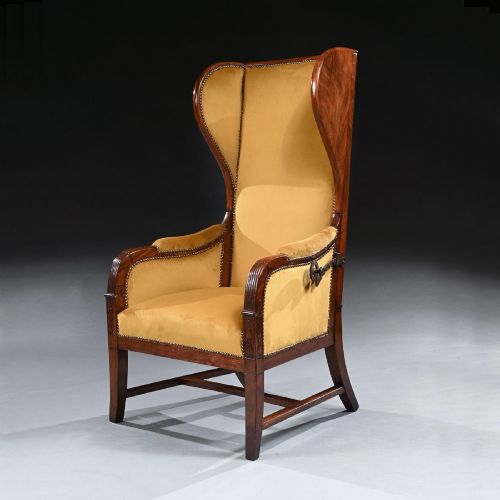
Empire style seating comprises armchairs, fauteuils, settees, sofas, and stools originating from the nineteenth century alongside later revivals. These pieces draw heavily on classical antiquity, presenting structured silhouettes designed to dominate a room.
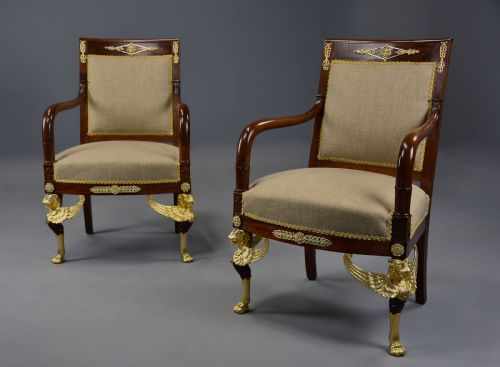
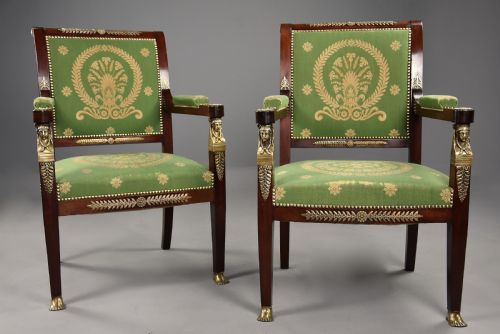
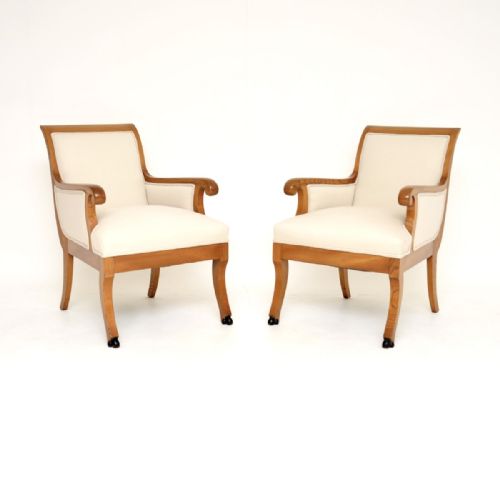
The version most commonly met on this page is the French mahogany armchair or fauteuil, frequently ornamented with gilt bronze or ormolu mounts. Alongside French examples, Swedish, Italian, and Danish variations appear in mahogany, birch, elm, and giltwood.
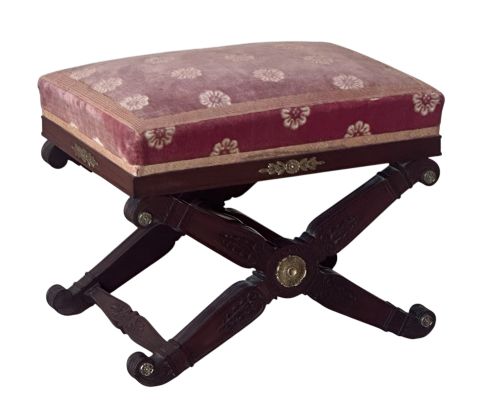
Formations extend beyond standard chairs to include X-frame stools, curule stools, piano stools with adjustable mechanisms, and larger salon suites. Window seats and ottomans also recur, matching the architectural seriousness of the primary seating forms.
Materials and construction
Makers utilised dense timbers such as mahogany, walnut, birch, and solid elm to build the structural frames of these chairs and settees. Giltwood and painted wood finishes provide alternative surfaces, often paired with gesso work to hold crisp decorative detail.
Cast ormolu and brass mounts adorn mahogany surfaces, fixed with precision to accentuate structural lines. Upholstery relies on traditional fabrics including velvet and various dedicated upholstery materials to pad seats and backs.
Several piano stools manage to incorporate screw-top mechanisms, proving that nineteenth-century musicians took proper height adjustment very seriously indeed.
Distinctions in quality
The calibre of empire style seating rests upon the crispness of the timber carving and the weight of the metal mounts. Superior pieces display finely chased ormolu and dense, well-figured mahogany rather than plain secondary woods.
Proportion and structural integrity dictate the standing of a chair or settee. Workshop execution shows in the precision of the joinery and the harmonious balance of classical motifs across the frame.
The Empire Style Seating Glossary
- Fauteuil
- An open armchair with wooden arms, typically featuring upholstered back and seat panels. These chairs originated in France and form a core component of salon seating.
- Ormolu
- Gilt bronze mounted onto furniture frames, providing bright metallic contrast against dark timbers like mahogany. This technique required skilled metalworkers to cast and chase the bronze components.
- Curule
- A form of X-frame stool or seat derived from ancient Roman magistrate chairs. The crossing legs create a stable, monumental silhouette found in both French and Italian pieces.
- Neoclassical
- A style drawing inspiration from the classical art and architecture of ancient Greece and Rome. It precedes and informs the later Empire aesthetic with clean lines and balanced proportions.
- Regency
- An English period style running concurrent with early continental empire design. Pieces from this era share a classical influence and heavy reliance on mahogany construction.
Empire Style Seating: Frequently Asked Questions
What defines empire style seating?
Empire style seating is characterised by formal classical proportions, drawing inspiration from ancient Roman, Greek, and Egyptian designs. Pieces typically feature substantial wooden frames in mahogany, birch, or giltwood.
Decoration often includes bronze or ormolu mounts, strict symmetry, and architectural silhouettes designed to convey authority and elegance.
How do I distinguish French and Swedish empire pieces?
French empire seating generally relies on dark mahogany contrasted with heavy, polished ormolu mounts and rich upholstery fabrics. The overall effect is dense and monumental.
Swedish empire and neoclassical pieces frequently utilise lighter woods such as birch and elm, or employ bright giltwood, producing a cleaner and brighter visual tone.
Were these chairs used in everyday dining?
Most pieces in this category were designed for formal reception rooms, salons, and drawing rooms rather than daily rustic dining. Fauteuils, settees, and window seats furnished spaces dedicated to receiving guests.
Specialist forms like piano stools and adjustable music seats served specific functional tasks within the formal parlour.
How should I care for ormolu mounts?
Ormolu mounts require gentle dusting with a dry, soft cloth to prevent the accumulation of dirt in the recessed chased details. Avoid commercial metal cleaners, which can strip the original fire gilding from the bronze.
Maintaining a stable room humidity helps protect both the underlying timber frame and the traditional joinery securing the mounts.
What is a curule stool?
A curule stool is a seat constructed with two curved legs intersecting in an X-shape, echoing ancient Roman portable folding chairs. In nineteenth-century interpretations, these frames are often carved from giltwood or mahogany.
They function well as occasional seating or window placements, offering a compact footprint with strong classical presence.